Showing posts with label Safety. Show all posts

Tuesday, September 6, 2011

Performance Safety: Know When To Stop

This weekend, I had the privilege of being invited to spin in front of non-spinners for the first time at the housewarming party of my friends, Joe and Lyndsey.  It was very impromptu -- the speakers were set up, the campfire fuel was put out, and Lyndsey and Joe invited all spinners to give an improv performance, in front of Joe's parents and other non-spinning guests.

Unfortunately, in my case, it was a dismal failure.  But I am choosing to turn my poor experience into a cautionary tale, with another lesson that I learned in fire-spinning that night.
In fire-spinning, this is a bad idea.
In most performance arts, we are told that, when we make a mistake, the best course of action is to shrug it off, pretend that it never happened, and power through the performance.  This is something I heard many, many times during my nine years of figure skating.  If you think about world-class performers or athletes, if they screw up, they keep going.  Most of the time (unless, like in figure skating, it's a serious fall), the audience isn't going to know that you messed up.  Just keep going, finish the dance/routine/game.  In other words, fake it 'til you make it.

In fire-spinning, sometimes the opposite is true.  It is much more dangerous to continue the performance than to stop.

On Saturday night, I was doing my improv fan routine to "Howl" by Florence and the Machine. (Music video shown below).  This is one of my favorite songs.  I first heard it on a preview for Season 4 of "The Tudors" and I hope to some day choreograph a real routine to it and use it as a signature piece.


In the first fifteen seconds, I misjudged one of my turns, and I ended up smacking the right side of my face with one of the wicks of my fan.  Fortunately, I suffered nothing more than some singed hair and a partly-singed eyebrow, no further damage.  I wasn't hurt, but it stings (and God, does burning hair smell), and I was pretty shaken, to the point where I completely lost my place and forget everything that I had learned about fire spinning, all of my technique, etc.  To the point where I froze completely, with the fans pointed down, which is a terrible idea.  With the fan pointed down, the fire goes up, and burns the hands.  This is a rookie mistake, and one that I stopped doing the day that I first held fans.  This was the first time in months that I did that.  I couldn't think, I couldn't focus.

So I stopped.  I called my safety (my friend Matt), and laid the fans out on the duveytene, and he extinguished them.  Then I went off into the corner of the yard where the campfire fuel was, to assess the damage.

After nine years of skating, and three years of dance, it felt incredibly wrong.  I was very upset, I felt like a screw-up, and how dare I not complete the performance?  But Matt pulled me aside and said that I had done absolutely right.  Fire spinning is not like other performance arts.  If you are not "in your right mind" to do it, it can become very dangerous.  Had I continued to perform, I could have burned myself again, and badly this time.  

When a spinner is not in his or her right mind to perform, s/he should call a safety to extinguish the flames, stop the performance, and then take a breather for at least ten minutes.  This will give the prop enough time to "cool down" to the point where it can be re-lit (never soak your prop in fuel immediately after extinguishing the flame, when it is still hot to the touch), and give the performer enough time to gather him- or herself.  

I wish I could tell you that I got up again and performed, but I didn't.  I decided that was enough for one night, and stuck to safety-ing my husband and friends for the remainder of the evening.  David, Lyndsey, Joe, and Matt did a hilarious precision staff performance to one of the instrumental pieces from the movie Pirates of the Caribbean: Curse of the Black Pearl, and Lyndsey asked me if I wanted to work on choreographing a precision piece with fans to another Florence song (yes!).  So I guess the story has a happy ending after all.

The moral of the story?  Fake it 'til you make it...unless you're wielding fire. 

Friday, July 22, 2011

Fire Spinning: An Amateur's Overview

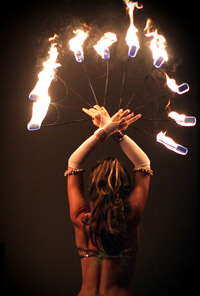
Image from firegroove.com
A lot of people have commented on my FB about fire spinning -- what it is, how it works, why anyone would ever decide that THIS is the hobby that he or she wants to take up?  Isn't it dangerous?  And so on and so forth.  So I'm going to give a little background information about fire spinning, particularly fan spinning.  (Please keep in mind that these are my opinions, and not necessarily the opinions of the whole fire-spinning community)

Fire spinning (otherwise known as "fire dancing" or perhaps more accurately, "fire performance") is a performance art that involves the manipulation of objects on fire.  Its page on Wikipedia is relatively informative, especially if you are looking for broad coverage of all the elements.  In fire spinning, the object of the performer's choice is made of metal, with thick (usually more than 1') Kevlar wicks.  The wicks are dipped in fuel (David and my friends and I use white campfire gas, usually used found in sporting goods' stores). 


The following are different elements of fire spinning or fire performance (this is not a complete list):

Fire fans are made of welded metal with the Kevlar wicks, and come in a varying range of sizes and shapes.  Unlike some of the other fire spinning disciplines, fire fan spinning is closely associated with dance, rather than sport or tech.  Granted, there is a rather large technical aspect to fan spinning (a lot of it is based on handling and grip techniques) but fan spinning is a lot like fan dancing or belly-dancing, which is what drew me to it in the beginning.  I love the fluid movements and the dance -- I used to take dance and figure skating lessons as a teenager, and that was a big part of my life.  I love expressing myself through dance.

A lot of fire-spinning techniques are largely technically based, rather than dance.  Fire staff (link to a terrible Wikipedia page) involves a metal staff with two large Kevlar wicks at each end and (usually) a soft grip in the middle.  Staff involves a lot of turning, contact motion, and tosses.  David's forte is fire staff, and his signature move involves bouncing the staff off of one knee, over his head, and catching it behind his back.

Fire hoop is pretty much exactly what it sounds like -- hula-hooping (or just hooping) with a metal hoop, from which extend spokes and Kevlar wicks.  Hooping employs both technical and dance elements.

Fire poi are two large wicks at the bottom of metal chains (in varying lengths, according to the height of the performer) that have small finger holes.  Fire poi are easily one of the most dramatic mediums for fire spinning, and have the least amount of performer control, since the chains allow the lighted wicks to go in all directions.  Poi spinning is another medium that, like fan spinning, utilizes dance.

Fire torches are small pins, almost like juggling pins, with Kevlar wicks.  They are juggled or used in other fire performance skills, such as fire eating or fire breathing.

There are two people involved in a fire spinning performance.  One, obviously, is the performer.  The other is called a "safety".  The safety stands nearby with a 2' x 2' (or about that size) piece of fire-retardant cloth.  David and I use a piece of Duvetyne, which is 100% cotton treated to be flame-retardant.  Frequently during spinning, the performer may miss a toss, or misjudge the distance between the flames and his hair/clothing/skin/etc.  The safety's job is to ensure that the performer does not catch on fire.

If at any point, the performer catches on fire, the safety's job is to shout "DOWN" (not "fire", because hey, obviously things are on fire) and then to pat out the flame with the cloth.  If the performer chooses to end his or her performance before the flames on the object burn out, the safety may also wrap the object with the cloth to extinguish the flames manually.  (I will be doing a post going more into fire safety in another post)

For those people who have said, on my FB wall, that "I could never do that" or "I would set myself/my dog/my house/my neighborhood on fire" -- if I can do it, you can.  I promise you.  I'm about as uncoordinated a human being as they come.  As David assured one of our friends last night -- it is not easy for the fire to catch and actually burn you.  We have a friend who has been doing poi spinning for 10 years, and he has never lit himself on fire to the point of injuring himself.  So if you are interested in fire spinning, and you're afraid of burning yourself -- please don't let that stop you.  Join a class, find some friends who are trained, have a good safety, and have fun!