Showing posts with label Dystopian Literature. Show all posts

Tuesday, August 30, 2011

Review: Delirium by Lauren Oliver

Day Three with no power, and now for something completely different, Day One with no hot water!  *sigh*  Because we're in such an area of low importance, I have a feeling we won't get either back until at least the end of the week.  At least, I am trying to prepare myself for the disappointment of going home every day and finding the power still out.

A silver lining (there is one, I think) is that I am tearing through books faster than I can review them.  I actually finished this book on Sunday, and I've finished another besides.  So here it is -- Lauren Oliver's much-touted Delirium.

Lena Haloway is terrified of love.  Love is the disease that has been eradicated by her government -- all citizens receive "the cure" at age 18, and go on to live completely normal, healthy lives free of amor deliria nervosa.  Love is what drove her mother to commit suicide when Lena was only six.  Love casts a shadow over every aspect of life, every part of Lena's dystopian society.  Love is the last thing that Lena wants any part of.  But less than 50 days before her cure, Lena realizes that love is the one thing she can't live without.  And now she has to make a choice -- live a lie forever, a life without love, or leave behind everything that she knows.

After The Hunger Games and Divergent, I've been definitely riding the wave of dystopian YA literature.  Abandon, while not dystopian, was a complete bust, and so I was hoping that Delirium would renew my faith in YA lit.  It did.  I liked Delirium, unfortunately not as much as HG or Divergent, but I liked it nonetheless.

Lena, as a character, is interesting in her mediocrity.  She's no Bella Swan -- quick to tout her mediocrity, yet unable to explain why everyone loves her (I still don't get the attraction).  She's not Katniss Everdeen, superwoman and queen of survival.  And she's not Tris Prior, a rebel without a cause from the right side of the tracks, rushing headlong into conflict.  Lena is...plain.  She's not attractive.  Boys don't like her.  There's nothing "special" about her.  Her main concern, unlike Bella, unlike Katniss, unlike Tris, is being singled out.  If it was up to Lena, she'd be completely ordinary forever, as long as it guarantees that she won't fall into the same trap her mother did.


The theme of love as a mental illness is an interesting one.  Lena is terrified of becoming like her mother -- so blinded by amor deliria nervosa that the disease eventually took her life.  It's interesting to see a writer talk so candidly and go so in-depth with the story of a child's response to the mental illness of their parent, and the question, in the end, of if the mother is the one who is sane, and not the authorities, after all.


The turning point of the book, for me, was the climax at the end.  Up until that point, I wasn't sure if I'd actually read the sequel.  Not that Delirium was bad, but that I had pretty much assumed I knew how everything would go, only to have the end come as a surprise.  I don't know if I'll be reading the sequel, Pandemonium, but I wouldn't rule it out.  We'll see.


Rating: *** and 1/2


Tuesday, June 7, 2011

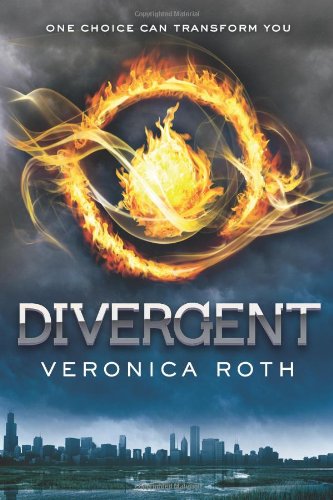
Review: Divergent by Veronica Roth

I have a confession to make.  I told it to my husband last night, and he gasped out loud (mockingly, I might add, because he is not a reader and probably never will be, to my great sorrow).

My name is Megan B., and I enjoy YA dystopian fiction.

I gotta admit it at this point.  I just finished reading my fifth YA dystopian book last night, and I liked it...and five is getting to be too big a number for me to keep saying that I don't read YA, or I don't like dystopian fiction.  Gotta embrace it, as our IT guy at work says.  A lot of people have laughed at me for liking Megan McCafferty's Bumped, I know.  But this...this book, I truly loved.

Veronica Roth's Divergent takes place in Chicago, years into the future, where the government has divided itself into sectors, factioning people by their natures and the attributes they feel are most beneficial to society.  The factions are Abnegation (the selfless), Amity (the peacemakers), Candor (the honest), Dauntless (the fearless), and Erudite (the intelligent).  At the age of sixteen, all members must make a very public choice -- to follow the faction in which they were raised, or to join a new faction and leave their old world behind.  Their choices are influenced by a pre-test that indicates where each individual would be best-placed.

The hero of Divergent is Beatrice Prior, an Abnegation-raised young woman who chooses to leave her faction and start a new life for herself as "Tris."  In her new faction, Beatrice struggles to find her true identity, while dealing with the residual emotions of the selfless community she chose to leave behind.  Underneath the surface of this new life lies the secret she took with her, and a gathering political storm that will change everything about Tris and the world she lives in.

A lot of people on Goodreads have been comparing Divergent to The Hunger Games trilogy, and although Roth has only published part I of her trilogy, I can see the similarities (somewhat).  Both are told from a first person POV, both feature female protagonists, and both are set in a futuristic dystopian society with a predilection for violence.  But.  I can also see where they (excuse the pun) diverge.

Tris is not Katniss, not by a long shot.  Katniss does not willingly throw herself into violence for no apparent reason; her motives for doing so are completely selfless.  Tris, on the other hand, has lived a whole life being selfless, and feels stifled doing so.  She knows when she leaves her faction that she is doing it for selfish reasons -- she wants to "be herself" -- and although she feels the pull back towards her selfless roots (almost constantly throughout the novel), she realizes that this was a change she had to make.  Their skill levels are much different as well.  Katniss is already a skilled archer and hunter when she goes off to the Hunger Games.  Tris is a small, weak-looking teenager with no survival skills whatsoever when she leaves her faction.  She still needs to learn everything she will need.

The testing scenes were similar (both Katniss and Tris must prove their worth and be ranked during an "initiation period") and I could see where people would draw those conclusions.  But Katniss' initiation period takes place over a couple of chapters, whereas Tris is struggling to better herself throughout the entirety of the book.  In Hunger Games, the initiation is a build-up to the action; in Divergent, it is the action.

The male protagonists in Hunger Games are eminently more likable than in Divergent (to a point).  Many people argue "Team Gale" or "Team Peeta" but there are no teams in Divergent.  When it comes down to it, Tris is a one-man woman (and I won't say anything else for risk of spoilers).  When it comes down to it, I really like the lack of a romantic triangle, which I feel has been beaten to death since the Twilight saga came out.  I'm really hoping that Roth doesn't introduce another male love interest in the second or third books...but I have a feeling she will.

I loved DivergentLoved it, and I can't wait until the next book comes out.  In 2012 *cries*.  I don't want to wait that long.  

Rating: *****

Wednesday, May 18, 2011

Review: Bumped by Megan McCafferty

Confession: I am not usually a fan of dystopian literature.  Or of young adult literature.  Or at least, I thought I wasn't, until 2011.  The last "YA" books that I read were Twilight and the Princess Diaries series.  We all know my feelings on Twilight, I doubt that I need to go over it again; and as for the Diaries...I found myself liking them less and less the further on I went.  I liked the originals, but as time went on, Princess Mia's lack of character development really started to chafe on me...but this isn't a review of Diaries.  This is my four dystopian-YA lit book review of the year (after all three books of The Hunger Games series).

In Megan McCafferty's Bumped, it is the year 2036, and the United States has been stricken with a virus that renders everyone over the age of 18 infertile.  For the first time in history, teen pregnancy is not only encouraged, it is a booming (and expensive) marketable enterprise.  Sixteen-year-old, separated-from-birth twins Melody and Harmony find themselves on opposite viewpoints regarding the business of giving birth.  Ambitious Melody is days away from sealing a contract that will give her a six-figure deal and a guaranteed position at a prestigious college in exchange for "bumping" and giving a couple her baby.  Virtuous Harmony has come to visit her sister, determined to help her find faith in God and realize that bumping for pay is a sin.  But a case of mistaken identity sends the two girls into tailspin, forcing them to admit to each other what they have never been able to give voice to on their own.

This book is (there's no other way to put it) a very quick read.  I bought it around 6 PM last night and I finished it this morning.  With cliffhangers at the end of nearly every chapter, it is nearly impossible to put down.  Unfortunately (and I expected this), the end is a cliffhanger as well -- McCafferty is said to be writing the sequel to Bumped right now, but since the book just came out at the end of April, I think it's going to be a very long time before the next installment of the saga of Melody, Harmony, and everyone else in their universe.

The biggest hurdle I had to overcome in reading Bumped is the futuristic language.  The world that McCafferty has created is wholly different from ours, where technology has literally taken over everything (except, ironically, bumping -- more on that later) and sometimes (especially in the beginning) trying to figure out what the characters are saying or doing can be difficult.  Once you clear the hurdles of the technical terms and slang, however, it's an easy read.

The book is eerie, not because it is so far-fetched, but because, as Bill Watterson once said in a Calvin-and-Hobbes strip, it's "not enough, really."  We talk today about the idea of being able to create life in a petri dish, or "test-tube babies" -- a world where sex-based procreation no longer exists, because it is unnecessary.  McCafferty envisions another world -- a world where sex is mass-market, where pregnant teens are the world's most expensive commodity, where safe sex is a myth and "everyone is doing it" isn't just a slogan, it's a way of life.  And yet, for all the sex that is going on, the emotions are cut right out of the act itself.  Even though sex is rampant, the heart of it is out.  "Lovemaking" is obsolete, even something to be scorned; a girl's worth is determined by how fruitful she is and what her genetic makeup will provide in the way of children; men are deemed worthless if they are missing a couple of inches in height or if their IQs aren't top-notch.  We talk constantly about "preserving the sex act" but in McCafferty's world, the sex act is preserved but emotionless -- leading me as the reader to imagine "what if we went in the opposite direction?"  Is it all that far-fetched, really?

As for character development: I have to admit that at first I did not sympathize with either Melody or Harmony, since they make themselves so very unsympathetic in the beginning of the book.  Melody comes across as a jaded opportunist, a girl who is willing to sell her soul and integrity for six figures and a good college.  Harmony is an insipid Bible-thumper, parroting what she has been told her whole life, someone to be completely ignored and overlooked.  Yet as the book progressed, and each girl endures her own tests and trial by fire, so to speak, the character development was impressive, and I found myself liking both girls immensely.  In regards to the back-up characters, with the exception of one, they were all completely zombified, toeing the party line on bumping and pay-for-pregnancy.  It was hard to relate to any of them, but I think that's where McCafferty was going with it.

I enjoyed Bumped very much, and I will be on the lookout for its sequel, whenever that day comes.

Rating: ****