Showing posts with label Fiction. Show all posts

Friday, January 6, 2012

Review: Tatiana and Alexander by Paullina Simons

Having finished The Bronze Horseman as my last book of 2011, I eagerly jumped into the sequel, Tatiana and Alexander (formerly called The Bridge to Holy Cross).  I didn't really know what to expect, considering that the first book was so action-packed (and left on quite the cliffhanger).  I didn't think T&A (ha, I'm five) could top it.  Well, call me a liar, because I loved it even more, and it is my first finished book of 2012.

NOTE: There are spoilers from The Bronze Horseman in this review.

From Goodreads: Tatiana is eighteen years old and pregnant when she miraculously escapes war-torn Leningrad to the West, believing herself to be a widow. Her husband, Major Alexander Belov, a decorated hero of the Soviet Union, has been arrested by Stalin's infamous secret police and is awaiting imminent death as a traitor and a spy. Tatiana begins her new life in America. In wartime New York City she finds work, friends and a life beyond her dreams. However, her grief is inescapable and she keeps hearing Alexander calling out to her. Meanwhile, Alexander faces the greatest danger he's ever known. An American trapped in Russia since adolescence, he has been serving in the Red Army and posing as a Soviet citizen to protect himself. For him, Russia's war is not over, and both victory and defeat will mean certain death. As the Second World War moves into its spectacular close, Tatiana and Alexander are surrounded by the ghosts of their past and each other. They must struggle against destiny and despair as they find themselves in the fight of their lives.

This book had everything, everything I could have asked for.  Told from both Tatiana's and Alexander's points of view, each thinking of the other as they slowly struggle through separate lives -- Tatiana as a nurse on Ellis Island in NYC, and Alexander in one terrible prison after another -- this book is chock-full of emotion, pain, and redemption.  Most of Part I of the book is backstory about Alexander's life and how his idealistic Communist parents defected from the United States to the Soviet Union, only to have their dreams crash around them.  So much of Alexander's story is glossed over in TBH, and I was so satisfied with the complete explanation in T&A.  Tatiana's story, in America, is just as interesting, as she struggles to put together a life for Alexander's baby son, trying to get over the death of her husband while not totally believing that he really is gone.  

I admit that I cried near the end of this book, too.  The last fifty pages or so are extremely fast-paced, and I tore through them all this morning just to find out what happened to Tatiana and Alexander.  The ending was brilliant, I loved it.  And I can't believe that Simons has more in her for a third book.  

...Which I will hopefully be reading on vacation.  My darling husband, who never reads EVER, decided after seeing a preview that he HAD to read The Hunger Games (which I read and loved last year), and so he has stolen my Kindle.  He's pretty far into it right now (he started Mockingjay yesterday), but I think I'm going to have to snag my sister's paper copy so that I can have my Kindle back and download The Summer Garden before we go on vacation on Sunday.  

As to vacation, this is my LAST day of work until January 17th!  I could not be more psyched.  Although I got a massive guilt-trip last night, as I was sorting through things to bring in my carry-on.  Ollie decided that he wanted to jump in and come with us on vacation.


Nothing makes you feel guilty like an adorable fat kitty.

Rating (for the book AND the cat): *****

Wednesday, December 14, 2011

Review: The Romanov Bride by Robert Alexander

While I won't take back my negative points on the review of Robert Alexander's The Kitchen Boy, I have to say, with this second of his books, he has absolutely, totally and completely redeemed himself in my eyes.  THIS book is everything I wanted in a historical fiction, and more.  Number #95 for the year (five left!  Five left in 17 days!  I have hope!) is The Romanov Bride.

Alexander tells the story of the beautiful Elizabeth Romanov, called "Ella" by her family and friends, a minor German princess who marries Sergei Romanov, the uncle of Tsar Nicholas II.  Born and raised by her mother to have a special care for the poor and ill, Ella is unable to shake her compassionate feelings, even managing to feel pity and love for her tyrranical husband as he rules her and the people of Moscow with an iron fist.  But when Sergei is assassinated by a revolutionary's bomb, Ella's life is transformed.  Juxtaposed with Ella's story is that of Pavel, a poor Russian worker whose revolutionary ideas are fueled by his hatred and grief over the senseless murder of his young wife on Bloody Sunday.  Pavel is determined to bring down the House of Romanov, no matter what the cost.  But his interaction will Ella will, unwillingly, change his life.

This book is splendid, exactly what I love about historical fiction.  There's a fascinating historical figure -- Ella -- and an original character invented by the author to cause a counterpoint -- Pavel.  I'm not usually a fan of multiple points of view in a novel, but the two characters are so strikingly different, and both really contribute so much to the tale.  Here we see the Russian Revolution from both sides -- the monarchist (Ella) and the communist (Pavel).

Ella is a lovely character -- there is nothing to hate about her, in fiction or in truth.  There is a reason why she was later canonized as a saint in the Russian-Orthodox Church, yet for all her saintliness and humility Alexander still manages to make her human.  Pavel is definitely relate-able -- his heartbreak, followed by rage and lust for revenge are all too well understood in this day and age.

This book is wonderful.  My only regret -- that one of the children that Ella and Sergei "adopts", Dmitri, is never fully explained.  This book contains many references to Grigori Rasputin and his part in the fall of the Russian Empire, and Dmitri was one of his murderers.  Alexander never fleshes out this little tidbit of information, which mystifies me, for I'm sure he discovered it during his thorough research.  Still, nonetheless, amazing work.

Rating: **** and 1/2


Tuesday, December 13, 2011

Review: Skipping Christmas by John Grisham

I'm on a roll.  Six left to go.

In John Grisham's Skipping Christmas, middle-class parents Luther and Nora Krank have had enough of the commercialism of Christmas -- at least for this year.  Their daughter, Blair, is in Peru with the Peace Corps, and Nora is unable to face the holiday routine in an empty house.  Luther, for his part, is sick of what he deems wasted money and the commercialism of the holiday.  So the Kranks make a vow -- they will not celebrate Christmas (including no decorating, no cards, no Christmas parties) -- and they will spend their money on a Caribbean cruise instead.  Word travels fast, and their friends and neighbors are outraged by the Kranks' perceived absence of holiday cheer.  Luther and Nora press on grimly, set in their opinion that they have the right to "skip Christmas" if they so choose.  But when an unforeseen holiday guest shows up on Christmas Eve, the Kranks realize that their brilliant plan may not have been so brilliant after all.

This is the time of year when you're really in the mood to read Christmas stories, and this one is a doozy.  Christmas in the Kranks' neighborhood is ridiculous, devoid of privacy and any perceived sanity.  The entire neighborhood bans together to decorate their street for the Christmas with identical plastic Frosty the Snowmen up on their roofs (you can see it in the picture above and to the right).  Nora and Luther (traditionally) spend $600 on their personalized Christmas cards (what?), and everyone they know turns out for their annual Christmas bash, to the point where they're all furious and irate that it's been canceled for the year (does nobody in this town have family?).  It seems that the Christmas cheer and well-being of the entire neighborhood, the local businesses, the entire little world of the book, is focused and dependent upon the Kranks' traditional Christmas cheer.  And when it vanishes, the backlash is astounding.

I don't know about John Grisham, but I know plenty of people who don't decorate their houses for Christmas, who don't send Christmas cards, who don't participate in the overwhelming commercialism of the season.  And nobody photographs their dark houses and puts the picture on the front page of the evening paper.  The overwhelming backlash to Luther and Nora's decision to abstain from Christmas is ridiculous and way far-fetched.  Although Luther is a grumpy curmudgeon and Nora a spineless parrot, the idiocy of their neighbors and coworkers practically forced me to cheer for them and champion their right to do as they pleased.

The scrapes and exploits that the Kranks get into during their month of living Christmas-less are humorous, but the humor mounts when Luther and Nora are reluctantly thrown into the chaos of trying to throw together Christmas with only six hours to spare.  When you come to the end of the book, it is apparent that both Luther and Nora have learned something, as have a couple of their neighbors.  Some of the nosier ones, though...apparently not.

Rating: *** and 1/2

Monday, December 12, 2011

Review: The Princess Diaries by Meg Cabot

Annd we're pulling away.  I'm up to 93 books and I'm hoping against hope to finish by the end of the year.  I've put aside my thick biographies and historical fictions in favor of shorter, snappier, lighter fare.  Seven more to go.  As David says, I'm "so close!"  But not quite there yet.  Book #93 is The Princess Diaries by Meg Cabot.

Fourteen-year-old Mia Thermopolis is in search of self-actualization.  She's the combat-boot wearing, strict vegetarian daughter of a free-spirited New York artist mother and a father who works in some sort of politics in the far-off principality of Genovia (think Monaco).  Mia's life is fraught with concerns -- how to increase her bustline, passing algebra (no mean fete, even if the algebra teacher is dating her mom), and getting the cutest boy in school to notice her.  Then her father drops a bomb -- he's not a politician, he's the Prince of Genovia.  And because of his recent bout with cancer, he can no longer provide Genovia with an heir.  Which means Mia is a princess, and heiress to the throne.  And she's not happy about it.

I first read Meg Cabot's tale of the reluctant princess back in college, at age 20.  I love the Disney film version starring Anne Hathaway and Julie Andrews.  Be forewarned -- the book is very different from the film.  Julie Andrew's kindly Dowager Princess Grandma is the French-speaking, chain-smoking, borderline alcoholic Grandmere, making Mia's life a living nightmare with a constant stream of French insults and deportment classes she calls "princess lessons."  While at 20 it was very easy for me to drum up sympathy for Mia, it is harder now at age 28, when I guess I'm that much more removed from teenage angst.  And that I can only summarize by saying this:

For someone who is a vegetarian because she is so concerned about the well-being of the planet and its creatures, Mia has absolutely zero grasp on perspective.  Everything is drama.  EVERYTHING IS A VERY BIG DEAL, whether she's being bullied into cutting and dying her hair blonde, or considering cheating on her algebra quiz, or discovering her teacher at her kitchen table in the morning in his boxer shorts.  Everything is a calamity to Mia.  It is hard to take her genuine problems seriously, because she can't differentiate them from minor catastrophes.  Again, maybe it's because I'm old and jaded now, but I wonder if the average teen girl is as flighty and overdramatic as Mia, and if so, how the hell do they ever grow out of it?

I used to love The Princess Diaries series -- I read all the way until Book 5, Princess in Pink, when I started to get bored of both Mia's dramatics and the unbelievable idiocy of the majority of her school friends.  I picked up #8, Princess On the Brink, and read about three chapters before realizing that no, it doesn't get any better (spoiler alert: Mia freaks out because her boyfriend happened to have had sex before he was dating her, with someone else, and dumps him).  

After the travesty that was Abandon (and omg, what a mess that was), I was hoping that rereading some old Meg Cabot, that I used to love, would be a palate cleanser.  Unfortunately, this is one of those books that's better left in your childhood memories, if you liked it when you were young.

Rating: ***

Wednesday, December 7, 2011

Review: White Oleander by Janet Fitch

And we're finally to the Final 10 Books!  I'm starting to despair of finishing, with only 24 days left to the end of the year and still 10 (or 9.5) books to go.  But I'm getting there.  And at least if I fail, I won't fail miserably.  Book #90 for the year is Janet Fitch's White Oleander.

Twelve-year-old Astrid has lived her entire life in the shadow of her mother, the beautiful, talented, and mysterious poet Ingrid Magnussen.  She lives in a sheltered world where her mother rules with an iron fist, raising Astrid according to her own rules and standards.  But when Ingrid is found guilty of a terrible crime and imprisoned for life, Astrid is swept away into the California foster care system, moving from one home and family to another, each with its own fear and pain, joy and tragedy.  As the years pass, Astrid struggles to find her true identity, understand who she is and what she believes in, as the voices of her foster parents and her mother, who writes her from prison, resonate in her head.

This is a book I did not fully appreciate the first time I read it, during the summer of 2002.  It requires second, third, maybe even fourth reads (I've probably gone through it a dozen times), to really sort through the nuances and symbolism.  Fitch's writing is awash with similes (which critics on Goodreads seem to intermittently love and hate), and while this makes complete sense in the letters written by Ingrid, the poetess, it makes less sense when it comes from Astrid, who claims she has zero writing ability (her talent is in art).  It is beautifully done, but it comes across as a bit heavy-handed at times.
Years ago, my best friend said that the film American Beauty, while very well-written and gorgeously filmed, is completely unbelievable, because "families have some of those problems, but not all of them."  White Oleander is the same way.  Thrown unceremoniously into the foster care system at age 12, Astrid runs the whole gamut of extreme situations, from starvation to physical abuse to statutory rape to racism to suicidal depression to theft, and that's just the beginning.  While the foster care system is bleak, it is highly improbable that Astrid would be forced to suffer so much from so many different foster families.

Nevertheless, I do enjoy this book, and the writing style, for all its unbelievability.  

Rating: ****

Wednesday, November 30, 2011

Yarn Along! November 30, 2011 edition

I hope that you all had very happy Thanksgivings (at least all of you Americans -- if you live in Canada, I hope your October Thanksgiving was equally as merry), and that you're all avoiding the holiday stress!  David and I are banging out our shopping, a little each night (I love Amazon.com and Shutterfly, just have to say).  And the Christmas knitting, of course, continues...I really need to get a better grip on it.  Each day I look at the stash and think "I could totally pull that off in the remaining few days..."

My friend Jess holds an annual Yule party (since we are all of different religions, and not all of our friends necessarily celebrate the traditional "Christmas"), and this year, it's on December 10th, which means that I have much less time than usual for knitting.  I'm working on each gift a little at a time, to avoid burnout.  Although I can hardly feel burned out when I'm working with such gorgeous yarns as these!


On the left is the first of a pair of fingerless mitts (my own "pattern", if you can call it that -- I work it over 40 stitches, 1x1 ribbing for the wrists and then simple stockinette, with an afterthought thumb and probably 1x1 ribbing for the top -- thrilling, I know).  The yarn is gorgeous Manos del Uruguay Silk Blend in "dove" -- I used it for a hat earlier this year, if it looks familiar.  The needles (for those who care) are US 4 dpns.

On the right is my favorite yarn probably of all time -- Trabajos del Peru in "9" (thrilling name).  I'm making it into a winter hat for a very dear male friend of mine and David's who helped me through a tough spot this past year and deserves a soft winter hat.  I hope he likes it (and that he isn't peeking at this page).  Again, simple pattern -- US 8 circular, 2x2 rib, stockinette to the decreases.  

This will be part of Ginny's Yarn Along, and it wouldn't be without reference to the book I'm reading (sadly, not included in the picture).  I'm in the middle of Janet Fitch's White Oleander (reread) and enjoying it as much now as I did the first time I read it.

Happy knitting!

Monday, November 7, 2011

Review: Phantom by Susan Kay

Anyone who loves musical theatre knows the story (or the Andrew Lloyd Webber adaptation) of the Phantom of the Opera.  Lloyd Webber's musical sets to music Gaston Leroux's tragic novel of the horribly disfigured musical genius and architectural magician who hides in the wings of the Paris Opera House, determined to steer clear of human beings forever, until he meets the beautiful young opera singer who becomes the love of his life.  But from where did the Phantom come?  What course of action lead him to choose the Opera House as his hideaway?  What was his life like?  Why is he disfigured?  These questions and more are the inspiration for Susan Kay's ultimate fanfiction novel (and book #82 for the year), Phantom.

The titular "Phantom" begins life as Erik, the terribly disfigured son of a widowed French mother who can hardly believe the burden placed upon her from his birth.  Resented and feared by his mother and forced from birth to wear a mask, Erik is expected to die young, and barring that, be nothing more than a mindless animal.  But his inquisitive brain and remarkable abilities in the fields of architecture, music, and magic stun the minds of all who meet him.   A loveless childhood and subsequent flight from his home lead Erik through the wilds of France to a Romany camp, then to Italy and Russia and Persia, where he becomes a victim of both the cruelty of the human race and the disfigurement of his own features.  Believing that he should expect nothing but hatred and cruelty from his fellow man, Erik remains content as an outsider to life, until fate brings him face-to-face with the beautiful young chorus girl, Christine Daae, forcing him to try his hand at love and acceptance one last time.

This book is a heartrending companion to both the Leroux novel and the Andrew Lloyd Webber play.  It fills in the gaping questions listed above, and more, giving the Phantom fan a well-plotted-out backstory and explanation for Erik's actions and the history behind his genius in so many fields.  The Leroux novel explains more about the Daae family, Christine and her relationship to her father, and what brought her to believe in the "Angel of Music" that Erik first pretends to be.  It speaks very little about Erik's lifetime or backstory, nor does it explain his mysterious friendship with the man only known as "the Persian", who becomes central to the climax of the book (and who is completely omitted from the Lloyd Webber play).  

Kay fleshes out Erik's story.  The book is divided into a series of vignettes, each from the point of view of Erik, or of a person who had an impact (positive or negative) upon his life, including Madeleine (Erik's unhappy mother), an Italian Freemason who educates Erik in the field of architecture, the Persian (who gets a name in this, as Nadir Kahn) who is ordered to bring Erik to Asraf to design a palace for the shah-in-shah, and of course, Christine Daae herself.  The chapter by Nadir Kahn is really among the most fascinating and telling parts of the book, and it explains the presence of "the Persian" in the original novel.

The myriad reviews on Goodreads show me that this is not a book that caters to all Phantom fans.  Some say that if you are a fan of the original book you'll love it, or if you love the play but hate the book, it's for you.  If you like the Phantom and think that Christine and Raoul, Vicomte de Chagny, never belonged together...or if you just like a ton of backstory.  For my part, I love it.  It's one of my favorite books, and I feel so lucky to have snagged a free copy on PaperbackSwap recently.

Rating: *****

Friday, October 28, 2011

Review: Slaughterhouse-Five by Kurt Vonnegut

The fun thing about this "100 books in 365 days" thing is that it's prompting me to read books that I was never forced to read in high school or college.  Slaughterhouse-Five is one of those books for me.  I never had to read it in high school, but had it described to me many times by classmates and friends.  When it dropped down to $4.27 on Kindle last week, I thought, what the hell, I'll take a chance.  And I did.  Number 80 for the year (we're getting so close to the end!) is Kurt Vonnegut's absurdist tale of war and its repercussions.

Slaughterhouse-Five's narrator (Kurt Vonnegut himself) is a veteran of World War II trying to write a story about his experiences in the firebombing of Dresden, Germany.  But instead, he makes himself only the bit-part in the tale of the tragic Billy Pilgrim, a student of optometry who is drafted into the war and finds himself woefully unprepared for the horror that greets him when he arrives in Europe.  Ridiculed by his fellow soldiers, he is captured by the German army and taken as a prisoner of war to the makeshift prison known as "Slaughterhouse-Five" in Dresden, a quiet city of seemingly little import.  There Billy lies adrift in a sea of fantasy as the city collapses around him in a firebombing worse than Hiroshima and Nagasaki combined, surviving to return to the United States a different person, wholly altered, trying to find his way in a world that does not understand him.

It took me a few pages to wrap my brain around the fundamental illness that was plaguing Billy Pilgrim -- post-traumatic stress disorder, or PTSD.  Known and understood now, after so many veterans of the Vietnam conflict returned home with such a diagnosis, it was virtually unheard-of during World War II.  Anyone who has seen the George C. Scott film Patton will remember the difficult scene where Patton screams at a young soldier that he finds huddled and sobbing in the hospital tent, accusing him of cowardice in the face of the enemy.  We've all heard stories of veterans "hitting the deck" when they hear a loud noise, or experiencing flashbacks to the Asian jungle, or any number of other horrific experiences.  But Billy Pilgrim takes it one step further -- he really believes that he has the ability to travel through time and space, and spends much of these travels on the far-away planet of Tralfamadore.  There he creates an alternate reality; instead of being a ridiculous optometrist-turned-soldier, he is a being both mysterious and respected.  Instead of having an overweight, foolish wife, he sleeps with a beautiful movie star every night.  Tralfamadore gives Billy a world he can understand, while providing a safe haven from the world he has never felt comfortable in.

I loved this book.  It's not my favorite ever, but I think it was a sad, but excellent description of the hell that post-traumatic stress disorder wreaks upon individuals, and how, if unchecked, it can drive them to create an alternative reality from a world too painful to confront.  It made me sad whenever someone in the book dismissed Billy as "ridiculous", "insane", or "demented".  To a 21st-century mindset, it was obvious what was hurting Billy and making him the way that he was.  Had he been alive (or, you know, real) today, hopefully he could have received the help he needed, rather than ridicule and dismissal.

Rating: ****

Monday, October 24, 2011

Review: Pride and Prejudice and Zombies by Jane Austen and Seth Grahame-Smith

As someone who has struggled to write for years, it is my opinion that the hardest part about writing fiction is developing your own "little world" -- characters, locations, story arcs, etc.  I feel like lifting those developments from an established writer or fandom is almost "cheating", as it is.  So I would never have picked up Seth Grahame-Smith's "adaptation" of Jane Austen's famous bestseller, had it not been free on Kindle a few months ago.  And I would probably never even have read it, if I had not been without a book to read one day, far from home and a wireless connection to download new material.  So here we are -- Book #79 for the year, Pride and Prejudice and Zombies.

Early-nineteenth-century England is plagued with an infestation of zombies, or "unmentionables".  Their sad fate is transferred via a deadly plague, and England's wealthy elite have taken to seeking ninja training in the far East, in hopes of surviving the outbreak.  The five Bennett sisters are such accomplished warriors, the greatest of them being Elizabeth "Lizzy" Bennett, the second-eldest at 21.  Lizzy entertains no greater wish in her life than to fulfill what she feels is her destiny: to become a great warrior and executioner of zombies.  But when she meets dashing and proud Mr. Darcy, and immediately dismisses him as vain and pompous, Elizabeth can hardly foresee the impact that he is going to have on her family's happiness and status, the zombie outbreak in England, and especially on herself.

I have a love-hate relationship with Austen.  I read Mansfield Park in late December of 2010 and I loved it.  I tried fighting my way through Emma and finally gave up.  Austen is one of those writers who has a compelling story and wonderful characters, but whose writing just doesn't do it for me.  That is why I loved PPZ.  All of the delicious characters and settings that Austen is known for, with a zombie outbreak, murders, vengeance, and action thrown in.  I wondered how the author had even come up with the idea to intersperse Austen's classic with a zombie tale -- turns out that he got his inspiration from the encampment of soldiers that is present around the Bennett family's estate.  Why would soldiers suddenly be camping in the country during England's Regency period?  And thus, the tale was born.

The idea that the Bennett sisters -- and all other wealthy individuals in England -- were trained in the art of combat in the Far East was a little too far-fetched for me.  The constant talk about the wealthy having private dojos and personal ninjas was bizarre and went over into the ridiculous.  But I loved how seamlessly the story was woven in.  SPOILER ALERT: In the original Pride and Prejudice, Darcy convinces his friend, Mr. Bingley, not to marry Elizabeth Bennett's sister Jane because he believes her to have no interest in him after a bad cold forces her into an extended visit at his estate.  In PPZ, Darcy believes that the cold is indicative of Jane's infection with the deadly virus responsible for the zombie outbreak, so he tells Bingley that Jane is disinterested, in the hopes of saving both his friend's life and heartbreak. 

All in all, I really liked it, and I'm looking forward to the film that's coming out in 2013.  David expressed an interest, so maybe we'll go see it together:)

Rating: ****


Tuesday, October 11, 2011

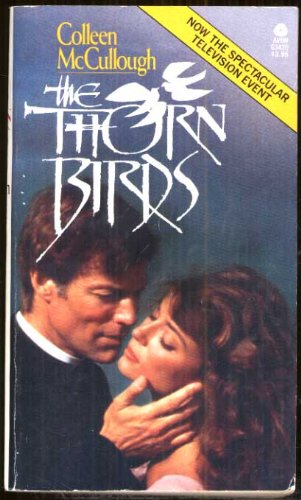
Review: The Thorn Birds by Colleen McCullough

Every so often, a truly remarkable book comes to those of us who love to read.  It's a book that we may not think much of when we first read it, but slowly, over time, it becomes more than just a book.  That is what Colleen McCullough's saga The Thorn Birds is to me.  Maybe it was part destiny -- being born in 1983 (the year the novel was adapted into a miniseries) and being named after the main character, maybe I was meant to love this book.  I've read it at least a dozen times, and I always come back for more.

Set in Australia in the first half of the 20th century, The Thorn Birds is the chronicle of a poor New Zealand-Irish family who strikes it rich when their elderly aunt wills them her home, a sheep ranch by the name of Drogheda.  The only girl in a burgeoning family of sons, Meghann "Meggie" Cleary, rails against the confines of her Catholic upbringing to pursue the love of the man of her dreams.   Fr. Ralph de Bricassart, the object of her affection, is a priest whose love for Meggie is surpassed by only one thing -- his ambition to be the "perfect" priest and a Cardinal of the Church.  Thrown together and torn apart repeatedly by love, ambition, and rules, their story comes to an abrupt turning point when Meggie takes her fate into her own hands to steal what little happiness she knows she can, with results and consequences that neither she nor Ralph could possibly foresee.

To me, this is one of the greatest "love stories" of all time.  The conception of a Catholic priest falling in love with a young woman is as old as time itself, and Thorn Birds has an almost Romeo and Juliet quality to it.  Why does Ralph push Meggie away and pursue the priesthood when he loves her so?  Why does Meggie go back to Ralph repeatedly when he brings her nothing but misery in denying her?  The difference between Thorn Birds and Romeo and Juliet is deliberation.  In Shakespeare's classic tragedy about imprudent child lovers, the titular hero and heroine are too young and foolish to realize the dire consequences of their actions.  In Thorn Birds, Ralph and Meggie (especially Meggie) realize exactly what they are doing, and why, and the consequences of their actions if they are discovered.

The theme of the book -- suffering great pain to achieve one's heart's desire -- is one that resonates with me more than ever, through the years.  McCullough's writing is beautiful and meaningful.  The last paragraph, even thirteen years after my first reading, still rings with its message:

"The bird with the thorn in its breast, it follows an immutable law; it is driven by it knows not what to impale itself, and die singing.  At the very instant the thorn enters, there is no awareness of the dying to come: it simply sings and sings until there is not the life left to utter another note.  But we, when we put the thorns in our breast, we know.  We understand.  And still we do it.  Still, we do it."

Rating: *****

Thursday, October 6, 2011

Revisiting an old favorite

Due to a lot of outside factors, September (and October, thus far) was not a good month for me, reading-wise.  For the first time this year on Goodreads, I am not any books ahead of where I should be (down from seven books ahead a few months ago).  Granted, part of this is due to the fact that I spent most of September reading a very long book -- Shogun, which beat out The Pillars of the Earth for longest book thus far this year -- an unfortunate general malaise about reading, and an inability to pick a "next book" to read.

On Monday, I decided to check out my shelves and see what (thus far this year) I haven't read.  Only one book stood out.  And now, a hundred or so pages into it, I'm realizing that it was exactly what I needed right now.


To say that this book is one of the ones that has influenced my life the most is probably an understatement.  Colleen McCullough published her epic saga about a Catholic priest and his illicit love for a young woman in New South Wales, Australia, in 1978, five years before I was born.  In 1983, the miniseries starring Richard Chamberlain and Rachel Ward was released, and the name Meghann and its variants skyrocketed to number 8 on the list of most popular names for that year.  I was one of the many thousands of "Megans" born in 1983.  And I wasn't prepared for the embarrassing essay I had to write for my Confirmation class, fourteen years later, about how my parents chose my name.  "I was named for the heroine of a novel who falls in love with a Catholic priest."  Awkward.

And yet, when I picked up the book, I had no idea how much I would fall in love with it, the story of a forbidden love, of two people who rush headlong into their passion, neither knowing or caring about the destruction they bring about on themselves and their future.  To me, The Thorn Birds is more a more passionate and terrible romantic tragedy than Romeo and Juliet.  In the latter, the lovers are children who have no idea what they are doing to themselves, no scope of the world beyond each other.  In the former, they surrender willingly to the fate that will inevitably destroy them.  And why?  Because they know that they are worth it.

The prelude to this incredible book is beautifully-written, and expresses a lot of the way I've been feeling these past few weeks.  Although I have read The Thorn Birds many, many times in the past thirteen years, re-reading it this time has been like a conversation with an old friend, when she reveals things to you that you never knew about her before.  I'm enjoying it more than I ever imagined I would, even after all these years.

There is a legend about a bird which sings just once in its life, more sweetly than any other creature on the face of the earth.  From the moment it leaves the nest, it searches for a thorn tree, and does not rest until it has found one.  Then singing among the savage branches, it impales itself upon the longest, sharpest spine.  And, dying, it rises above its own agony to out-carol the lark and the nightingale.  One superlative song, existence the price. 

But the whole world stills to listen, and God in His heaven smiles.  For the best is only bought at the cost of great pain...or so says the legend.

Friday, September 23, 2011

Review: Shogun by James Clavell

September is going to go down in infamy this year as being the month where I read the least amount of books, but perhaps the most amount of pages.  All due to the ambitious project this book has been.  I started reading it on September 2nd, and it took me twenty days to finish, longer than any other book this year.  But clocking in at a mere 1152 pages, this was not an easy undertaking.  Book 75 for the year is James Clavell's Shogun.

In the year 1600, an English pilot, John Blackthorne, accidentally steers his Dutch ship into a storm, and the crew is wrecked upon the cost of Japan.  They are taken prisoner in a strange land, where the speech is alien, men lose their heads for simply disrespecting their betters, and there is no greater sin than that of shame.  Through a streak of luck, Blackthorne finds himself at the hands of the warlord Toronaga, whose interest  in the English "barbarian" drives him to instruct Blackthorne to learn Japanese through the tutelage of the beautiful Lady Mariko.  But Japan is divided by two warlords, Toronaga and Ishido, during the minority of the future Emperor of Japan, and only one of them can win the top prize and become Shogun, supreme military dictator of Japan.  Blackthorne finds himself and his ship are pawns on the formidable chess game between two feudal lords, where only one can win. 

I was first introduced to Shogun when I was a young teenager, through the miniseries starring Richard Chamberlain as John Blackthorne and Toshiro Mifune as Toronaga.  It is a haunting, sad story about a man completely marooned in a foreign land, unable to speak the language or understand the culture, yet finding himself of vital importance to the political situation at hand.  Blackthorne is a pitiable character in the beginning of the novel -- he suffers as he is humiliated before the Japanese samurai, and he is terrified to discover that Japan is overrun by Spanish Catholic priests (Blackthorne, being a Protestant, is a natural enemy of the Spanish Catholics, the story taking place during the time of the Spanish Inquisition).  In his tenuous position, Blackthorne clings to the only person he feels he can trust -- the beautiful Mariko Toda, the Christian wife of a Japanese samurai, who acts as his translator.

The love story between Mariko and Blackthorne is as beautiful as it is heartbreaking.  It is difficult to read because you, the reader, know that tales of forbidden love almost never turn out well.  The only part of the love story I found corny was when they chose to speak in Latin to each other.  Mariko and Blackthorne both speak both Portuguese and Latin, and during times when they do not want anyone to understand them, they choose Latin, which turns into a bunch of "thee", "thou", "I love thee".  Gag.  It's the only time in the book that the relationship seems forced.

The book deviates from the miniseries in one important area.  In the miniseries, we see and hear everything only from Blackthorne's point of view.  We understand what is translated to him.  We never know the motives or the minds of the other individuals.  In the novel, Clavell frequently writes from the points of view of all characters, major and minor, Japanese, Spanish, and Portuguese.  My favorite character in the book has to be the warlord Toronaga.  He is the antithesis of a xenophobe, unlike most of his countrymen, and he is a very practiced dissembler.  One does not really know the extent of his plans until the very end of the novel, and it is only in the moments when he finally lets his guard down and explains what he is thinking that the reader understands exactly how much of the game he has been playing all along.

This is a stunning book, a real tour de force, as it has been described.  But I won't be reading it again any time soon.  It is simply too long for light reading.

Rating: ****

Friday, September 2, 2011

Review: The Catcher In the Rye by J.D. Salinger

I said it at age 15 and I'll say it again at 27.  

It is really, really hard to write anything profound about J.D. Salinger's The Catcher In the Rye.

Holden Caulfield, 16 years old, has just been dismissed from his fourth prep school.  Overcome with feelings and emotions that he is unable to sort out, he makes a spur-of-the-moment decision to take the train to his hometown in New York City, and spend three days before Christmas living on his own, observing the human race, in a sort of self-seeking adventure.  What follows is Holden's first-person written account of a life-altering experience, altogether vivid and subdued, the writings of a child-adult desperate for answers and innocence in a world he views as eminently corrupt.

This is one of my favorite books, read for the first time as a very, very innocent sophomore at a Catholic girls' school, and since then I've probably read it cover-to-cover at least fifteen times.  After my first reading, my grandfather told me that it was one of the best books of the 20th century, and asked me what it was precisely that I liked about it.  I couldn't give him an answer then, and even now, I'm not sure that I could give one.  The best I can sum it up in is three words.

It's Holden's voice.  It's Holden's caustic honesty, the way that he struggles and bleeds all over the pages of Catcher.  It's his desperation to find some meaning in life, as he flails about trying to find a stronghold at the age of only 16, battling depression and juvenile disillusionment and being unable to cope with either of them.  It's the way that you can give this book to almost any teenager, the most jaded, the least matured, and they will still understand it.  Holden is the archetypal teenager.  Most of the negative reviews I have read for Catcher have, I found, been written by adults.  I'm not trying to say that you can't enjoy Catcher when you read it for the first time as an adult...but I do believe that Holden makes more sense to a teenager.

The one thing I love about this book is that it transcends time, gender, and interest.  My husband, who never, ever reads, saw me reading Catcher this past week and said "That is the only book I ever really liked when I had to read it in school."  Five stars then, five stars now.

Rating: *****

Thursday, September 1, 2011

Review: Harry Potter and the Chamber of Secrets by J.K. Rowling

Finally!  After four days without power, the Connecticut Light and Power Co. turned on our power sometime yesterday afternoon.  I can't tell you how relieved we are to have electricity and hot water again.  I feel about 100% more human than I did the whole beginning of this week, and more equipped to tackle what's been going on my job (things be crazy lately).  But I'm even MORE ready to run headlong into the upcoming three-day weekend!  Two more days and I'm there!

Because of the power outage, I'm really behind in my reviews (I was reading faster than I was reviewing).  Today is book 73, an old favorite, Harry Potter and the Chamber of Secrets.

Harry Potter, now 12, has spent his entire summer daydreaming about returning back to Hogwarts School of Witchcraft and Wizardry, but is off-put by a visit from Dobby, a long-suffering house-elf, who warns him not to return to Hogwarts, since he is in grave danger.  Ignoring the warning, Harry returns to find his school in chaos.  Students are being Petrified by a mysterious being that moves through the school  unseen. Words painted on a wall declare that "The Chamber of Secrets Has Been Opened".  And rumors run rampant about the identity of the "Heir of Slytherin", the only person who can open the Chamber.  Harry must work with his best friends, Ron and Hermione, to discover the identity of the Heir and the location of the Chamber of Secrets and to clear his reputation for good.

This book, second in the series, is certainly not my favorite, though I think it's a great "second" novel.  Now we know the characters -- Harry and Ron, Hermione and Snape and Dumbledore.  The lack of Voldemort in this book is what sets it apart from the later books -- granted (spoiler) he makes an appearance in some form towards the end of the book, but it is certainly different from his presence in Books 4 - 7, where he is a constant malevolent presence.  Chamber of Secrets is still lighthearted enough that I feel it can still be categorized as a childrens' book.  Harry and the crew are only 12 years old, and they still have the pre-pubescent thought patterns that children their age have.  Plus we have the introduction of the Polyjuice Potion, when it was a plot point and not a fall-back.  Ahhh, the good old days.

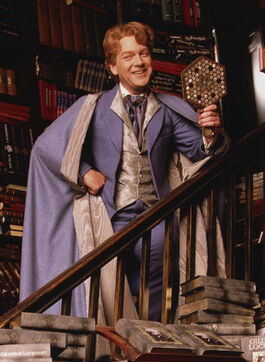
Kenneth Branagh as Lockhart
(from the Harry Potter Wiki)
Plus, we have the introduction of "Professor" Gilderoy Lockhart, possibly my favorite of all the one-shot Defense Against the Dark Arts teachers (Remus Lupin excluded, of course).  Although he's a complete con artist with a shoddy past, I can't help but like Lockhart, and feel sorry for him when he gets his come-uppance is spectacular fashion.  His overbearing presence throughout Chamber and his whopping tales is what makes him relatable -- we've ALL had that relative/friend/acquaintance whose entire repertoire of stories has to do with his commendable courage, his riveting good looks, or his astounding intelligence.  And Kenneth Branagh was absolutely perfect at playing Lockhart in the film.  I can't help but laugh when I see him donning the ridiculous colored attire and prancing about Hogwarts like he's the greatest thing since sliced bread.

A good second novel, and worth a reread every few years, most definitely.

Rating: ****

Tuesday, August 30, 2011

Review: Delirium by Lauren Oliver

Day Three with no power, and now for something completely different, Day One with no hot water!  *sigh*  Because we're in such an area of low importance, I have a feeling we won't get either back until at least the end of the week.  At least, I am trying to prepare myself for the disappointment of going home every day and finding the power still out.

A silver lining (there is one, I think) is that I am tearing through books faster than I can review them.  I actually finished this book on Sunday, and I've finished another besides.  So here it is -- Lauren Oliver's much-touted Delirium.

Lena Haloway is terrified of love.  Love is the disease that has been eradicated by her government -- all citizens receive "the cure" at age 18, and go on to live completely normal, healthy lives free of amor deliria nervosa.  Love is what drove her mother to commit suicide when Lena was only six.  Love casts a shadow over every aspect of life, every part of Lena's dystopian society.  Love is the last thing that Lena wants any part of.  But less than 50 days before her cure, Lena realizes that love is the one thing she can't live without.  And now she has to make a choice -- live a lie forever, a life without love, or leave behind everything that she knows.

After The Hunger Games and Divergent, I've been definitely riding the wave of dystopian YA literature.  Abandon, while not dystopian, was a complete bust, and so I was hoping that Delirium would renew my faith in YA lit.  It did.  I liked Delirium, unfortunately not as much as HG or Divergent, but I liked it nonetheless.

Lena, as a character, is interesting in her mediocrity.  She's no Bella Swan -- quick to tout her mediocrity, yet unable to explain why everyone loves her (I still don't get the attraction).  She's not Katniss Everdeen, superwoman and queen of survival.  And she's not Tris Prior, a rebel without a cause from the right side of the tracks, rushing headlong into conflict.  Lena is...plain.  She's not attractive.  Boys don't like her.  There's nothing "special" about her.  Her main concern, unlike Bella, unlike Katniss, unlike Tris, is being singled out.  If it was up to Lena, she'd be completely ordinary forever, as long as it guarantees that she won't fall into the same trap her mother did.


The theme of love as a mental illness is an interesting one.  Lena is terrified of becoming like her mother -- so blinded by amor deliria nervosa that the disease eventually took her life.  It's interesting to see a writer talk so candidly and go so in-depth with the story of a child's response to the mental illness of their parent, and the question, in the end, of if the mother is the one who is sane, and not the authorities, after all.


The turning point of the book, for me, was the climax at the end.  Up until that point, I wasn't sure if I'd actually read the sequel.  Not that Delirium was bad, but that I had pretty much assumed I knew how everything would go, only to have the end come as a surprise.  I don't know if I'll be reading the sequel, Pandemonium, but I wouldn't rule it out.  We'll see.


Rating: *** and 1/2


Monday, August 29, 2011

Review: Russian Winter by Daphne Kalotay

Sometimes I get a hold of a novel that doesn't strike me as that alluring at first.  I don't have difficulty putting it down to do something else, I don't really "get into" the story.  And then all of a sudden, something happens, and I fall headlong into it, and wind up loving it.  That happened with The Pillars of the Earth, it happened with The Hunger Games.

And it happened with Daphne Kalotay's Russian Winter.

Boston, present day.  Nina Revskaya, a former ballerina and star of the Russian Bolshoi Ballet, now confined to a wheelchair, is auctioning off her priceless and legendary collection of jewels to benefit the arts.  In doing so, she hopes to finally close off the painful past, memories of the years before her defection from Stalinist Russia, once and for all.  Drew Brooks, the curious young woman who is in charge of setting up the auction, is fascinated by Nina's jewels and the history behind them, and wonders why she can't figure out Nina or her motives as she sets up the final sale of these priceless gems.  And when Grigori Solodin, a middle-aged professor of Russian studies, produces an amber pendant that appears to belong to the collection, all three are intrinsically linked in the uncovering of a mystery that changed the course of Nina's life -- and Grigori's.

First of all, this book has everything in it that I love.  Russian history.  Ballet.  Jewelry.  Poetry.  Boston.  There was really no way that I wasn't going to love it.  But the writing style was what sealed it for me.  Everything was so beautifully written, so well described.  My favorite parts were Nina's flashback episodes, which take up the majority of the book.  Kalotay really paints a vivid picture of life as a ballerina during the Stalinist regime -- living as one of the elite in a period where so many people were poor and had nothing, the balance between being fortunate and being afraid of the fall.  There is so much that we in the West still don't know about life in the Eastern Bloc, behind the Iron Curtain of communism, during the reigns of Stalin, Kruschev, etc.

Although Nina is not overtly made a sympathetic character, I had to pity her so many times throughout the novel.  She has made mistakes and lived to regret them, but feels that now, fifty years later and across the ocean, it is too late for her to redeem herself.  I love novels with a theme of redemption, and I loved Russian Winter.  Another five-star, and one of my favorite books of 2011.

Rating: *****

Wednesday, August 10, 2011

Review: Abandon by Meg Cabot

I have long professed my dislike for the Twilight series.  I don't like it.  I've tried it, and I just don't like it.  In fact, my dislike of the Twilight series ran so deep that for awhile, I gave up YA literature.  Well, that was a stupid decision, and I've since amended it, and I've read a LOT of YA fiction this year.  When I heard the Meg Cabot had a new book out, Abandon, I decided to pick up a copy and give it a try.  Years ago, I ate up her Princess Diaries series.  I figured I'd like this too.

Wrong.  So wrong.

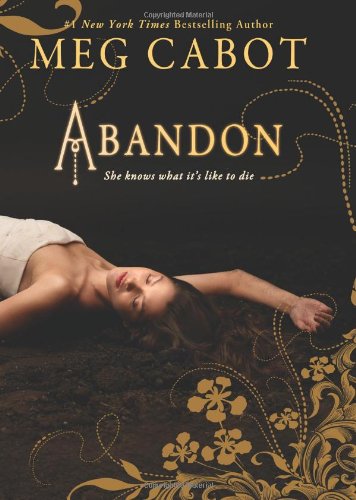
Abandon markets itself as a darker tale of Hades and Persephone -- the Greek god of the Underworld and the young girl he kidnapped and made his queen.  Our heroine, Pierce Oliviera, has been to the Underworld before.  She died a year and a half earlier in a freak drowning accident.  And while she was there, she met John, who gave her a beautiful necklace to "protect her from evil."  Pierce, frightened, ran away from John, managed to escape the Underworld ,and returned to the land of the living.  But her life didn't go back to the way it was before the accident, and after too many incidents, Pierce is forced to return to her mother's homeland of Isla Huesos, the "Island of Bones", Florida, where darkness and evil seem to follow her wherever she goes.  Pierce knows that she escaped death once, but Death wants her back, and she isn't sure she'll be able to escape again.

*sigh*  Okay.

First.  The character of Pierce (the name, OMG, I realize it's supposed to be a throwback to "Persephone" but dear God).  If you like Bella Swan, or any other "heroine" who gets herself into stupid situations and suddenly finds herself rescued by an overbearing male suitor, congratulations, here's Pierce Oliviera.  It really makes me want to cry that this generation of teens "relates" to this type of literary character.  Pierce died.  I get it, that sucks.  I think it would especially suck to be fifteen years old and find out what happens when you die.  But for the first half of the book, Pierce's mental meanderings (I can't call them "thoughts") went along the lines of What does it matter?  Why do all these other peons think that anything they do in this life means anything?  We're all just going to die anyway.  In short, Pierce is that teenage emo wannabe goth that sat in the corner of the cafeteria not talking to anyone and cried during classes in high school.  Why are we glorifying this again? 

When she's not talking about how useless life is or emo-ing about her trip to the Underworld and back, Pierce is incredibly shallow, narcissistic, and stupid.  She doesn't know who Homer is (the Greek writer, not Simpson) and she doesn't know any Greek mythology, which most of us learned in elementary school (Pierce is supposed to be 17 and a senior in high school).  But it's okay, because John's mysterious necklace will protect Pierce from evil, so naturally, anything terrible that happens to anyone else is obviously HER FAULT for not stopping it.  So when she thinks she can "help" somebody, she puts herself in danger (so John comes swooping in yet again all Edward Cullen-like to save her AGAIN), and causes damage that WOULD be irreparable, except that Pierce's daddy is a multi-billionaire (what?).  So Daddy can just write a seven-figure check and get her out of all of it!  Tee-hee!  *headdesk*

Then we have John, our brooding and devilishly (pun intended) handsome male lead, who is just...too Edward Cullen.  Except that Cabot exchanged ten million references to bronze eyes into ten million references to silver eyes.  Sweet.  And unlike Edward Cullen, he spends the majority of the story trying to bring Pierce back to the Underworld, instead of pushing her away.  Admittedly, I thought in the beginning that this would be a nice change of pace.  But the two characters have zero chemistry for 90% of the book, and that 10% is supposed to make the reader believe that they are meant to be?  I realize that teenage relationships are supposed to be rushed and insipid, but come on.

All of the other characters (besides John and Pierce) are flat and one-dimensional.  And I couldn't get it up to care about any of them.  Close to the climax of the book, one of the characters dies.  And not a single fuck was given that day.  Seriously.

Second.  The writing.  I understand that Abandon is supposed to be Book One of a trilogy.  But there is no story arc.  This is the first book of a trilogy that I ever read that couldn't stand alone at all.  Nothing is resolved at the end of the book.  Everything is left hanging.  There are so many side-plots that it is impossible to follow everything.  Everyone in Pierce's family has a hidden agenda -- but you don't find out what any of them are, or how any of them relate to the main plot of the story.  The climax is truly unbelievable, and didn't make me excited to find out what was going to happen next.  The story fizzled out at the end.

The chronology of this book is one gigantic tangle.  The narrator, our "heroine" Pierce, jumps around so many times it's like reading a story written by someone with untreated ADHD.  The story jumped from present-day, to past-tense, to present-day, to WAY-past-tense, and back again.  It didn't give me time to really wrap my brain around what was going on.  Cabot doesn't give the reader a chance to really envision what is going on in the story, what the setting is, any subtleties.  It's just a whack on the head and THIS IS THE UNDERWORLD.  Okay.

I'm irritated that I spent the money on this book.  I'm mad because it's yet another YA novel glorifying the emo, nancing teenage heroine and the brooding, overprotective male hero.  The starting premise was interesting and showed some promise; I'm tempted to say that Cabot could have salvaged this book with another read-through and some heavy editing.  But I don't think that's going to happen with the sequel, Underworld, and I have doubts that I'm going to read it and find out.

Rating: *

Monday, August 8, 2011

Review: Dealing with Dragons by Patricia C. Wrede

Confession: I have a soft spot for faerie tales.  I don't read them very often, but I do love them.  This book, number 65, is one of my favorites from my pre-teen years.  I managed to snag a copy for $3 the other day, re-read it, and realized how much I still love it.  Number 65 for the year is Dealing with Dragons by Patricia C. Wrede.

Princess Cimorene, of the Kingdom of Linderwall, feels as if her title is a prison sentence.  She's too tall for her age, she's opinionated, and she's a dreadful trial to her royal parents, since she would rather fence and cook than learn embroidery and etiquette.  She tries to take it all in stride, but when her parents betroth her to a dimwitted prince whom she cannot love, Cimorene takes her future into her own hands -- and runs away.  She takes the drastic step of volunteering to be a "dragon's princess" -- a title usually reserved for those princesses who are kidnapped by dragons -- and amuses herself by cataloging treasure, conjugating Latin, and cooking cherries jubilee for her mistress, the dragon Kazul.  But when she discovers a plot concocted by the dragons' sworn enemies, Cimorene must use her wits and skills to save the dragons' throne, and their lives.

To me, this book is one of the only true "feminist" faerie tales.  Cimorene is the world's most badass princess -- she's got survival skills, she's gutsy, and most importantly, she's independent.  She doesn't want to be rescued, and there's no need for her to be rescued; she's got everything she needs and wants already.  Wrede created the "Enchanted Forest Chronicles" to be a world unto itself, but it's very tongue-in-cheek, with the constant message of "the way that faerie tales are supposed to be, isn't always the best way."  Cimorene is a princess, but she's the only one with sense, much as Morwen the witch is the most powerful witch in the Enchanted Forest, but she's young, attractive redhead with a feisty, no-nonsense attitude.  The idea that "sometimes different is better" rings throughout this book, and I like it.  I very much look forward to reading this book to my children someday.

Rating: **** and 1/2

Friday, August 5, 2011

Review: Harry Potter and the Sorcerer's Stone by J.K. Rowling

I'm on a bit of a Harry Potter kick lately (you don't say, Meg?) so I apologize, and I promise that the next book will NOT be HP.  But having finished book 7, and film 7.5, I wanted to go back to the beginning while it was all fresh in my memory, and see the differences between the start and the finish of the series.  And so book 64 for the year was Harry Potter and the Sorcerer's Stone.

Seven years before the Epic Final Battle...Harry Potter doesn't know any magic.  He's not even famous (well he is, but he doesn't know it yet).  He hasn't got a clue what he's doing, or where he's going.  He's an orphan who has lived with his mean-tempered uncle and aunt and his bullying cousin ever since his parents died when he was one.  But when Harry Potter turns eleven years old, a mysterious visitor tells him the truth: that he is a wizard, he's just been accepted to Hogwarts School of Witchcraft and Wizardry, and his parents were not killed in a car crash as he was told, but murdered by the most feared and evil wizard of all time, Lord Voldemort.

Re-reading Sorcerer's Stone after so many years (I first read it in 1999, when I was 16 years old) was like a breath of fresh air (excuse the cliche), especially after seeing how everything ends in Deathly Hallows.  Harry is still young and naive, has low self-esteem, and lacks the "hero complex" that a lot of people say he has in the latter books.  It's funny to see Ron and Hermione as their pre-teen selves as well: Ron is still a scrappy little redhead with an inferiority complex, and Hermione is a bossy know-it-all who hasn't learned to reign it in for diplomacy's sake yet.

The plot is much more subtle as well.  I feel that in later books, J.K. Rowling hits you over the head with plot points, or becomes repetitive.  In Sorcerer's Stone, the villain is much more subtly revealed, and I like that.  I like how Rowling doesn't reveal too much about Harry's past, or what makes him special in the books to come.  It's definitely written for a younger audience, but that is really what made Harry Potter so appealing -- he grew up as we did.

Rating: ****

Tuesday, August 2, 2011

Review: The Princess Bride by William Goldman

William Goldman's The Princess Bride is one of those books that every child of the 1980's should read.  Well, IMO, everyone should read it regardless of when they were born, but especially those of us who were young when the movie starring Cary Elwes and Robin Wright came out.  The movie is everything that a good fantasy/adventure film should be -- with the fencing, kidnapping, beautiful princess, handsome rogue, villainous prince, Cliffs of Insanity, Pit of Despair (called the Zoo of Death in the book), etc. etc. etc.  The book, if possible, has more.

Summary: The most beautiful woman in the world is a teenager named Buttercup, who has spent the majority of her lifetime avoiding male interest and taunting the family farm boy, Westley.  After a chance encounter leaves Buttercup jealous, she realizes that she is in love with Westley, and tells him.  Westley confesses that he loves her too, but that he must leave to make his fortune before he can marry her.  Whilst seeking this fortune, Westley's ship is captured by the Dread Pirate Roberts, who never leaves prisoners alive.  Buttercup is devastated and vows never to love again.  Of course, the most beautiful woman in the world can't avoid marriage forever, and Buttercup receives a proposal from Prince Humperdinck, the greatest hunter in the world: marry him and provide him with a son, or die in terrible pain.  Buttercup agrees to a loveless marriage, and goes off to become queen.  But she is kidnapped by three men who wish to harm her...and then by the mysterious man in black...and that is really only the beginning.

 I'm going to do my  best to describe the writing technique employed by Goldman, but I'm going to fail miserably, considering that I tried to explain it to David the other day and left him thoroughly confused.

Goldman is not writing the typical fairy novel -- this isn't J.R.R. Tolkein, where the world he creates is just that, and there's nothing else.  Goldman writes the book as an abridgment -- giving credit for the original story to the fictitious writer S. Morgenstern, and claiming that the original story was writing as a long-winded satire, which he only discovered after his son tried desperately to muddle through the book and got hopelessly bored.  In the prologue, Goldman writes that his father read The Princess Bride to him when he was recovering from pneumonia, always skipping through the dry sections and only reading "the good parts."  Goldman has created this fictitious author and backstory in order to frame the real Princess Bride fairy tale -- which he himself invented.

(Confused?  I know I was for quite some time.  I'm not even going to admit how long it took me to realize that "S. Morgenstern" wasn't a real person, and that The Princess Bride unabridged version didn't exist.  It's embarrassing.)

A lot of people on Goodreads complain about Westley and Buttercup's relationship in the book, as opposed to the movie.  I have to say that I agree with them in passages.  For example, in the film, Westley threatens to backhand Buttercup during a fight -- bad enough -- but in the book, he literally slaps her.  Granted, William Goldman is writing about an era when "wife-beating" was prevalent, but still -- someone reading in this day and age doesn't expect "true love" and "backhanding" to go hand-in-hand.

What I love about The Princess Bride (the book) is an explanation of the backstory behind the other characters.  Buttercup and Westley are all well and good, but I haven't found a single guy who has watched this movie who hasn't loved Inigo Montoya, the revenge-seeking Spanish fencer, the best of all the characters.  Who doesn't cheer for Inigo as he ruthlessly pursues the six-fingered man who killed Inigo's father when he was only a child?  But how much more do you cheer for him once you've read the backstory, what Inigo's childhood was like, what his relationship with his father was...and why the six-fingered man killed him in the first place?  That is why I love the book as much as (or more than) the film.

Rating: **** and 1/2