Showing posts with label Film Adaptations. Show all posts

Friday, September 23, 2011

Review: Shogun by James Clavell

September is going to go down in infamy this year as being the month where I read the least amount of books, but perhaps the most amount of pages.  All due to the ambitious project this book has been.  I started reading it on September 2nd, and it took me twenty days to finish, longer than any other book this year.  But clocking in at a mere 1152 pages, this was not an easy undertaking.  Book 75 for the year is James Clavell's Shogun.

In the year 1600, an English pilot, John Blackthorne, accidentally steers his Dutch ship into a storm, and the crew is wrecked upon the cost of Japan.  They are taken prisoner in a strange land, where the speech is alien, men lose their heads for simply disrespecting their betters, and there is no greater sin than that of shame.  Through a streak of luck, Blackthorne finds himself at the hands of the warlord Toronaga, whose interest  in the English "barbarian" drives him to instruct Blackthorne to learn Japanese through the tutelage of the beautiful Lady Mariko.  But Japan is divided by two warlords, Toronaga and Ishido, during the minority of the future Emperor of Japan, and only one of them can win the top prize and become Shogun, supreme military dictator of Japan.  Blackthorne finds himself and his ship are pawns on the formidable chess game between two feudal lords, where only one can win. 

I was first introduced to Shogun when I was a young teenager, through the miniseries starring Richard Chamberlain as John Blackthorne and Toshiro Mifune as Toronaga.  It is a haunting, sad story about a man completely marooned in a foreign land, unable to speak the language or understand the culture, yet finding himself of vital importance to the political situation at hand.  Blackthorne is a pitiable character in the beginning of the novel -- he suffers as he is humiliated before the Japanese samurai, and he is terrified to discover that Japan is overrun by Spanish Catholic priests (Blackthorne, being a Protestant, is a natural enemy of the Spanish Catholics, the story taking place during the time of the Spanish Inquisition).  In his tenuous position, Blackthorne clings to the only person he feels he can trust -- the beautiful Mariko Toda, the Christian wife of a Japanese samurai, who acts as his translator.

The love story between Mariko and Blackthorne is as beautiful as it is heartbreaking.  It is difficult to read because you, the reader, know that tales of forbidden love almost never turn out well.  The only part of the love story I found corny was when they chose to speak in Latin to each other.  Mariko and Blackthorne both speak both Portuguese and Latin, and during times when they do not want anyone to understand them, they choose Latin, which turns into a bunch of "thee", "thou", "I love thee".  Gag.  It's the only time in the book that the relationship seems forced.

The book deviates from the miniseries in one important area.  In the miniseries, we see and hear everything only from Blackthorne's point of view.  We understand what is translated to him.  We never know the motives or the minds of the other individuals.  In the novel, Clavell frequently writes from the points of view of all characters, major and minor, Japanese, Spanish, and Portuguese.  My favorite character in the book has to be the warlord Toronaga.  He is the antithesis of a xenophobe, unlike most of his countrymen, and he is a very practiced dissembler.  One does not really know the extent of his plans until the very end of the novel, and it is only in the moments when he finally lets his guard down and explains what he is thinking that the reader understands exactly how much of the game he has been playing all along.

This is a stunning book, a real tour de force, as it has been described.  But I won't be reading it again any time soon.  It is simply too long for light reading.

Rating: ****

Wednesday, August 3, 2011

Harry Potter and the DH, Part II -- some thoughts on the end

Well, it's finally over.  Harry and the crew have rung down the curtain on the epic series that pretty much changed pop culture from the 1990s until now.  And David and I went to the theatre (bargain night Tuesdays -- $2.50 off tickets) last night and saw Harry Potter and the Deathly Hallows, Part IISo in the same vein as I wrote about Part I, I wanted to sum up my experience and my feelings about Part II.

Again, spoiler alert for anyone who hasn't seen the movie yet.

I will say that I was exceptionally pleased that the scriptwriters kept as close to the book as possible in Part II.  After cutting the book into two films, they had plenty of time to write in everything.  Very little was cut, and I liked that.
However.  There were some huge changes that I wasn't expecting at all in Part II.  So I'll start out my review with the things I disliked, rather than the things I liked, in order to keep this review positive.

What I Disliked About Part II
- Important deaths glossed over.  This was an issue for me in Part I, too.  We only see the Weasley family sobbing over the body of one of the completely-indistinguishable-from-each-other twins.  There is a brief moment later when Neville (?  I think?) says who it was...but if you blink, you miss it.  Also, the death of Remus and Tonks is completely omitted -- but that was in keeping with the book, so I'm not entirely surprised.

- The omission of Ariana Dumbledore.  The side story about Dumbledore's youth, his battle with Gellert Grindlewald, and especially his family -- Aberforth and Ariana -- was such a crucial part of the book.  I was upset that the filmmakers chose to omit it.  Also, the scene in "King's Cross" with Harry and Dumbledore was drastically altered, which also saddened me.  I felt that this would give Dumbledore's character a little meat.

- The "final battle" and the aftermath.  *sigh*  I don't understand why the filmmakers wanted to put Voldemort and Harry off someplace remote for their "final battle".  I don't understand why, after eight movies, that crucial scene was so rushed.  I didn't get why they omitted the explanation for why Voldemort's wand didn't work until after the scene was over.  Just...does not compute.
- "19 Years Later".  Or, as David whispered to me in the theatre, "More like 19 months later."  Though, I have to admit, the "epilogue" was better in the film than in the book.  Probably because of the lack of shitty writing.  But why does Ron have an enormous beer gut?  Why?

Enough of the negativity.  Let me talk about the good parts.

What I Liked About Part II
-  Snape, Snape, Severus Snape.  OMG, Alan Rickman.  Absolutely amazing.  He played his part to the hilt, and brought me as close to tears as I have ever come watching Harry Potter.  He delivered the flashback scenes exactly like I had predicted.  Just...perfect.

- Helena Bonham Carter (Bellatrix Lestrange) pretending to be Hermione.  I mentioned in my review of Part I how I enjoyed characters pretending to be other characters (under the Polyjuice Potion).  But I loved Carter as Hermione.  Brilliant.

- Small redemption for Draco.  Not shown in the book, and admittedly it was a change, but I liked Harry and Draco's confrontation in the Room of Requirement.  In the book, it's Draco trying to stop Harry.  In the movie, it's Draco trying to get his wand back.  You see a hint of humanity in Draco -- though I would have liked to see it fleshed out.  Though, as I mentioned before...in J.K. Rowling's world, there is no room for snakes, or people who like them.  Ever.

- Neville-FREAKIN'-Longbottom.  Oh.  My.  God.  I love this kid.  I love the development of his character throughout the seven books -- especially after Book Five, when he begins to really cultivate his skills -- and I love seeing him come to life in the movies.  His unprecedented display of badassery, at the exact moment when it counted, makes this movie (and the book) wonderful.  The only other thing I can say about it is what someone on my FB feed said in a status update a month ago: Chuck Norris' Patronus is Neville Longbottom.  'Nuff said.

The film was good.  I'm sad to see the series end.  Although, considering that J.K. Rowling is about to launch the "Pottermore" website, I have a feeling she's going to be milking this cash cow for a good long while.

Thursday, July 21, 2011

Harry Potter and the DH, Part 1 -- some thoughts, eight months too late

SPOILERS (for those of you who, like me, are the last people on earth to see this film)

 Last November, everyone and their mother was buying tickets to see Harry Potter and the Deathly Hallows, Part I.  I had originally planned to go see the film as well, but that was before I discovered two things.

1. The film was being split into two parts.  I have never liked nor understood this idea.  One book = one movie, right?  If Peter Jackson could turn the Lord of the Rings trilogy into...well, a trilogy, then the myriad directors of Harry Potter should be able to do the same.  Yes, yes.  I am aware that I have to eat my words now, since Peter Jackson is splitting J.R.R. Tolkein's famous prequel The Hobbit into two films. 

2. David and I got married on November 5th, and were on our honeymoon until November 14th.  At the end of that weekend  of festivities, followed by a week in Montreal, we were just too damn tired.  Neither of us wanted to leave our apartment, much less drag our lazy butts to the movie theatre and deal with lines, screaming fans, etc.  David also hasn't read a single Harry Potter book (I know right?  It's a sore point), so he definitely wasn't going to fight me on waiting to see the movie until it came out on DVD.

But eight months later, and with Harry Potter and the Deathly Hallows, Part II finally released into theatres, my curiosity got the better of me, and I asked David to put Part I on our Netflix queue, so I could finally see it.  We watched it over two days (Tuesday and Wednesday evenings, due to some interruptions and visiting my parents) and here are...I guess, some thoughts on the whole thing?

What I Liked About Part I
- The opening scene with Hermione modifying her parents' memories in order to protect them before they went into hiding.  Obviously, since the book is told mostly from Harry's POV (and occasionally, Voldemort's), we didn't get to read about this in the book, with the exception of a brief explanation by Hermione.  It was really heartbreaking, and I thought very well done.

- Every scene at the Malfoys' manor.  I realize that the most difficult thing about reading the book first is that you will constantly compare the movie to what you imagined in your mind while reading.  But that scene was exactly how I pictured it.  Loved it.

- Recurring, awesome characters.  Snape.  Fred and George.  Bellatrix Lestrange.  All of them were so good.  Alan Rickman makes me actually love watching the films.

- The animation of the "Deathly Hallows" explanation.  Really interesting use of animation, and it broke up the movie a bit.  I loved it.

- The characters pretending to be Harry/Ron/Hermione using Polyjuice Potion.  I know.  I've already explained my hatred of that stupid "cure-all for every major plot-point".  But I love watching actors pretending to be other characters, and doing it well.  The scene at the Ministry was very well done.

And now...

What I Didn't Like About Part I
- No redemption for Dudley Dursley.  What?  The kid's been an asshole for all six of the preceding books.  He gets one moment of shining goodness in book seven...and it gets cut?  Fail.

- Too Much Exposition.  I wondered how they were going to work Bill and Fleur's wedding into the film, considering that, in the first six films, we haven't seen Bill at all.  Never fear!  We'll just throw six books' worth of exposition into about 30 seconds.  While we're at it, we'll also talk about Lupin and Tonks' wedding, and maybe hint at the baby (but we won't directly say it).  Sheesh.

- Major deaths are only hinted at.  I had to explain to David why Mad-Eye Moody's eye was stuck into the door at the Ministry, almost two hours into the film.  Because Mad-Eye's death is completely glossed over.  I hear it gets worse in Part II.  But since Rowling did that in the books, I wasn't completely surprised.

- Wormtail's death.  In the book, Wormtail is forced to kill himself when Harry recalls that Wormtail owes Harry life for sparing his own.  Very dramatic.  In the movie...Dobby fires a spell at Wormtail's back, Wormtail goes "...Oh", and drops to the ground.  David didn't even know that he was dead until I told him.  And that is the one thing I will never understand about these movies.  Why take out perfectly good drama and put in...something seriously less dramatic?

IN CONCLUSION: I feel the same way about Part I as I expected to feel about it, and the way I regarded all the other movies.  Taken alone, they are okay.  They just aren't on par with the books.  I will admit that I do see the merits now of cutting the book into two films, considering how much they are actually cramming into the films, and staying true to the story as much as possible.  (I'll never understand why they are cutting Mockingjay into two parts...but that's a story for another time.)  I do want to go see Part II, but we'll see if I get to it in the theatre before it leaves, or if I wait until it comes out on DVD, like I did with Part I.

Thursday, June 2, 2011

Review: Girl with a Pearl Earring by Tracy Chevalier

I love Renaissance art.  I took a class on art history in college and I definitely fell in love with both the architecture and the art of the Renaissance period.  One of my favorite pieces is "Girl with a Pearl Earring" by Johannas Vermeer.  I loved this painting because it is so striking -- the girl staring out from the frame, not beatifically like the Mona Lisa, but with almost a question in her face. as if she's almost surprised to be caught off-guard, and found someone painting her. 

Girl with a Pearl Earring, by Tracy Chevalier, is my favorite kind of historical fiction.  Chevalier takes a painting with an unknown history -- we know nothing about who the subject is, or what inspired Vermeer to paint her, or why she is wearing that particular headgear -- and creates a story around it, to explain the whos, whys, and hows of the painting's existance.

Griet is sixteen years old when her father is blinded in an accident and she is forced to take up work as a maid in order to assist her family financially.  She is employed in the home of the painter Johannes Vermeer, where she quickly discovers that the only bright part of her life is tidying the studio where he works.  Griet is enamored, first of the colors and the paintings, and then slowly, over the years, of Vermeer himself.  Yet, when Vermeer's hands are tied by a wealthy patron into painting a portrait of Griet herself, she realizes she is caught between two worlds -- the one to which she has always felt she belongs, and the world of Vermeer's paintings, which only he can see.

Griet is a unique character.  She is stern, upright, honest, and proud, although she states numerous times that her family's tragedy and her lowly employment give her no reason to be.  She is not a sympathetic character because she does not allow anyone to pity her.  She is a lady unsure of what she wants.  Although she has more gravity and self-reflection than her betters, when it comes to seeing the world around her, Griet is very uncertain, not as to where she should go or what she should be, but of how much she wants it.  She baffles everyone around her, for many reasons -- Vermeer's wife because she is suspicious of her motives; his mother-in-law, who grudgingly accepts her though she feels Griet does not know her place; the butcher's son, her beau, who does not understand why she does not leap at the chance to marry him and free herself from a maid's life.  The only person who asks nothing of her, who says nothing about her future, is Vermeer himself.  And while this enamors Griet, she begins to wonder if he truly cares for her, or if she's just a pretty face in his painting.

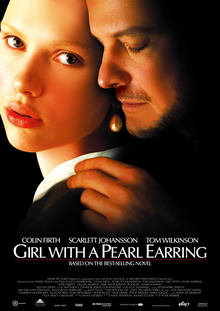
As part of the Nest Spring Book Challenge, I watched the 2003 film adaptation of the book.  The film stars Scarlett Johannson as Griet and Colin Firth as Johannes Vermeer.  It is a good film, when taken by itself, free of the novel.  Scarlett was made to play the part of Griet, and she is perfectly matched to the book's description both physically and vocally.  I love Colin Firth as an actor, and I think he looks great for the role, but the part of Vermeer is over-stressed in this film.  The relationship between Griet and the painter is so delicate, so barely stressed in the book, that you wonder whether or not it's even there.  Does Vermeer have feelings for Griet, or is it all in her own mind?  Or is it based on the painting?  There is no question as to this in the film.  Even the movie poster (left) is indicative of this.  Griet's face is not the gentle look of surprise that the original painting boasts.  Instead, she looks shocked, almost trapped.  Firth is touching her as he would a lover -- this does not happen in the book.  There is only one instance where Griet and Vermeer touch, and it is nothing as erotic as the poster would lead the viewer to believe.  The ending of the film also goes unexplained, and seems hurried, almost rushed.  There is zero character development for Griet in the film.  Where in the end of the movie, every decision made is her own, she is an adult who is finally ready to seize her destiny, in the film, it is thrust upon her, and she has no choice in the matter.  I think the film would be a lot more enjoyable if taken on its own, rather than in comparison to the book.

Rating: **** and 1/2 (book), ** (film)

Wednesday, February 2, 2011

Snow day, a baby blanket, and The Pillars of the Earth (the miniseries)

I know it may come as a shock (OMG, there's snow!?) but New England is still in the throes of the ice storm (I think its name is Ella), and I'm home again from work.  The husband, unfortunately, is not -- he works for a hospital and he's considered "essential staff", which I hate, because it means he has to drive in this crap.  So I'm home alone, except for some cats and a guinea pig, iced in, and knitting on a baby blanket.

It's the Big, Bad Baby Blanket from Stitch 'n Bitch: The Knitter's Handbook, which didn't help me learn to knit but has provided me with some good patterns.  I knitted this in summer of 2009, when David had first moved down to Connecticut, for my good friend Kim, who was pregnant with her second daughter, Anna Sophia.  I knitted it of the now-discontinued Noro Yuzen, which was really not suited to a baby blanket, but I loved the colors and figured it was more an heirloom than a practical gift.

This one, I'm making for David's cousin's baby, a boy, out of Mirasol Cotanani, 60% pima cotton, 40% merino wool.  It's in shade #407, "turquoise", which I guess works, I think of it as more of a sky blue though, instead of the normal "baby blue".  It's really soft and the wool keeps it pliable.  I tore out everything I did yesterday.  It was riddled with mistakes.  But it's really all right when the yarn is this comfortable to work with.

And what's keeping me company (besides the knitting, the cats, and the guinea pig)?

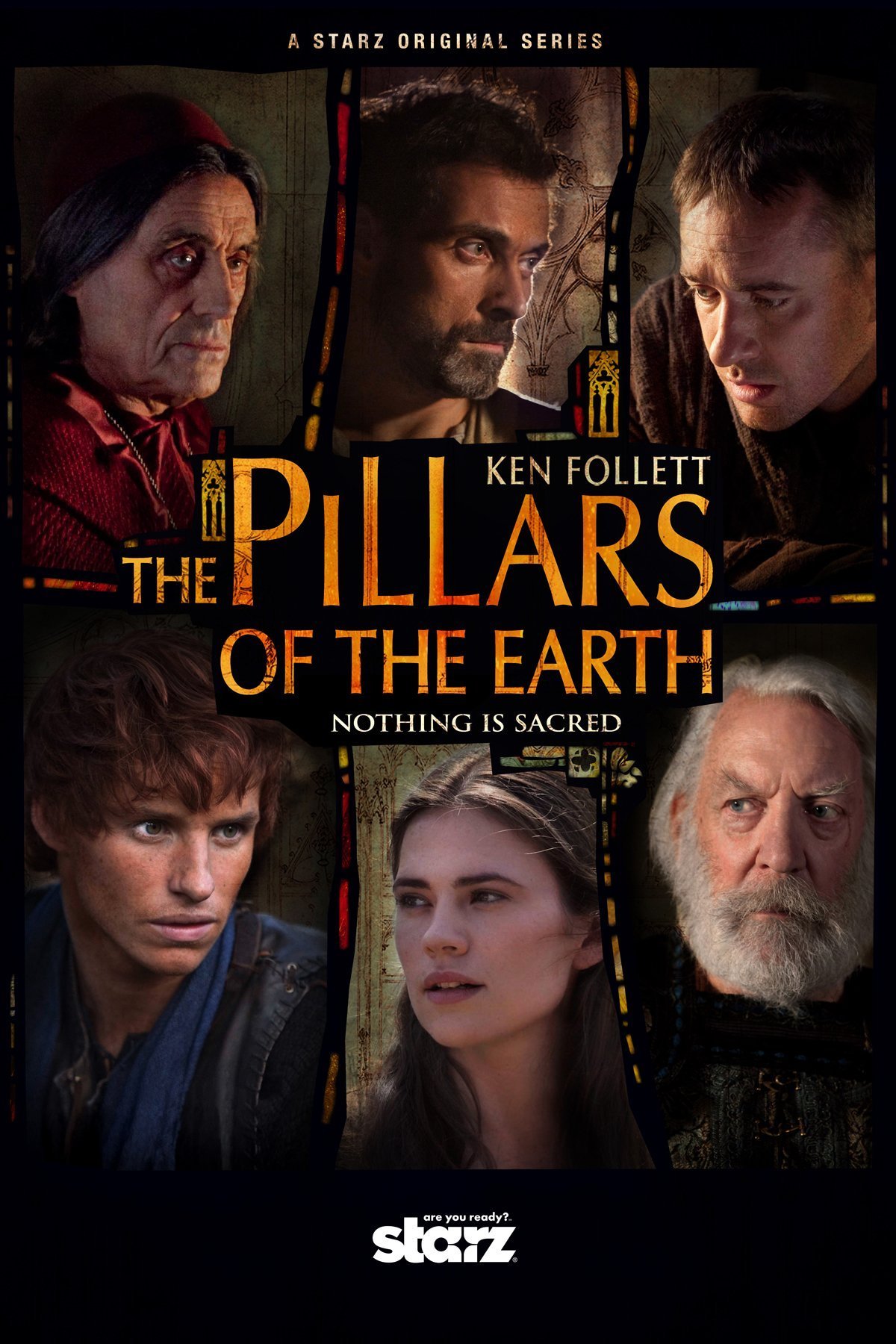
The Pillars of the Earth, the miniseries.  My parents watched this last year and my father's been professing his love for it ever since.  I started it on a whim today (since we all know how much I loved the book), and now I'm completely involved.  It's got episodes.  I'll more than likely be done with it today.  I love it when film actually respects literature (unlike with Angels&Demons).