Showing posts with label Fan Fiction. Show all posts

Monday, December 19, 2011

Review: A Christmas Carol by Charles Dickens

With six days until Christmas, I'm definitely feeling in the spirit, besides the fact that my shopping isn't done, and my house is a mess, and I've been sick all morning (ugh).  I decided to read one of my holiday favorites this past weekend.  Number 98 for the year is A Christmas Carol, by Charles Dickens.

Ebenezer Scrooge is an old man who has lead an unhappy life, seeing everything in terms of black and white, and shunning his fellow man for the comforts loneliness and solitude afford him.  His contempt for poverty and compassion even cause him to neglect his poor clerk, struggling family man Robert "Bob" Cratchit.  But one Christmas Eve, Scrooge is haunted by the ghost of his former business partner, Jacob Marley, who informs him that unless he changes his miserly, contemptible ways, he is doomed to a miserable eternity.  His one salvation lies in the mercy of the Ghosts of Christmas Past, Present, and Future, who arrive to show Scrooge what he has missed, what he continues to ignore, and what his future will become if he goes unredeemed.

This is one of my favorite Christmas stories, if not my absolute favorite.  A lot of people on Goodreads complain about Dickens' heavy-handed prose, and I will admit, the beginning of Stave (rather than "Chapter") One can really be off-putting.  But it is also very beautiful, and no Christmas for me is complete without reading the book and seeing the 1984 made-for-TV version starring George C. Scott.  I love them both.

Rating: *****

Thursday, December 15, 2011

Review: Knit Two by Kate Jacobs

As obsessed as I am with reading and knitting, all too often, knitting fiction piques my interest.  I read The Friday Night Knitting Club last year, and was gifted with a copy of the sequel this Christmas.  WARNING: If you have not yet read Friday Night Knitting Club, this review will contain spoilers.

Knit Two takes place five years after the end of Friday Night, and the members of the Club are still struggling to put the pieces of their lives back together after losing their beloved Georgia Walker.  Dakota Walker, Georgia's daughter, is 18 now, brooding, restless, and hoping for a future where she isn't tied down to her mother's knitting store and legacy.  Peri, the co-owner of the store following Georgia's death, struggles between her loyalty to the store and her desire to branch out with her own line of pocketbooks.  Lucie discovers that her hasty decision to enter single-motherdom isn't as simple now, with a five-year-old terror and a booming career that takes her to Italy.  Catherine, having left her vile husband, tries desperately to understand what is missing from her life as a wealthy divorcee.  Elderly widower Anita has recently accepted a proposal from her boyfriend Marty, and must confront the naysaying of her angry sons while battling her own secrets.  And ultra-feminist Darwin, a new mother to twins, attempts to balance life as a professor and as a mom.

The book is a page-turner, the characters lively, making you wonder what is going to happen next.  But Knit Two lacks the story arc that made Friday Night the bestseller that it was.  For the first 150 or so pages, there's plenty of build-up.  And then, all of a sudden, half of the characters (Anita, Lucie, Dakota, and Catherine) are in Italy for various reasons, and the other three (I neglected to mention KC above, mainly because her main story arc, her battles with smoking and menopause, are the most forgettable of the book) are left behind and shunted to the side.  Here is where I felt both Knit Two and Friday Night lost their appeal -- when the gang goes to a foreign country.  The idea of a European trip in order to find oneself has been done to death, and going to Rome really doesn't bring any sort of spin to the book -- Jacobs could just as well have sent them all to Napa for the cultural differences that they experience in Rome.
The overwhelming grief over Georgia's loss -- five years later -- is also unbelievable.  Dakota, of course, as Georgia's daughter, who was only 13 when she lost her mother, is the only one whose grief is understandable.  She is still working through it, and at 18 still figuring out who she is.  But the overwhelming apathy of James (Dakota's father) and Catherine was ridiculous.  The part about them going out to dinner frequently and setting a place at the table for Georgia made me roll my eyes.  And the entire community being obsessed with Georgia reminded me how skeptical I was of the obsession everyone had with Lorelei and Rory on "Gilmore Girls" -- does the entire world revolve around young, unfortunate, single mothers and their offspring?

The final chapter reminded me way too much of the "Sex and the City" films.  Not everything is perfect -- but enough is.  It was an enjoyable read, if one can get past the few eye-rolly chapters.  I wish there had been more about Darwin.  She was definitely my favorite character from the first book, and not enough was fleshed out about her in book two.

Rating: ***

Monday, November 28, 2011

Three book reviews (because I really can't be bothered right now)

I'm telling you, I'm super sick of these book reviews (this is mainly because I've been knitting more and I could really not care less about the reviews now).  I remember all the way back in January, when I got so excited and really put thought into my reviews...and now it's December, I've read 89 books (11 from my goal!) and I just Do Not Care anymore.  I am so far behind in my book reviews now that I'm going to be doing THREE in one entry today...and that's okay.  Because I make the rules on this blog.

Review: Henry's Blog by Elizabeth Newbery (#87)
 My little sister just came back from a week-long, whirlwind tour of London, England, and brought me back this gem -- Henry's Blog: My Life in My Own Words, OBVS! by Elizabeth Newbery, found in the Tower of London gift shop.  It was meant as a gag gift, and I read it in one night.  Henry's Blog is an extremely short book, written in cyber-speak and blog form, through the eyes of King Henry VIII.  I still can't decide how I feel about it.  The humorist side of me thinks that it's hilarious (and so does everyone else who has read this, including my father) -- the idea of Henry giving his wives cyber-like nicknames (KatyA for Katharine of Aragon, AnnieB for Anne Boleyn and so forth) and talking himself up constantly.  The history major side of me weeps with the idea that kids will read this (it is obviously written for a young adult or teenager).  I went back and forth wondering if I should even count this is one of my books for the year.  But then something HUGE happened.  David read it.  Read a book.  All the way through.  And ENJOYED IT.  Clearly, that cemented it.  I have to give Henry's Blog a good solid three-star rating, simply for the hilarity factor, and readability (did I mention that my husband read it?  A real book?  Go figure!)
Rating: ***

Review: Knitting Rules! by Stephanie Pearl McPhee (#88)
This is my second Stephanie Pearl McPhee (otherwise known as the Yarn Harlot) book of the year -- I read The Secret Life of a Knitter back in January -- and I have to say, I enjoyed Knitting Rules! much more than Secret Life.  The Yarn Harlot is known as a "knitting humorist", but Knitting Rules! is equal parts funny and useful.  I've read it before, and I look at the big as one big pep talk for the anxious knitter, the one who is afraid to try new things, to pick up a skein of yarn and some needles and just go for it.  The Yarn Harlot's handy rudimentary sock pattern is also included with step-by-step (no pun intended) instructions -- a great tool for those knitters who are learning to knit socks for the first time.  I can't tell you how many times I've gone back over the pages when I've needed a little encouragement.  I recommend it to anyone who is interested in learning how to knit, or who could use a little boost every now and then, a reminder that "in the end, it's just knitting."

Rating: ****

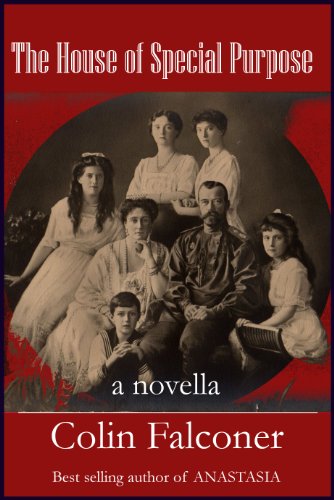
Review: The House of Special Purpose by Colin Falconer
Every so often (usually when I'm broke) I find myself perusing the "free Kindle books" link on Amazon.com.  The other day, this book caught my eye, because as a child I was obsessed with anything and everything to do with the Russian Revolution and the fate of the Romanov family.  "The House of Special Purpose" was the name given to the Ipatiev house in Ekatrinburg where the Romanovs spent their final days before they were executed.  Falconer wrote The House of Special Purpose as a prequel of sorts to his book Anastacia, a sort of "what if" about the fictional destiny of the most famous of the Romanov children, Anastasia Nicholievna.  It's tagline is "How was it possible for any of the children to have survived?  You won't believe the answer; except it's all true."

I don't know what I was hoping for, but this book was not it.  It was a chronicle of the last days of the Romanov family as seen through the eyes of Anastasia and some of the guards employed to imprison the family.  Falconer takes every negative story about Anastasia and makes her about the least sympathetic character in literature -- even her fiestiness seems petulant, cruel, and childish.  There are some vaguely pornographic descriptions and a scene of female rape (without historical accuracy' the author conjured it up himself, which just lead me to be disgusted and disturbed). The novella also suffers from supreme historical inaccuracy.  The cook, Kharitonov, is described as female, yet his real name was Ivan Kharitonov, and he was decidedly male.  Also, *SPOILER ALERT* the elephant in the room was the fact that in 2007 it was proved that none of the Romanov children survived the execution -- the remains of the missing two were discovered at last.  I wouldn't have been surprised with a novella such as this before 2007, but it was published in September of 2011.  

My final "beef" (if you could call it that) with this book was the tired theme, the implausible escape of Anastasia (or another Romanov child).  It's been done before.  It was done by the mysterious Anna Anderson and countless others in the 20th century.  There was a movie made with Ingrid Bergman and the Don Bluth animated film (which I must confess is one of my favorites, even though it's nonsense).  With great writing, it might have been pulled off, but the story has been done.  Time to move on to something else. 

Rating: *

Friday, November 18, 2011

Review: Of Mice and Men by John Steinbeck

I am two books behind in my reviews, so they're going to be quick and short (again, I'm losing interest for these, and I'm sure nobody else cares).  Of Mice and Men, by John Steinbeck, was one of those books that I never read in high school or college, but felt that I should read, and it was #1 on my "to-read" list for much of the past year.  I finally borrowed a copy from my father and read it in 24 hours.

Of Mice and Men is more a short story or a novella than a novel.  Two ranch hands head across California during the Great Depression, looking for work and dreaming of better things.  George Milton is wiry, alert, and thinks of nothing but the better life that could be his.  Lennie Small is a lumbering, slow-witted animal-lover who never means to hurt a fly, but doesn't know his own strength.  In a world where every man must live for himself, these two thrive on relying upon each other, ignoring the oncoming tragedy which, in the end, is inevitable.

My sister warned me that this is "a tough book", and she was correct.  Not the writing style, not the length, but the content.  As an animal lover, reading a book that involves the death of several small, helpless creatures was difficult at best, and made it harder for me to sympathize with poor, dim-witted Lennie or feisty, harsh-mouthed George.  There aren't many likable characters in Of Mice and Men; besides Lennie and George, there's Curley, the blustering son of the ranch owner; his nameless, skank-tastic wife; and various other ranch hands and workers who play minor parts in the book.  The only real character I felt any sympathy for was Candy, the elderly, handicapped ranch hand, who is forced to give up his best friend (his old dog), foreshadowing the events of the rest of the book.

I liked Steinbeck's writing style, and I think I'd read another of his books, but I doubt I'll be reading Of Mice and Men a second time.

Rating: ***

Monday, November 14, 2011

Review: To Kill a Mockingbird by Harper Lee

I am quite behind on my reviews lately, but that's okay because I'm honestly losing interest.  Not in reading, but in reviewing the books I finish.  After the end of the year (and with it -- hopefully -- the end of the 100 books), I'll probably be stopping, unless the book is something of extreme interest.  And that's something else -- most of the books I'm reading now are short, snappy ones that almost everyone I know has read.  What else is there honestly to say about To Kill a Mockingbird, book # 84 for the year?

Jean Louise "Scout" Finch's whole world revolves around the little town of Maycomb, Alabama, and its dry-as-dust inhabitants: Miss Maudie Atkinson, the colorful gardener who is her main inspiration for becoming a lady; Arthur "Boo" Radley, a mysterious hermit whose malevolent presence has terrified Scout and her brother Jem since birth; and her beloved father, lawyer Atticus Finch, who is about the blow the town apart by agreeing to defend a Negro man accused of raping a teenage white girl.  As consequences pile up around them, and the little town is turned upside-down, Scout's eyes are opened, not only to the people around her, but to the state of the nation as a whole.

This is a book that almost every high school student in America reads at one point or another.  I myself read it as Summer Required Reading when I was going into my junior year of high school.  It is one of my favorite books, and I'm pretty sure I've memorized parts of it.  Is there anyone who has read this that doesn't love Atticus Finch?  The book is written from the POV of Scout, but this is Atticus' story, more than anyone else's, as he is the major protagonist (and causes much of the action).  A great story, and a must-read.

Rating: *****

Monday, November 7, 2011

Review: Phantom by Susan Kay

Anyone who loves musical theatre knows the story (or the Andrew Lloyd Webber adaptation) of the Phantom of the Opera.  Lloyd Webber's musical sets to music Gaston Leroux's tragic novel of the horribly disfigured musical genius and architectural magician who hides in the wings of the Paris Opera House, determined to steer clear of human beings forever, until he meets the beautiful young opera singer who becomes the love of his life.  But from where did the Phantom come?  What course of action lead him to choose the Opera House as his hideaway?  What was his life like?  Why is he disfigured?  These questions and more are the inspiration for Susan Kay's ultimate fanfiction novel (and book #82 for the year), Phantom.

The titular "Phantom" begins life as Erik, the terribly disfigured son of a widowed French mother who can hardly believe the burden placed upon her from his birth.  Resented and feared by his mother and forced from birth to wear a mask, Erik is expected to die young, and barring that, be nothing more than a mindless animal.  But his inquisitive brain and remarkable abilities in the fields of architecture, music, and magic stun the minds of all who meet him.   A loveless childhood and subsequent flight from his home lead Erik through the wilds of France to a Romany camp, then to Italy and Russia and Persia, where he becomes a victim of both the cruelty of the human race and the disfigurement of his own features.  Believing that he should expect nothing but hatred and cruelty from his fellow man, Erik remains content as an outsider to life, until fate brings him face-to-face with the beautiful young chorus girl, Christine Daae, forcing him to try his hand at love and acceptance one last time.

This book is a heartrending companion to both the Leroux novel and the Andrew Lloyd Webber play.  It fills in the gaping questions listed above, and more, giving the Phantom fan a well-plotted-out backstory and explanation for Erik's actions and the history behind his genius in so many fields.  The Leroux novel explains more about the Daae family, Christine and her relationship to her father, and what brought her to believe in the "Angel of Music" that Erik first pretends to be.  It speaks very little about Erik's lifetime or backstory, nor does it explain his mysterious friendship with the man only known as "the Persian", who becomes central to the climax of the book (and who is completely omitted from the Lloyd Webber play).  

Kay fleshes out Erik's story.  The book is divided into a series of vignettes, each from the point of view of Erik, or of a person who had an impact (positive or negative) upon his life, including Madeleine (Erik's unhappy mother), an Italian Freemason who educates Erik in the field of architecture, the Persian (who gets a name in this, as Nadir Kahn) who is ordered to bring Erik to Asraf to design a palace for the shah-in-shah, and of course, Christine Daae herself.  The chapter by Nadir Kahn is really among the most fascinating and telling parts of the book, and it explains the presence of "the Persian" in the original novel.

The myriad reviews on Goodreads show me that this is not a book that caters to all Phantom fans.  Some say that if you are a fan of the original book you'll love it, or if you love the play but hate the book, it's for you.  If you like the Phantom and think that Christine and Raoul, Vicomte de Chagny, never belonged together...or if you just like a ton of backstory.  For my part, I love it.  It's one of my favorite books, and I feel so lucky to have snagged a free copy on PaperbackSwap recently.

Rating: *****