Showing posts with label Classics. Show all posts

Monday, December 19, 2011

Review: A Christmas Carol by Charles Dickens

With six days until Christmas, I'm definitely feeling in the spirit, besides the fact that my shopping isn't done, and my house is a mess, and I've been sick all morning (ugh).  I decided to read one of my holiday favorites this past weekend.  Number 98 for the year is A Christmas Carol, by Charles Dickens.

Ebenezer Scrooge is an old man who has lead an unhappy life, seeing everything in terms of black and white, and shunning his fellow man for the comforts loneliness and solitude afford him.  His contempt for poverty and compassion even cause him to neglect his poor clerk, struggling family man Robert "Bob" Cratchit.  But one Christmas Eve, Scrooge is haunted by the ghost of his former business partner, Jacob Marley, who informs him that unless he changes his miserly, contemptible ways, he is doomed to a miserable eternity.  His one salvation lies in the mercy of the Ghosts of Christmas Past, Present, and Future, who arrive to show Scrooge what he has missed, what he continues to ignore, and what his future will become if he goes unredeemed.

This is one of my favorite Christmas stories, if not my absolute favorite.  A lot of people on Goodreads complain about Dickens' heavy-handed prose, and I will admit, the beginning of Stave (rather than "Chapter") One can really be off-putting.  But it is also very beautiful, and no Christmas for me is complete without reading the book and seeing the 1984 made-for-TV version starring George C. Scott.  I love them both.

Rating: *****

Friday, November 18, 2011

Review: Of Mice and Men by John Steinbeck

I am two books behind in my reviews, so they're going to be quick and short (again, I'm losing interest for these, and I'm sure nobody else cares).  Of Mice and Men, by John Steinbeck, was one of those books that I never read in high school or college, but felt that I should read, and it was #1 on my "to-read" list for much of the past year.  I finally borrowed a copy from my father and read it in 24 hours.

Of Mice and Men is more a short story or a novella than a novel.  Two ranch hands head across California during the Great Depression, looking for work and dreaming of better things.  George Milton is wiry, alert, and thinks of nothing but the better life that could be his.  Lennie Small is a lumbering, slow-witted animal-lover who never means to hurt a fly, but doesn't know his own strength.  In a world where every man must live for himself, these two thrive on relying upon each other, ignoring the oncoming tragedy which, in the end, is inevitable.

My sister warned me that this is "a tough book", and she was correct.  Not the writing style, not the length, but the content.  As an animal lover, reading a book that involves the death of several small, helpless creatures was difficult at best, and made it harder for me to sympathize with poor, dim-witted Lennie or feisty, harsh-mouthed George.  There aren't many likable characters in Of Mice and Men; besides Lennie and George, there's Curley, the blustering son of the ranch owner; his nameless, skank-tastic wife; and various other ranch hands and workers who play minor parts in the book.  The only real character I felt any sympathy for was Candy, the elderly, handicapped ranch hand, who is forced to give up his best friend (his old dog), foreshadowing the events of the rest of the book.

I liked Steinbeck's writing style, and I think I'd read another of his books, but I doubt I'll be reading Of Mice and Men a second time.

Rating: ***

Sunday, May 22, 2011

Review: Little Women by Louisa May Alcott

Louisa May Alcott first wrote Little Women as a submission for a newspaper column's call for "a girls' book" -- and that really is, at its heart, what Little Women is.  I'm sure there must be some men who enjoy it (I don't know any) but it is a book about and directed towards young women.  A unisex book, this very much is not.

Alcott patterned the titular "little women" of her book after herself and her three sisters, which may explain the very lifelike characters and very obvious failings of each girl (except for Beth, of course, who has no failings -- more on that later).  Gentle Meg is sweet and nurturing, but her vanity and covetous nature often lead to heartbreak.  Tomboy Jo is always blundering into one mishap after another, though she has a heart of gold and a fervent desire to do good.  Pretty Amy is spoiled and pettish, but quick to repent of her wrongdoings.  As for character development -- the book is rife with it (and should be, since it takes place over the course of fifteen years), and the girls' natures are tried and changed throughout.

The language is antiquated and can be difficult, not to read, but to endure without eye-rolling at times. Despite their clearly-outlined weaknesses, the girls speak like "Mary Sues" at times, parroting their elders and, when criticized, falling docily into line.  Also, there's the issue of the character of Beth.  *sigh*  There is a reason why nobody ever says that Beth is her favorite character.  Because Beth doesn't really have much of a personality.  Sure, she's sweet and good, but that's it.  The only chapter in which one really starts to feel any sort of emotion about Beth is where she visits the Hummels when the baby has scarlet fever.  Other than that, she's relatively forgettable.  Perhaps the personality was true to life -- Alcott modeled the character of Beth after her own younger sister, Elizabeth Sewell Alcott -- but when compared to the vivacious and entertaining personalities of Meg, Jo, and Amy, Beth fades into the background and becomes largely forgettable.

I think I loved this book more when I was a teenager, because it is more a teenager's (or even a child's) book.  Not necessarily because it has a happy ending (it doesn't in the fairy tale sense), but because it truly is a story about "little" women coming of age.  Nevertheless, I will keep the paperback on my shelf, to hopefully share with a daughter of my own someday.

Rating: *** and 1/2

Sunday, May 15, 2011

Review: Anne of Avonlea by Lucy M. Montgomery

Forty books down, sixty to go!  My goal was to be halfway through by June 1.  I don't think I'm going to quite reach fifty by that point, but I shouldn't be more than a book or two off!  The last few books have flown by, and I've enjoyed them immensely.  This book, number 40, also fulfills the requirement of "book that continues a series I've started already" for the Nest Spring Book Challenge (SBC).  So let's get to it.

I first read Lucy M. Montgomery's classic Anne of Green Gables when I was in fifth grade (I was captivated by the paperback cover picture of Anne "walking the ridge-pole of the roof"), and it's safe to say that I loved it from first read.  I never really bothered to get into the rest of the series as a child.  I picked up the second book a year later and couldn't get into it.  The other day, I decided to download it to the Kindle and give it another shot.

As the title suggests, Anne Shirley has grown and branched out from her earlier moniker, and has now become Anne of Avonlea.  Fifteen years old and now the mistress of the school she used to attend, Anne believes she has become quite grown up indeed, and sets out to do a world of good for anyone she meets.  Whether it's the crotchety old bachelor who moved in next door, or a pair of orphaned twin cousins that she and her adopted mother, Marilla, resignedly adopt, or pretty imaginative Miss Lavender, the self-proclaimed "old maid", Anne is determined to spread her good influence (and a little bit of cheer) to everyone she encounters.  And of course, there's always Gilbert Blythe, her tormentor-turned-competitor-turned-friend, who seems to have something else entirely on his mind...

It is nice to go further in the series and find out exactly "what happened?" to Anne, Marilla, Mrs. Lynde, Gilbert, Diana, and the host of other "Avonlea folk" from the first book.  The hamlet of Avonlea is still, author Lucy Montgomery assures us, the prettiest place on earth with the most interesting and well-meaning inhabitants to ever grace Prince Edward Island.  Yet, I wasn't prepared for the amount of reminiscing on what happened in Green Gables.  Montgomery clearly doesn't belong to the writing school of "show, don't tell."  In nearly every chapter, I was greeted with another recap of one of Anne's many misfortunes from the first book.  I guess, for the reader who isn't familiar with Green Gables, it would be helpful, but for someone who has read it so many times, it just came off as tedious.

Some of the character development (especially Anne's and Marilla's) was interesting and continued to captivate me up until the very end.  Unfortunately, I can't say the same for all of the characters -- Dora Keith and Paul Irving in particular.  Montgomery has mixed feelings about "perfect" characters.  Where Dora and Paul were equally praised for their sweetness, diligence, and obedience, Dora was referred to as placid and boring, and Paul was "angelic".  I can't think of a reason why Montgomery would choose to exalt one character and patronize the other -- unless it is because Paul, unlike Dora, aped the same penchant for "imagining" that our heroine Anne did in Book One.

Going down the road to Avonlea a second time was fun.  But I am not sure I'll be continuing on with book three, Anne of the Island.  Maybe I, like Marilla, just want to keep Anne the same scrapgrace she was when she first came to Green Gables at age 11 -- red hair, freckles, imagination, and all.

Rating: ***

Monday, May 9, 2011

Review: Pollyanna by Eleanor H. Porter

We have all heard it said, in a disgusted, or almost derogatory term, to "quit being a Pollyanna."  The name Pollyanna, it seems, has become synonymous with obnoxious, in-your-face optimism, and so, even having seen the Hayley Mills film a couple of times when I was a kid, I started Pollyanna with a smidgen of trepidation.  Just how sugar-coated vanilla-cupcake sprinkles-on-top was this book going to be?

Pollyanna Whittier is the original "cockeyed optimist."  Orphaned at age 11 when her missionary father dies unexpectedly, Pollyanna is sent to live with her no-nonsense old maid Aunt Polly Harrington, who makes it clear she is only doing her duty in taking Pollyanna in, and that she has no interest in children.  Pollyanna insists on making a bleak future bright by playing "The Glad Game" and teaching it to anyone who will listen.  The Glad Game, she says, originated when she received a charity present for Christmas.  Hoping for a doll, Pollyanna was dismayed to find that she'd been given a pair of crutches.  Her father quickly said that she should be glad that she got crutches, since she "didn't have to use 'em".  Pollyanna's bright-eyed, optimistic way of turning every bad situation into a good one slowly begins to win over even the most caustic and ornery inhabitants of the town.  But when tragedy strikes, it is Pollyanna who needs reminding that even the worst situations can be made the best of.

The book's titular heroine reminds me in many ways of Anne Shirley from Anne of Green Gables.  Like Anne, Pollyanna is eleven years old, freckled, orphaned, and adopted unwillingly by an older person who did not originally want her.  Both girls talk a blue streak and endear themselves to anyone in their paths.  But Pollyanna lacks some of Anne Shirley's drama, theatrics, and love of tragedy.  In Pollyanna's world, the sun is always shining, and if you're miserable, it's only because you haven't found the reason why you should be happy yet.  The saccharine-sweetness I expected never did come.  Pollyanna is optimistic, yes, but she isn't a "Mary Sue" -- she realizes that there is darkness and sadness in the world, and she doesn't shy from it; she is only determined to make the best of every situation.  And when her life takes an unexpected turn for the worst, she exhibits very real little-girl emotions. 

This book was a very quick read -- I think because it's definitely geared more towards children or young adults -- so I read it in two days, and I liked it.  I don't know if I'll reread it, since it was geared towards someone much younger than me -- but still, very cute.

Rating: *** and 1/2

Wednesday, May 4, 2011

Review: A Little Princess by Frances H. Burnett

Because so many "classic" novels are free on the Kindle, I hauled off and downloaded a whole bunch of them back in December when I received the e-reader as a Christmas gift from my family.  When I saw that the SBC (see above link) featured a "read a classic" task, I had any number of books on my Kindle to choose from -- many of which I have never read.  But I went with an oldie that was a favorite as a kid: A Little Princess, by Frances H. Burnett (author of The Secret Garden).

Sara Crewe, the titular "little princess", is pre-teen royalty at Miss Minchin's Select Seminary for Young Girls, where her wealthy, pampering father leaves her when she is only seven years old.  A girl who is used to having everything her little heart desires, Sara is sweet-natured, sympathetic, and generous with her many, many possessions -- qualities that skyrocket her to the coveted position of most popular girl in school.  But when Sara is eleven years old, tragedy strikes, leaving her alone, penniless, and entirely dependent on the school's headmistress, Miss Minchin, who has secretly resented and despised her for several years.  Her world obliterated, Sara must face up to the lonely, difficult years ahead of her, striving all the time to behave as if nothing ever happened, as if she is still just "a little princess".

I read a scathing review of Princess on Goodreads, stating that Sara Crewe is the original "Mary Sue" -- a disparaging name for a female protagonist who is unnaturally sweet and empty, with little to no character development or negative qualities.  I very much disagree.  Although Sara remains a gentle, good-natured character throughout the novel, she experiences quite a bit of personal growth.  At the beginning of the novel, she is depicted as a feisty child, who enjoys discomforting others who are cruel to her by refusing to stoop to their level of rage and simply staring at them in response.  She falls back on this quality throughout her years of tribulation -- admitting, during one particularly dark night of the soul, that it is not always easy to hold in her pain and anger.  I feel quite the opposite from the reviewer about Sara Crewe's character -- I think she's a very natural depiction of a little girl.

Burnett's novel, at its core, is the tale of a child who must face a terrible adversity, who squares her shoulders and accepts the burden she is forced to carry, without believing that she will ever have a reversal of fortune, without any hope that her situation will change someday.  Warning: if you have seen the Warner Bros. adaptation of the novel, the ending of the book will come as as surprise to you, and possibly not a pleasant one (I read the book before I saw the movie; my sister did not, and she disliked the book as a result).  The ending of A Little Princess is fairy-tale like, while retaining some level of believability.  The film ending is, well...what we've all come to expect from a typical children's film (re: Disney-esque) ending. 

Rating: ****

Monday, March 7, 2011

Review: Jane Eyre by Charlotte Bronte

I have a confession to make.

I have my Bachelor of Arts degree in English...and until now, at age 27, I had never read Jane Eyre.

I know, I know!  I should have my B.A. confiscated!  In any case, when I finished Churchill and was hankering for some good fiction, I went to Goodreads and saw that they were doing a Jane Eyre Challenge, since the new film with Mia Wasinowski (of Tim Burton's Alice in Wonderland fame) playing Jane, I decided what the hell, I'd give it a shot.

From Goodreads: Charlotte Brontë’s most beloved novel describes the passionate love between the courageous orphan Jane Eyre and the brilliant, brooding, and domineering Rochester.  The loneliness and cruelty of Jane’s childhood strengthens her natural independence and spirit, which prove invaluable when she takes a position as a governess at Thornfield Hall. But after she falls in love with her sardonic employer, her discovery of his terrible secret forces her to make a heart-wrenching choice. Ever since its publication in 1847, Jane Eyre has enthralled every kind of reader, from the most critical and cultivated to the youngest and most unabashedly romantic. It lives as one of the great triumphs of storytelling and as a moving and unforgettable portrayal of a woman's quest for self-respect.

Having never read the book before, but knowing the storyline from seeing the 1970 film version with George C. Scott and Susannah York, I began reading this book with very little expectation.  Before two days were out, I was halfway done with it.  I heard from several of my friends that Jane Eyre was boring, dull, antiquated, etc.  But it's apparently a matter of taste, because I definitely enjoyed this book, as much as I enjoyed Jane Austen's Mansfield Park at the end of 2010.  Jane can be a difficult character to relate to, at times -- she is stoic and strong and self-deprecating, and thinks very little of herself as a rule.  Yet her desire to love, and more importantly, to be loved in return for all of herself, is an emotion that even the most hardhearted of readers can relate to.

Rating: ****

Wednesday, March 2, 2011

Yarn Along Wednesday! (3/2)

It's Yarn Along time!  Every Wednesday, I (try, at least) to join in on the Yarn Along happening over at Ginny's blog, small things.  The objective is to take a picture of what you are currently reading and knitting, together, and then post it to your blog.  Then link your post to the Yarn Along, and everyone can see what everyone else is reading and knitting.


Yeah, I feel like a complete follower here...but I'm knitting Ginny's newborn hat with a hint of lace for one of the many babies to be born in the next few months.  Knitting it out of (what else?) Debbie Bliss Baby Cashmerino (too lazy to look up the link today).

I joined the Jane Eyre "Read the Book, See the Movie" challenge on Goodreads, so that's what I am reading at present.  Somehow I managed to avoid reading Jane Eyre in high school and college, and even though some people (like my sister) tell me it's  horrific, I really wanted to read it for myself.  I downloaded it for free on my Kindle, and I'm about 25% through with it, with a goal to finish by March 11, the date of the film's release.  I do look forward to seeing the film, I like Mia Wasinowski (she of Alice in Wonderland fame) and I think she'll do a wonderful job as Jane in the new movie.

Other than that, today is...going to be insane.  David came home last night in searing pain from a wisdom tooth, so we're waiting until the dentist opens at 8 AM to see if they can get him in right away to pull that thing out.  *sigh*  Never a dull moment, right?

Monday, February 28, 2011

Review: The Man Who Would Be King by Rudyard Kipling

I spent so much time in February reading historical non-fiction, I didn't even notice we were getting to the end of the (already short) month.  Fortunately, I finished up Churchill and Alison Weir, so I was able to pick up a few fun, short pieces, and I've picked up the slack in February.  I'm not going to meet my goal of 10 books for the month, but I managed six, and two of those were extremely long, so I don't feel bad.  Unless I finish my current read tonight (unlikely, considering I'm going to be at work until 5:30 PM), my count at the end of February will be 18 books of 100.  Not shabby. 

Today I'll review a book that I've planned on reading many times, but just picked up recently free for Kindle: The Man Who Would Be King by Rudyard Kipling.

We visited my in-laws in Massachusetts this weekend, and I started (and finished) this book en route back to CT.  It's a short book, and a quick read.  The story is told in the first person, by an unnamed narrator (presumably Kipling), who is an Englishman living and working in India.  One evening, he is visited by a former acquaintance, English soldier Peachey Taliaferro Carnahan, and his friend, Daniel Dravot, who confide to the narrator that "India has become too small" for them, and that they plan on traveling to the most remote corners of the land, to the uncharted territory of Kafiristan, and once there, declare themselves kings of the native people.  One year later, a bedraggled, broken Carnahan returns to the astounded narrator, and rambling, tells the tale of what happened to "Peachey" and "Danny" and their enterprises in Kafiristan.

This book was made into a film in 1975, starring Michael Caine as Peachy Carnahan, Sean Connery as Daniel Dravot, and Christopher Plummer as Rudyard Kipling, the narrator.  As with Brokeback Mountain, a story of surprisingly brevity was lengthened into a two-hour-plus film -- but it's a great film, and one I definitely wouldn't mind reviewing for Film Friday, if I can get my hands on it.  Although it deviates from the book, the changes aren't noticeable, and are merely "fleshing-out" of the story, rather than abrupt changes.

I first read Kipling as a child when my sister received a copy of Just So Stories from my grandfather -- which I very much recommend, if you haven't read them.  Kipling is occasionally criticized for his use of imperialism and what is sometimes perceived as xenophobia or racism.  But to do this is the same as calling Samuel Clemens a racist for writing The Adventures of Huckleberry Finn, or Margaret Mitchell a white supremecist for Gone with the Wind.  Kipling is describing quite vividly the English empire in India and the line of public opinion during that era.

What I find remarkable about his writing in The Man Who Would Be King is that Kipling is able to take two men -- white men, chauvinists, convinced of their own superiority as Englishmen -- and yet make them tragic heroes, the instruments of their own demise.  One cannot help but feel pity for Danny and Peachey, as they walk into a trap of their own making, constructed by their own sense of righteousness and self-satisfaction.  Kipling may have lived in the thick of imperialist India, but it is quite obvious what his opinion of it was, and that he knew exactly what the consequences might be, in the end.

Rating: ****


Thursday, February 10, 2011

Review: Through the Looking Glass... by Lewis Carroll

Loving Alice's Adventures In Wonderland as I did, I was hoping to love Through the Looking Glass, and What Alice Found There just as much.

Unfortunately, I couldn't.  Maybe it was because I was less familiar with the story line (everyone is familiar with the original Alice, not many of us are as familiar with its sequel).  Wrapping my brain around "backwards living" was a trip in itself, but like Alice, I just found myself very confused.

Still, it's entertaining, bringing Alice falling through her own mirror into Looking Glass Land, where everything is backwards and the effects occur before their causes -- for example, the White Queen's finger bleeds before she pricks it with her brooch.  The concept is interesting -- in Wonderland, the royal court is comprised of suits of cards; in Looking Glass Land, there are two royal courts, one White and one Red, and the whole world is a giant game of chess which Alice (taking the place of a White pawn) must navigate if she is to become a Queen piece at the end of it, and thus secure her way home again.

This book took me a longer time to read than its predecessor (mainly due to work, knitting, and checking out apartments for the eventual move in April), but it was still a quick read, which is exactly what I have needed in this chilly, gray weather.  I'd recommend it, if for no other reason than to continue following Alice's journeys.  Be advised though, the Kindle edition of Through the Looking Glass does not feature any of Lewis Carroll's poetry.  The lines are taken out, removing such classics as "Jabberwocky" and "The Walrus and the Carpenter", which are so vital to the storyline that they leave the reader at quite the loose end.

Rating: ***

Wednesday, February 9, 2011

Yarn Along!

It's Wednesday, and we're halfway to the weekend!  That's enough reason for excitement.  We're in the midst of another cold snap in CT (brrr) but fortunately, the sun is shining and it looks like it's going to be a beautiful day, even if it doesn't melt any more of the snow.  Even better, it looks as if the snowstorm predicted for tomorrow is going to go right past us, without hitting us.  I'm so happy.  We might get through one whole week without a snow day!

Today, I'm participating in the Yarn Along over at Ginny's blog.  Participants take a picture of what they're knitting and reading, and upload it to their blog.  Then Ginny posts the links on her blog, so we reading knitters can all see what other people are reading and knitting.  Get that?  Good.


I'm knitting (what else?) a baby hat for one of the many babies that are coming into the world this year in my extended family.  It's not one of the hats in that entry; this one's going to be a little more subdued.  I'm knitting it out of a skein of Debbie Bliss Baby Cashmerino (55% merino wool, 33% microfibre, 12% cashmere), in what I think is color 002 (as the Yarn Harlot would say, bewitching name) -- I lost the ball band a while ago.  I love this yarn for baby garments; it's super-soft and bouncy.  Plus it's easy on the fingers.

As for reading?  I know you can't get a good idea from just looking at the attractive apple green cover of my Kindle, Annabelle Lee.

After finishing Alice's Adventures in Wonderland and enjoying it very much, I downloaded its sequel, Through The Looking Glass and started it last night.  I'm more than halfway done with it.  I like it, although not as much as I liked Alice.  There are more characters (many who don't last more than a page or two) and the settings change quite often, which isn't surprising, as she's now in Looking Glass World (where everything is backwards), so it can be a bit more confusing than the first.  But I'm really enjoying it.

Also, I finally saw the Tim Burton version of Through The Looking Glass last night -- more about that when I finish the book!

Tuesday, February 8, 2011

Review: Alice's Adventures in Wonderland by Lewis Carroll

I refuse to believe that there are people who are reading this who haven't heard of Alice's Adventures in Wonderland, and who, even if they haven't read the book yet, aren't familiar with little Alice and what happens to her after she tumbles down the rabbit hole.  So I won't waste time in writing a synopsis.  Let's not kid ourselves.  We're all familiar with it.

But there is a huge difference between knowing what happens in the pages, and actually reading Lewis Carroll's story about a curious and bored little girl who finds herself hopelessly lost in the world of her own illusion.  I've seen two versions of the movie (no, not the Tim Burton fest of weirdness, but the Disney animation and a made-for-TV musical -- more about that later), and I thought I knew the story inside and out. I was wrong.

For one thing, reading Carroll's prose is quite different from simply knowing the story (I've found this can be detriment in some ways -- such as with Hawthorne's The Scarlet Letter -- love the story, hate the actual prose).  I really did enjoy Carroll's style of writing, and I was surprised to find that it really is a children's book.  I could easily have read this when I was eight or nine, at the same time as I was reading The Secret Garden -- which is much longer than Alice.  I'm just a little sad that I didn't forge ahead with Alice as a child, and have resolved to read it to my children as soon as they're old enough to understand it.

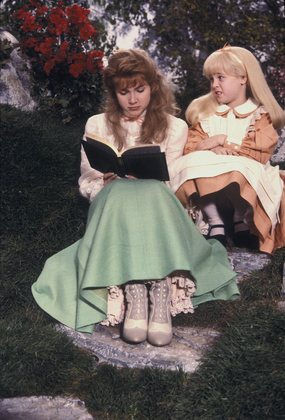
I'm also, in hindsight, disappointed with the Disney animated adaptation, and wish they had been a little more faithful to the book.  The made-for-TV musical, made in 1985 and starring Natalie Gregory (shown on the right) as Alice, is a much better adaptation, with the added bonus of co-starring every famous person from the 1980's (except Michael Jackson).  There's also a second part, which is Through the Looking Glass, the sequel to Alice.  If you can find a copy (try Amazon, I think that's where my sister got hers), give yourself a treat and watch it.

I loved Alice.  It was just what I needed right now, in the middle of this really dreary New England weather -- a short, fun book I could snap up and read really quickly, and enjoy 100%.

Rating: *****

Friday, December 31, 2010

Review: Mansfield Park by Jane Austen

Having a Kindle can be, at first, intoxicating.  What books to download first?  What to read?  There are so many good ones, and so many that are FREE!  Yet, for some reason, my mind went immediately to one that I had picked up twelve years prior, and then put down with disinterest.  I wanted to give it another shot.  I really did.

And wow.  Am I glad now, that I took it up again!

Jane Austen.  Like millions of people before me, I think I might very well be in love with her.  I'm completely enamored of her writing style, and this book has skyrocketed right to the top of my list of favorite books ever.

I saw the 1999 film "Mansfield Park" when it was in theatres, and I fell in love with the heroine, Fanny Price, and her snobbish but (generally) well-meaning relatives, the Bertrams, especially her gallant and humble cousin Edmund.  The film Fanny Price is very diffferent from the literary heroine of the same name; however, she is no less endearing.  Movie-Fanny (played by Frances O'Connor) is fiesty, plucky, and adventurous, where Book-Fanny is quiet, demure, and delicate.  Both "incarnations" of Fanny Price are eminently relateable, though entirely different in nature.

The world of Mansfield Park, a manor in Northamptonshire, England, at the turn of the 19th century, is beautiful and constantly proper, yet possess an undercurrent of turmoil and tempestuousness.  The primary characters -- Fanny, her cousins Edmund, Tom, Maria, and Julia, and their charming and tempting neighbors, brother and sister pair Mary and Henry Crawford -- attempt to walk the delicate line between what is proper in society, and what matters most in the depths of their hearts.  Without spoiling the ending for those of you who are yet to read it (and if you haven't read it, you should), some characters fail in this task, and some succeed.  It's a beautiful story, at its heart, a love story, absolutely timeless.

I only wish (as I said before) that I had discovered Lady Jane so much earlier, like when I was a misguided young woman with a torrid love life, instead of now that I am married very comfortably to a very steadfast and dependable man.  But no matter.  I will spend the majority of 2011 making up for lost time.