Showing posts with label Non-Fiction. Show all posts

Thursday, December 22, 2011

Review: The Princes In the Tower by Alison Weir

The penultimate book!  With only nine days left to read my last book (which as yet remains unselected), I come to you with what will most likely be my final historical non-fiction book of the year, and book #99: Alison Weir's The Princes In the Tower.

Reading like a historical thesis, Alison Weir tells the dramatic and tragic story of the child-King Edward V, who ought to have ascended the throne upon the death of his father, and his younger brother, Richard, Duke of York.  Only 12 and 10 years old, respectively, when their father died in 1483, the boys were apprehended by their uncle, Richard, Duke of Gloucester, who had the boys removed to the infamous Tower of London for their supposed protection, only to embark on a smear campaign to disinherit them as illegitimate.  His campaign successful, Richard of Gloucester was crowned King Richard III of England, and the "Princes in the Tower" were never seen nor heard from again.  Taking the traditional myth of their end as fact, Weir illustrates the story in the hopes of solving the mystery for once and for all: who was the murderer of the Princes in the Tower?

In the centuries since the death of Richard III and the meteoric rise of the Tudor dynasty that followed, the tide of public opinion has turned back in favor of Richard III not murdering the Princes, as is commonly suggested.  Weir opens up the book to debate, taking each and every individual who may have benefited from the deaths of the Princes -- including Richard's successor, Henry Tudor (later King Henry VII).  Weir takes all of the evidence that she can unearth with thorough research, and tries to remain objective while pointing out whom she feels to be the Princes' obvious murderer.

Some critics on Goodreads say that Princes reads more like a textbook; in truth I'd say it reads more like a graduate thesis, a good one.  Being someone who always wondered who did kill the unfortunate Princes, Weir's book is interesting, and very thorough, and as an added bonus, it's way more interesting than Paul Murray Kendall's Richard the Third, which I read at the beginning of the year.  I loved it.

So now comes the big question...what is number 100 going to be?  I started The Bronze Horseman, but 832 pages in nine days (during the holidays) seems like suicide.  So I'll have to find something shorter.  Making it count!  I'm almost there!

Rating: ****

Friday, December 16, 2011

Review: Mastering Color Knitting by Melissa Leapman

Every knitter has a knitting book library.  Since I'm still relatively new to extensive knitting (I knitted a million garter stitch scarves before finally branching out into new stuff), my library is still relatively small.  But I received the gift of another new knitting book last Saturday (thanks Drea!) and I just read it and want to review it today.  Book 97 for the year 2011 is Mastering Color Knitting by Melissa Leapman.

Color knitting -- Fair Isle, intarsia, or double-knitting, can be a daunting prospect.  In her book, Leapman breaks down the fundamentals of each of these techniques, making them slightly more approachable and somewhat less scary.  Fair Isle, the kind of knitting you think of when you picture fancy Scandinavian sweaters, is the art of color knitting in patterns over many rows, carrying the unused colors on the other side of the knitting in floatsIntarsia, or "picture-knitting", is just what it sounds like -- knitting pictures into your knitting without carrying the unused yarn.  Double-knitting is a technique where the knitter works both sides of the knitting at the same time, but in contrasting colors and patterns.  All of these are more intermediate skills, but Leapman breaks them down so as to make the knitter more comfortable.

There are loads of pictures and charts, most of them colored, and even a handy graph in the back that Leapman encourages the reader to photocopy and use in designing his or her own color knitting.  The book boasts 12 original patterns ranging from easy -- a throw pillow, a hat -- to challenging -- a full fair isle sweater with steeking.

I really enjoyed reading this book, and it's definitely pushing my itch to try some color knitting of my own.  Perhaps the Selbu hat pattern that I mentioned before?  Gotta wait until after Christmas when my knitting is done!

Rating: ****

Monday, November 28, 2011

Three book reviews (because I really can't be bothered right now)

I'm telling you, I'm super sick of these book reviews (this is mainly because I've been knitting more and I could really not care less about the reviews now).  I remember all the way back in January, when I got so excited and really put thought into my reviews...and now it's December, I've read 89 books (11 from my goal!) and I just Do Not Care anymore.  I am so far behind in my book reviews now that I'm going to be doing THREE in one entry today...and that's okay.  Because I make the rules on this blog.

Review: Henry's Blog by Elizabeth Newbery (#87)
 My little sister just came back from a week-long, whirlwind tour of London, England, and brought me back this gem -- Henry's Blog: My Life in My Own Words, OBVS! by Elizabeth Newbery, found in the Tower of London gift shop.  It was meant as a gag gift, and I read it in one night.  Henry's Blog is an extremely short book, written in cyber-speak and blog form, through the eyes of King Henry VIII.  I still can't decide how I feel about it.  The humorist side of me thinks that it's hilarious (and so does everyone else who has read this, including my father) -- the idea of Henry giving his wives cyber-like nicknames (KatyA for Katharine of Aragon, AnnieB for Anne Boleyn and so forth) and talking himself up constantly.  The history major side of me weeps with the idea that kids will read this (it is obviously written for a young adult or teenager).  I went back and forth wondering if I should even count this is one of my books for the year.  But then something HUGE happened.  David read it.  Read a book.  All the way through.  And ENJOYED IT.  Clearly, that cemented it.  I have to give Henry's Blog a good solid three-star rating, simply for the hilarity factor, and readability (did I mention that my husband read it?  A real book?  Go figure!)
Rating: ***

Review: Knitting Rules! by Stephanie Pearl McPhee (#88)
This is my second Stephanie Pearl McPhee (otherwise known as the Yarn Harlot) book of the year -- I read The Secret Life of a Knitter back in January -- and I have to say, I enjoyed Knitting Rules! much more than Secret Life.  The Yarn Harlot is known as a "knitting humorist", but Knitting Rules! is equal parts funny and useful.  I've read it before, and I look at the big as one big pep talk for the anxious knitter, the one who is afraid to try new things, to pick up a skein of yarn and some needles and just go for it.  The Yarn Harlot's handy rudimentary sock pattern is also included with step-by-step (no pun intended) instructions -- a great tool for those knitters who are learning to knit socks for the first time.  I can't tell you how many times I've gone back over the pages when I've needed a little encouragement.  I recommend it to anyone who is interested in learning how to knit, or who could use a little boost every now and then, a reminder that "in the end, it's just knitting."

Rating: ****

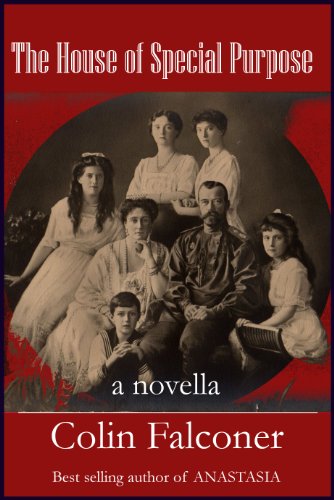
Review: The House of Special Purpose by Colin Falconer
Every so often (usually when I'm broke) I find myself perusing the "free Kindle books" link on Amazon.com.  The other day, this book caught my eye, because as a child I was obsessed with anything and everything to do with the Russian Revolution and the fate of the Romanov family.  "The House of Special Purpose" was the name given to the Ipatiev house in Ekatrinburg where the Romanovs spent their final days before they were executed.  Falconer wrote The House of Special Purpose as a prequel of sorts to his book Anastacia, a sort of "what if" about the fictional destiny of the most famous of the Romanov children, Anastasia Nicholievna.  It's tagline is "How was it possible for any of the children to have survived?  You won't believe the answer; except it's all true."

I don't know what I was hoping for, but this book was not it.  It was a chronicle of the last days of the Romanov family as seen through the eyes of Anastasia and some of the guards employed to imprison the family.  Falconer takes every negative story about Anastasia and makes her about the least sympathetic character in literature -- even her fiestiness seems petulant, cruel, and childish.  There are some vaguely pornographic descriptions and a scene of female rape (without historical accuracy' the author conjured it up himself, which just lead me to be disgusted and disturbed). The novella also suffers from supreme historical inaccuracy.  The cook, Kharitonov, is described as female, yet his real name was Ivan Kharitonov, and he was decidedly male.  Also, *SPOILER ALERT* the elephant in the room was the fact that in 2007 it was proved that none of the Romanov children survived the execution -- the remains of the missing two were discovered at last.  I wouldn't have been surprised with a novella such as this before 2007, but it was published in September of 2011.  

My final "beef" (if you could call it that) with this book was the tired theme, the implausible escape of Anastasia (or another Romanov child).  It's been done before.  It was done by the mysterious Anna Anderson and countless others in the 20th century.  There was a movie made with Ingrid Bergman and the Don Bluth animated film (which I must confess is one of my favorites, even though it's nonsense).  With great writing, it might have been pulled off, but the story has been done.  Time to move on to something else. 

Rating: *

Friday, November 4, 2011

Review: Marie Antoinette: The Journey by Antonia Fraser

Connecticut is still recovering from our freak snowstorm and widespread power failure.  I entertained myself by downloading a book on Kindle right before the storm.  I seem to have a penchant for reading about doomed female monarchs, and having read a great deal about the Tudors and England, I have moved on to the French Revolution.  Book #81 for the year was Marie Antoinette: The Journey by Antonia Fraser.

Born an Austrian archduchess and married at 14 to the future King of France, Maria Antonia Josepha Johanna, better known as Marie Antoinette, is an elusive character to understand.  Like Anne Boleyn, another doomed queen, she takes on many forms.  On one hand, she's the she-devil who corrupted a nation, spent millions of dollars on frivolity, kept countless lovers while cuckolding her husband the King, and deserved the inglorious end she received.  On the other, she's the tragic martyr of Versailles, a doting wife and loving mother who was falsely accused of a storm of accusations, betrayed by the nation she loved and whose interests she worked tirelessly for.  It is difficult to remember that the woman who mounted the scaffold at thirty-eight years old began her life as an indulged little daughter of one of Europe's most celebrated monarchs, a young girl desperate to please all around her.  Antonia Fraser takes this much-disputed figure and shows the journey from archduchess to queen to mother...to legend.

Like Alison Weir, Antonia Fraser has the gift of taking historical nonfiction and writing it like a novel.  This book, long as it was (500 pages) was an incredibly fast read.  Having seen the Sofia Coppola film that it was loosely based upon, I expected pages upon pages of indulgence, frivolity, and saccharine sweetness.  The film does Fraser's book no credit.  Antoinette's spendthrift days are over long before the book is halfway complete -- truly, Fraser spends the majority of her writing discussing and dissecting the long and terrible years of imprisonment and terror that Antoinette and her family spent after the liberation of the Bastille and the fall of the monarchy.  A great deal of time is spent in trying to explain exactly why the French people so hated Marie Antoinette, that she became the scapegoat and the symbol of all that was wrong with the monarchy.

Growing up, most of us are introduced to Marie Antoinette as the frivolous queen who wasted the country's money like crazy and was too stupid to realize she was spending her way into her own grave.  And Sofia Coppola and Kirsten Dunst would surely point us in that direction.  But Fraser's book offers a closer look into the life of the real Antoinette, her lifestyle, her motives, her viewpoints, and why, as Fraser believes, her tragic end was a foregone conclusion from the moment of her birth.

Rating: **** and 1/2

Tuesday, October 18, 2011

Review: Columbine by David Cullen

Almost anyone who was in high school in the late 1990s - early 2000s remembers April 20, 1999, or more simply "Columbine" -- the day that the word ceased to be the name of a high school, and became the name of the most deadly school shooting to date.  On that day, two teenagers entered their high school, armed with automatic guns and homemade pipe bombs, and slaughtered classmates and teachers indiscriminately, before turning the guns on themselves and committing suicide.  Shock waves resonated across the United States, leaving everyone wondering "Could it have been prevented?  Why would two teenage boys commit such an atrocity?  What caused them to do so?  Can we keep 'Columbine' from happening again?"

Columbine is the result of a decade's worth of gathering information by the author, David Cullen, in an attempt to quash the plethora of rumors surrounding this terrible tragedy and set the record straight.  In the months surrounding the attack, all sorts of stories -- especially about the motives of the killers, Eric Harris and Dylan Klebold -- rampaged through the media.  Everything from bullying to Marilyn Manson to the highly-violent computer game Doom was blamed.  But Cullen paints quite a different, equally-mystifying picture of the two antagonists, and why they did what they did.  He takes evidence from both of their respective journals and homemade videos known as the "Basement Tapes", plus forensic evidence taken by the FBI, to show the boys in their true lights: Harris, the dangerous, violent psychopath, driven by his lust for killing and his insatiable desire to mastermind the ultimate massacre, and Dylan, the manic-depressant, whose obsession with finding his true place in the world and equally-futile search for love spiraled him downward into suicidal thoughts.

Besides doing an extensive study into the lives and motives of the two killers, Cullen also interviewed the survivors and the families of the victims, illustrating their struggle to put their lives back together and move on after the tragedy.  It is equally touching and heartbreaking to see the different ways in which the victims' families attempted to move on: from the father who turned his grief into an anger-based crusade to rid the world of guns and abortion, to the parents of questionable martyr Cassie Bernall, who wrote a book about their daughter's life and death as a means of keeping her legacy alive, to the principal who channeled his PTSD into helping a generation of students take back Columbine High School.  All are stories of struggles and triumphs, and all are depicted beautifully, tragically in this book.

In the end, Columbine is as victorious as it is tragic -- the story of a generation of people in a small town learning to rise from the ashes of the most vicious school shooting of the 20th century.

Rating: ****

Sunday, September 25, 2011

Review: Edge of Glory by Christine Brennan

Ah, figure skating.  My favorite sport ever.  When I was a teenager, I was pretty much glued to the television set during Nationals, Worlds, and especially the Olympics.  My favorite skater was Michelle Kwan and I wanted desperately for her to win the gold medal at the 1998 Nagano Olympic Games.  Well, we all know how that turned out.  Michelle skated the program of her life, but so did Tara Lipinski, a 15-year-old sprite who tore into the Olympics and made them her own.  Michelle was left to go home and pick up the pieces of what might have been.

In Edge of Glory: The Inside Story of the Quest for Figure Skating's Gold Medals, sportswriter Christine Brennan takes the reader through the 1997 - 1998 figure skating season for several of the sport's top athletes -- Elvis Stojko, Todd Eldredge, Alexai Urmanov, Michael Weiss, and of course, Tara and Michelle.  Starting at their home rinks, going through the selection of music and choreography, to the introspection (does a top male figure skater "need" the quadruple toe loop, or can he win the gold without it?), she goes through the year to Nationals and finally, to the Olympic Games, building up and following the champions to the biggest nights of their lives.

It's the sort of book that someone with a passing interest in figure skating wouldn't be interested in.  This book is more for the former skater or current skating aficionado, one who can tell a difference between the jumps and understand that a penchant for doing the most difficult technical stunts does not always a gold medal earn.  In some parts, it gets very technical -- the nitty gritty about jumps and why they are placed where they are in the program, etc.  But it is a very interesting and fast-paced book; I read this in a day.

My criticism comes in the writing.  Since it is written by a sportswriter, I expect the book to read like a series of newspaper articles.  And in parts, it does.  Where the skater or the skater's family granted Brennan an interview, it reads like a syrupy-sweet and introspective analysis, such as with Michelle Kwan, Alexai Urmanov, Michael Weiss (whom Brennan clearly has a thing for) and Todd Eldredge.  But when speaking about the skaters who declined an interview, Brennan unloads both barrels, and the writing takes a dive in quality, to be on par with trashy supermarket tabloids.  Unfortunate.

Those who are fans of Tara Lipinski will abhore this book.  "Team Tara" (Brennan's name for the tight-knit group of Tara's parents, coaches, and agent) was notorious for being picky about who talked to their little star.  Brennan was never granted an interview with the Lipinskis, but she more than makes up for it with hearsay obtained from Tara's former coaches, snarky "skating moms" at the rink where she used to skate, and interview fodder of Lipinski's mother shooting her mouth off again and again.  Those readers who would love a chance to snark on Lipinski as a "flash in the pan" would love this, but after nearly 14 years, I found it tedious.  In figure skating, as in all sports, there can only be one winner, and everyone else must learn to content themselves with lesser places.  Brennan's clear biases towards certain skaters taint the book somewhat, and that is really unfortunate.

Rating: ***


Wednesday, July 13, 2011

Review: Belles On Their Toes by Frank B. Gilbreth Jr. and Ernestine Gilbreth Carey

Ever have one of those days where you can't find anything to read?  My bookshelves are looking quite bare these days.  I've read most of my books, and right now I'm kind of on a hiatus from buying any (although I do troll Amazon.com each day in search of cheap or discounted ebooks).  But this one has been on my shelf as a throwback to when I was a little kid and my mom read it to me.  It's a quick read, and one I love because of the background.

My mother grew up in a very large family.  My grandparents had nine children, two boys and seven girls, and adopted another girl late in life.  My mother was number seven of the ten.  When we were growing up, my sister and I were fascinated by the stories she told about growing up in a big family with so many kids.  And my mom, who read to us a lot, read us the stories of the Gilbreth family -- a husband and wife engineering team who had a dozen children, six boys and six girls.  Two of the children went on to write a book series about their lives.  The first was called Cheaper By the Dozen (which is nothing like the Steve Martin knockoff film), and featured mainly stories from the early years, as each of the children were born, and life with both parents.

The sequel, Belles On Their Toes, begins in 1924, after "Dad", Frank Bunker Gilbreth, Sr., has passed away.  In order to keep the huge family together, their mother, Lillian Moller Gilbreth, an engineer in her own right, must work hard to keep her husband's business afloat.  Left alone with the eldest girl -- Anne, age 18 -- in charge, the children must work together, save their pennies, and do their best to make ends meet so that the family won't be divided.  Despite the tremendous odds stacked against her, Lillian is determined to fulfill her husband's dream of putting every single one of the dozen children through college.  She refuses to listen to the naysayers who tell her that a woman can't run a business, the family won't survive on its own, and she'll never manage to send them all to school.  Through a series of vignettes, the authors (daughter Ernestine and son Frank Jr.) tell the humorous stories of making ends meet and growing up in a riotous family, while honoring their mother and giving credit where it's so due.

The major character who is sorely missed in Belles is Frank Sr., who provided a lot of the comedy in Dozen.  But Belles is meant to honor Lillian, and really gives her a chance to shine, and her own personality to show through.  Where Frank ran the household like a factory (efficiency charts, regimentation, etc), Lillian (as a psychologist) struggled to treat her children as individuals, and insisted that they remain so.  It shows -- Belles highlights the children individually, with their own stories and memories, rather than referring to "the dozen."  There is much more stressing on the individuality, especially of the oldest and youngest children.  The ones in the middle, such as Frank Jr., Lillian, and Bill, don't seem to have a big part in the sequel -- unfortunate, since Bill was one of my favorite characters in Dozen.  

Still, it's a cute book, and funny (though I know a lot of reviewers complain that they have trouble relating, since the book is set almost 80 years ago).  And I still can't read it without thinking of my mom :)

Rating: *** and 1/2


Tuesday, June 21, 2011

Review: My Sergei: A Love Story by Ekaterina Gordeeva and E.M. Swift

In the 1980s and 1990s, the greatest names in pairs figure skating were Ekaterina Gordeeva and Sergei Grinkov, from Russia.  For nearly a decade, they dominated their sport, winning gold medals at the 1988 and 1994 Olympic Games, and turning professional to great accolades.  Gordeeva and Grinkov (or G and G, as they were playfully known) were the poster children for the "image" of the pairs skaters: the tiny, childlike female skater and the strong male partner a whole head taller than her.  They were skaters, they were best friends, they were lovers.  Their lives were a virtual fairy tale, until November 20, 1995.  On that day, while practicing a routine, Sergei suddenly collapsed on the ice and died of an undiagnosed heart condition.  He was 28 years old. 

A widow at age 24 with a two year old daughter, Ekaterina was left with the pieces of her shattered life, wondering how to move on and learn to live again without the partner she had had since the age of 11.  The result was this collaboration with E.M. Swift, My Sergei: A Love Story.

Ekaterina tells both her story and Sergei's, intermingling stories of their childhoods, of growing up in the Soviet Union, learning to skate and their pairing together.  The book truly is a "love story", living up to its subtitle -- Ekaterina brings the reader through their courtship, marriage, and foray into parenthood with their daughter, Daria.  Their brief but illustrious figure skating career is described throughout; the book would be incomplete without it.  

But Ekaterina's real purpose in this collaboration is the "celebration of a life" -- finding a way to move past the pain of Sergei's early, tragic death and find joy in the life left to her and her daughter.  She expresses her fear and grief at the prospect of living the rest of her life without him, yet by the end, she has learned to accept her future.  

As a figure skater, I read this book as a child, barely knowing who Gordeeva and Grinkov were.  This book has the distinction of being the first volume to ever make me cry -- and I must confess that I cried again in reading it now, for the first time in probably ten years.  It is a beautiful memoir, something that would touch even someone who has never laced up a pair of skates.

Rating: **** and 1/2

Sunday, May 1, 2011

Review: Into The Wild by Jon Krakauer

One week ago, I read Jon Krakauer's horrifying account of the 1996 Mt. Everest disaster, Into Thin Air.  At the time, I was stunned and eerily fascinated by the allure that these people found in climbing a mountain that proves fatal for one out of every 10 climbers.  Why would someone willingly endure something that, in the end, has a 10% chance of being fatal (even moreso if the individual is inexperienced and unprepared)?  

Four years before he climbed Mt. Everest, Krakauer became obsessed (as he puts it) with the story of Chris McCandless, a graduate of Emory College who left home abruptly after graduation, abandoned his car, burned all of his cash, and set out, as he put it "into the wild".  Two years later, his body was found, emaciated and frozen, in an abandoned bus along the Stampede Trail in Alaska.

In Into The Wild (title taken from one of McCandless' journal entries), Jon Krakauer acts, once again, as historian and forensic psychologist.  He follows McCandless' trail from Atlanta, GA, to the Yukon wilderness, tracking down and interviewing the people whom the boy met along the way.  The story is as tragic as it is fascinating.  Why would a twenty-four year old boy with his entire life ahead of him choose to give everything up to die in the wilderness?  Though it seems ridiculous to me (and probably to many), in his research, Krakauer shows that not only is this theology of life common, it's almost predictable in certain people -- including himself.

I didn't find myself as drawn to Into The Wild as I was with Into Thin Air, and I think this is mainly a formatting issue.  In Air, Krakauer went through the events surrounding the Everest disaster chronologically, whereas in Wild, he interspaces Chris' fatal travel to the Yukon territory with anecdotes from his friends and family, stories about other doomed hikers who battled the elements and lost, and a tale from Krakauer's own youth, when he himself attempted to go "into the wild."

At first I found it difficult to feel sorry for Chris, in the same way I did with the doomed Mt. Everest hikers in Air.  It was his own fault, I thought to myself.  He should have known better, should have been more careful -- maybe then he would still be alive today.  But by the end of the book, Krakauer had made me feel that I understood McCandless more, and to feel sorrow, not for his loss of life, but that the life he lost was cut off so young, before an old man can realize a young man's mistakes, before age brings wisdom and a little clarity to us all.

Rating: ****

Tuesday, April 26, 2011

Review: Into Thin Air by Jon Krakauer

Please Note: There will be spoilers here in this review.  I don't know if I can adequately review it without putting in some spoilers.  So.  If you haven't read this book yet, and plan to in the future (and I HIGHLY recommend you do!), then I would close your browser and skip this review for now.

In 1995, freelance writer and adventure-seeker Jon Krakauer was selected by Outsider magazine to travel to the slopes of Mt. Everest, the highest mountain in the world, and write a feature article about the "consumerization" of mountain climbing, along with its effect on the world's tallest mountain.  This mission would require Krakauer to leave his home and travel to "Base Camp", the lowest of the camps on Everest, and observe guides and their "clients", the wealthy men and women who were paying dearly ($26,000  per head) to be helped up to the summit.  Outsider magazine, sensing a story among the hype of the wealthy elite to climb Everest (even the ones who were grossly unsuited for it, except for the small detail that they had the cash to blow), asked Krakauer to report on it.

Krakauer, a mountaineer himself who had dreamed of Everest since childhood, asked if the magazine would pay for him to "take the story to the top", so to speak, and climb the mountain to the summit, following the paths of his guide, famous Everest mountaineer Rob Hall, and the other "clients" who would be summitting from all over the world.  Outsider accepted his proposal, and Krakauer set out with a team of climbers (guides, professional mountaineers, rookie mountaineers who were paying out the nose to be guided up Everest, and the Sherpas who were employed to help) to spend six months acclimatizing and summitting Mt. Everest, in early spring of 1996.  The "final summitting" happened on May 10th, 1996.

What happened in the twenty-four hours in which these men and women summitted Mt. Everest has become famous as one of the greatest tragedies to ever happen in mountain-climbing history.  A hurricane-force storm came upon them, and through a series of incidents that, taken separately, would have not been much cause for alarm, together caused an unspeakable tragedy that haunts some of them to this day.  Eight climbers died in a single day on the mountain, fifteen in all in the month of May, 1996.  Those who survived were left stunned and reeling, wondering how such a thing could have happened.

Into Thin Air is a large expansion on the article that Krakauer wrote (read it here; I did before I read the book), was largely published, as he explains, in an attempt to get some closure on what had happened.  Krakauer wrote his original article when he still did not have all the facts about what had happened to people he had considered teammates and friends, and he apologizes for the gaps and errors in the original article.  Attempting to set the record straight, he gives a blow-by-blow account of what happened in the weeks leading up to the disaster, and the great tragedy of May 10-11, 1996.  His feelings of guilt (however justified or misplaced is left up to the reader to decide) are difficult to read at times.  I could tell as I read that he was writing while still dealing with an incredible sense of futility and guilt regarding the accident, when as a "client" and not a guide, it was not technically his responsibility to be out saving lives.  However, Krakauer illustrates that he possesses a sense of morality and obligation to his fellow man that some other mountaineers (such as those who left climber David Sharp to die on Everest ten years later) seem to desperately lack.

I finished Into Thin Air with a sense of hopelessness that I had not expected.  Krakauer's original mission in writing the article for Outsider was to create commentary on the booming business of experienced guides charging wealthy clients (most of whom had almost zero experience and no business whatsoever climbing the highest mountains on earth) to literally drag them up to the summit.  Krakauer argues that the use of bottled oxygen (without which, only the most experienced climbers could manage to summit) creates a "security blanket" for those who are not experienced enough to go without it, and keeps them flocking to and paying guides to bring them up to the top.  Without experienced people to lead them, and without the use of bottled oxygen, Krakauer argues, those who have no business being on Everest would more than likely get discouraged and quit the climb far before they reached the so-called "death zone" (altitudes higher than 8,000 meters where it is impossible to sustain life for long periods of time).  But with the high marketability of Everest and its location between two of the poorer nations of the world, Krakauer reports sadly, it is unlikely that either of these rules will be implemented any time soon.  Until that time, any rookie climber (and indeed, some of the more experienced ones) will still remain in danger every time they attempt to conquer Everest.


I put this book on my poll on The Nest Book Club, asking which of five books I should read next, and it was the clear winner.  I would like to thank those fine ladies for recommending it to me, as well as my father for loaning me his copy with the assurance that "It is one of the best books that (he has) ever read."  It is an amazing, although horrifying at times, tome, really driving home the point that human failing and mortality is nothing versus the elements of this world.

Rating: *****

EDIT: After three days of being unable to get this book out of my head, I have changed my original rating of four-and-a-half stars to five stars.  This was not a decision lightly made (I'm not in the habit of giving out five-star reviews), but I think it is only fair to Krakauer and to his book that I give the rating I feel it more than deserves.  Phenomenal.

Sunday, April 10, 2011

Review: Eat, Pray, Love by Elizabeth Gilbert

I don't know how I managed to finish a book in between moving furniture into our new place, but I'm happy to say that we are finally "all moved in" and that the only (rather large) task left for us to do is unpack everything.  And find some living room furniture, but that's another story.  We have several wonderful friends who were willing to help us move in yesterday.  Exhausted today, I spent the majority of my Sunday resting, reading, and eating Asian food.  Perfect Sunday.  And somehow, I managed to finish book #27 for 2011 -- Elizabeth Gilbert's memoir Eat, Pray, Love.

When writer Elizabeth Gilbert finds herself sobbing on her bathroom floor in the middle of the night, overcome with the realization that she no longer wants to be married, she knows that she is missing something very fundamental in her life.  Upon concluding her very messy divorce, she takes a year-long trip around the world, spending three months each in Italy, India, and Indonesia -- the three I's, as she puts it -- to find God, seek enlightenment, and rediscover the joy in her life.

As a woman who has struggled with anxiety disorder and religious conviction for the past six years, I felt a kinship with Liz as she fought against her problems with opening up her consciousness and letting go of her guilt.  I found myself cheering for her as she learned to indulge herself again in Italy, to meditate and enlighten herself in India, and to flirt again in Bali.  Her whirlwind year of re-learning to express herself, and looking for God in all things, was really a treat to read.  I agree with a lot of reviewers on the Goodreads page, that the Italy chapter (the book is divided into three segments for the three countries she visits) is really the one that is the most forgettable -- India was my favorite part.  But still, good.  

My one complaint about the book is that the ending can read as a little trite and unbelievable.  I realize that it is Liz's life, and it did happen...it's just a little too predictable, you know?  (Or maybe you don't know, you'd have to read the whole thing to really relate).  Still, I enjoyed the book, and that's two memoirs in the past week finished.

Rating: ****

Wednesday, April 6, 2011

Review: Angela's Ashes by Frank McCourt

As I wrote previously, my goal for my "100 Books in 2011" was to reach 25 books by the end of March.  I'm a few days late, but only six!  Technically five, because I finished my 25th book yesterday evening while David was at class.  Twenty-five percent down, seventy-five percent to go!  (When you put it that way, it doesn't seem like I'm too far done!)  And here I'll sum up my 25th book for 2011: Angela's Ashes, by Frank McCourt.

"When I look back on my childhood I wonder how I managed to survive at all. It was, of course, a miserable childhood: the happy childhood is hardly worth your while. Worse than the ordinary miserable childhood is the miserable Irish childhood, and worse yet is the miserable Irish Catholic childhood."

Francis "Frank" McCourt is an odd case.  Born in New York City in 1930 to Irish immigrants (a father from Northern Ireland and a mother from Limerick), he moves with his family back to Ireland following the unfortunate death of his baby sister, Margaret.  The McCourts are a sad, pitiable family, comprised of Frank's alcoholic father, his emotionally-fragile mother (the titular Angela), and his younger brothers, Malachy (named for his father), Oliver, and Eugene.  After being spurned by his paternal grandparents in Northern Ireland and rebuffed by his maternal grandmother's family, the McCourts finally settle in Angela's hometown of Limerick, in the hopes that their new life in Ireland will bring better fortune.

Good fortune is hard to come by, unfortunately.  Malachy McCourt Sr., Frank's father, is in and out of work, and spends what little he makes at the pubs.  Angela McCourt can hardly scrape the family by on her husband's meager earnings "on the dole" (the Irish term for welfare) and is forced to resort to begging at times to keep her children fed.  She is also constantly pregnant -- the family is ever-expanding, which only adds to their financial woes.  Frank finds what little solace he has in his Catholic religion, which runs every aspect of his life, and in school, where he discovers he is incredibly intelligent.  His one, all-encompassing dream is to finish school, get a job that pays a little money, and save enough to move back to America, what he and everyone else considers his homeland.  But over the years, Frank discovers that Ireland is more in his blood and soul than he ever imagined it would be.

Angela's Ashes has a reputation for being depressing, and is it ever.  I gave up on the hope that the McCourts would eventually have some good luck about a third of the way into the book.  But the rawness, the reality, is so complete, I could picture Frank's life in rainy, cold Limerick as easily as if I had been there myself watching it.  Rarely have I ever been so transported by a book.  

Frank's interesting penchant for not using quotation marks took some getting used to, but by the second chapter, I was acclimated and on my way to eating the book up.  My one complaint was that the ending came too soon, and left too many unanswered questions.  Frank McCourt wrote two sequels to his Pulitzer-prizewinning novel, 'Tis and Teacher Man, that apparently continue the story (and maybe answer some of those questions), so I may pick those up in the future.  On a whole, one of my favorite memoirs, and I will definitely be reading this again.

Rating: ****

Wednesday, January 19, 2011

Review: Labor of Love: A Midwife's Memoir by Cara Muhlhahn

Little-known fact about yours truly: I pretty much grew up on the maternity ward of a hospital.  My mother has been a secretary at a hospital in CT that is known for its maternity ward for twenty-years -- she's been working there since I was seven.  My aunt works there as well, as did my late grandmother.  So it's safe to say that I've been exposed to the business of birthing babies since I was seven years old, or thereabout.  Surprisingly enough, it is a field where, thus far, I harbor no biases.  I don't argue with homebirth vs. hospital birth, or midwives vs. doctors, or breastfeeding vs. formula.  I'm not a mother yet, and though I've grown up hearing the strong opinions of the strongly-opinionated women that I'm related to, I have more or less made the decision to draw my own conclusions.

This is what lead me to Labor of Love: A Midwife's Memoir by Cara Muhlhahn.  Since David and I are not parents yet (but plan to be in the not-so-distant future), I thought that this free Kindle book might be a different take on the business of birthing, a 180-degree turnaround from what I grew up with.

...About halfway through the book, I was so turned off that it took all my willpower to finish reading it.  Why did I finish reading it?  Two reasons: the first, because if I gave up halfway it wouldn't count towards my 100 books for the year, and I refuse to be a quitter.  The second: because I wanted to be able to write the review you see here with the confidence of knowing I read the whole book.

Yes, it is a memoir.  It is intended to be about the author.  But Labor of Love is less a story about a midwife's trials and triumphs than it is a 256-page ode to the author herself.  I have never read anything so blatantly self-centered and self-congratulatory.  The first three chapters were dedicated to her formative years -- growing up with her parents, moving around the country -- always sprinkled with snippets about how different and special and fantastic she is.  I kept hoping that we'd eventually move into some birth stories, and away from the author's self-gratification.  But it only got worse.  Muhlhahn went on to talk about her training in the medical field and her years of striking out on her own as a midwife, continuously patting herself on the back as she went.  Midway through the  book, I was picturing Muhlhahn as Julia Roberts as depicted in Family Guy.


But (astoundingly) her arrogance wasn't what I considered the worst part about her book.  The worst part?  The blatant lies she tells about the statistics of birth.  Muhlhahn claims that when a woman conceives a child past the age of 40, the chance of the baby having Down syndrome is one in 1.

...Yeah, you read that right.  If  Muhlhahn's statistics were true, 100% of babies born to women over the age of 40 would have Down syndrome.  I guess my cousin Nicholas, born to my aunt Cathi when she was, you guessed it, 40, is a genetic miracle then.

She has a personal agenda towards anyone who doesn't think like she does: the hospital approach to birthing as a whole, women who used epidurals and pain medications, doctors who perform episiotomies and cesarean sections, family members who don't want her going through their refrigerators looking for something to eat, and the state of New York for not understanding why she is so damn important (she's saving lives, people!) that she needs special plates for her car so she can park anywhere she damn well pleases.

Can you tell I didn't like this book?  I don't, and judging by the reviews on Amazon.com and GoodReads, there are a fair number of people who agree with me.  Many of them recommended the book Baby Catcher: Chronicles of a Modern Midwife by Peggy Vincent as a palate-cleanser after Labor of Love, and I might just take them up on that suggestion.  I'm fairly certain that Muhlhahn's arrogant attitude doesn't speak for the entire field of modern midwifery.


Rating: *

Friday, January 14, 2011

Review: Yarn Harlot (the Secret Life of a Knitter) by Stephanie Pearl-McPhee

Yay for Friday!  I'm so glad that it's the weekend, and not just any weekend, but a three-day weekend!  It's Martin Luther King Jr. Day on Monday in the States, and my office has all government holidays off.  So I'm very much looking forward to three glorious days off.  Especially tomorrow.  David isn't working, we're not traveling out of state...this is a good thing.  I'm very excited to curl up in front of the TV tomorrow with my knitting.

And speaking of knitting...

Considering that the title of this blog is Read~Knit~Blog, it was only a matter of time before I read a knitting-oriented book (not a pattern book, I don't think those count) and reviewed it.  It was the first book I purchased for the Kindle (still happy in its little green case), and I finished it during the snow day we had on Wednesday, along with the other two books I was trying to finish all at the same time.

I discovered the Yarn Harlot (real name: Stephanie Pearl-McPhee) in early 2008.  My apartment  had been broken into (on Christmas Eve, no less) and I was feeling very violated and uncomfortable.  I met up with a dear friend of mine at Atlanta Bread Company in Manchester to do a little knitting.  It was then that she wrote down the words "Yarn Harlot" on a scrap piece of paper and told me to check out her blog.  And it was really all downhill from there.

I never knew that knitting could be a lifestyle.  I never knew that there really were people out there for whom knitting was that important.  Stephanie's blog was funny, endearing, and inspirational.  To a knitter (like me) who was still struggling with the fear of branching out past the garter stitch scarf...Stephanie was like a knitting goddess.  Not only did she knit pretty much everything, she wasn't scared to try new things.  She said "If you screw up, you pull it out and start over.  It's just knitting."  And the realization hit me, over time.  If I screwed something up, if I dropped a stitch, if I knit where I should have purled...oh well.  Nobody was going to die because of my mistakes.  Yeah, I'd be irritated, but if that's the worst than could happen?  Clearly it wasn't the end of the world.

This isn't the first of Stephanie's books that I've read.  I picked up Knitting Rules! last year and read it from cover to cover in about a day.  All of her books are quick reads, but Knitting Rules was more of a book about the philosophy of knitting itself.  Yarn Harlot: The Secret Life of a Knitter, Stephanie's first book, is written in the exact style of her blog entries: snippets of a life lived after falling headlong into knitting, and having no shame of it.  It's not a book so much as a collection of short stories, where Stephanie endearingly pokes fun at herself as she encounters one knitting escapade after another.

I doubt anyone who isn't a knitter would pick up Yarn Harlot, as it is primarily found in the knitting or craft section of bookstores and libraries.  But feel confident in saying that anyone who has a passion (re: obsession) for a craft or skill would understand where Stephanie is coming from when she writes.  I haven't met her on one of her many book tours (yet), but I would be honored to make her acquaintance.  She is not only a wonderful writer and a sometime comedienne, she is a huge philanthropist.  In December of 2004, in response to the tsunami disaster, Stephanie founded Tricoteuses Sans Frontieres (English: Knitters Without Borders), to raise money for the international foundation Doctors Without Borders -- medical staff that travel to places in extreme need of disaster relief.  In the six years and one month since their inception, the Knitters Without Borders have raised $1,062,217 in funding for MSF.

Good on you, Steph.  This wasn't my first Yarn Harlot book, and it won't be my last.

Rating: ****