Showing posts with label History. Show all posts

Wednesday, January 18, 2012

Back to life

After our whirlwind vacation, David and I have been settling back into "real life", and everything seems to be starting up again this week.  So much is going on in the next couple of months, but when you live life with two people balancing between three jobs, graduate school, one car, and two active social lives, it gets a little crazy!

I re-start graduate school tonight.  I have two semesters and one major thesis left until I complete my Master of Arts degree in History, and that starts tonight.  I'm nervous as hell (I haven't been in school since 2008), and things are going to get very busy for a while.  My husband works between 61 and 64 hours a week between two jobs, I work 35 hours a week at my job and classes will take up another five hours a week (classroom time; I have no idea what homework/writing time will take up).  We won't be seeing much of each other Wednesdays and Thursdays from now until May, but I keep telling myself that it will be worth it in the end.

I am wondering what this is going to do for my reading and knitting productivity.  :(  I'm taking three books out of the library today, and I was hoping to get through them quick enough, but considering the amount of books I had to purchase for my two classes (it was something like 12  books), I have a feeling that I'm going to be doing a lot more "work-reading" than "pleasure-reading." :(

Speaking of books...I realized after Christmas that I desperately need a new bookshelf.  My current bookshelf is full to overflowing.  My very generous family gifted me many books for Christmas -- some fiction, some history, some knitting technique books -- and I have no room for them.

Right now, I have two bookshelves.  A big one for my fiction and nonfiction, and another little one for my knitting technique books.  I have a $50 gift card that I got for my birthday in September from my parents, and right now I'm thinking the best use for it would be a new, big bookshelf, devoted either entirely to my fiction or my non-fiction history (I'm thinking the latter).

I often joke with my family and friends that the reason I have so many hardcopies of books (even though I have a Kindle) is that I'm "building a library" of my history books -- and it's true!  I have a pretty good start to a vast collection.  Every college teacher I've ever been fortunate to have has had a vast library of their own in their office -- I aspire to this one day.  So far, my "history library" includes the following (and I might have missed one or two):

British History:
The Six Wives of Henry VIII by Alison Weir
The Life of Elizabeth I by Alison Weir
Mary, Queen of Scots, and the Murder of Lord Darnley by Alison Weir
The Children of Henry VIII by Alison Weir
Eleanor of Aquitaine: By the Wrath of God, Queen of England by Alison Weir (title used in England, where I purchased it)
Henry VIII: The King and His Court by Alison Weir
The Princes in the Tower by Alison Weir
Katherine Swynford: The Story of John of Gaunt and His Scandalous Mistress by Alison Weir
Britain's Royal Families: A Complete Geneology by Alison Weir
Faith and Treason: The Story of the Gunpowder Plot by Antonia Fraser

Russian History:
Catherine the Great: Portrait of a Woman by Robert K. Massie
Nicholas and Alexandra by Robert K. Massie
King, Kaiser, Tsar by Catrine Clay

U.S. History:
The Devil In Massachusetts: A Modern Enquiry Into the Salem Witch Trials by Marion L. Starkey
Battle Cry of Freedom by James McPherson

Do you consider your book collection "your library" or "your legacy"?  

Thursday, December 29, 2011

Review: Nicholas and Alexandra by Robert K. Massie

Ready?  Because this is momentous.


I DID IT!

With this book, I've completed 100 books in 2011.  Robert K. Massie's Nicholas and Alexandra was THE final book.  I am done, and for about five minutes, I was exhausted.  And then I went to the library and picked out another book.  Review on this page, wrap-up in the next entry.

At the turn of the 20th century, Russia was one of the few remaining autocratic nations in the world.  Its vast dominions had been governed for 300 years by the Romanov family.  The current tsar, or Emperor, was Nicholas II, a young, handsome, quiet man who feared confrontation and lived to make people happy.  His bride was the German princess Alix of Hesse, who later changed her name to Alexandra Fedorovna.  Theirs was a love match, not an arranged marriage, and together they had five children -- four elder daughters, and one young son and heir to the throne, Alexei.  Unbeknown to her, Alexandra carried in her the mutant gene that plagued the ruling houses of Europe -- her son Alexei was born with hemophilia, at the time a dangerous blood disease that constantly threatened his life.  In time, the silence surrounding Alexei's affliction, coupled with the unrest in their society, lead Russia full-tilt into revolution, and the Romanov family into tragedy.
Massie's book reads more like a novel than a non-fiction history, in most parts.  His chapters about politics, war, and Lenin are rather dry; those are difficult to get through at times.  But his writing is never better than when he is describing the day-to-day life and relationships of the Romanovs.  Like Louis XVI and Marie Antoinette, the Romanovs are often lambasted in history as being antiquated, pretentious, spoiled and undisciplined, rulers who deserved the terrible ends that befell them because they did not heed the cries of their subjects, letting them starve instead.  But Massie illustrates the backgrounds that lead them to be this way, including the murder of Tsar Nicholas II's grandfather after he freed the serfs and instituted a Duma (parliament) and Nicholas' tutelage under Podobenostov, the student of autocracy.  You can't help but feel for the Romanovs during their plight.

Massie's "inspiration" (if you can call it that) for writing this book was the birth of his own son, who, like Alexei, was born with hemophilia.  His thesis in writing Nicholas and Alexandra was this: that although the country was already pre-inclined towards revolution and the death of the autocracy, the fate of the nation was sealed when Alexei was born with that small but critical gene mutation.  I won't explain his reasons for thinking so; you'll have to read the book yourself, I can't recommend it enough.  Anyone who is interested in Russian history or the lives of the Romanovs should read this book.  It is amazing.

Rating: *****
 

Tuesday, December 27, 2011

Christmas book haul

I'm not usually a huge fan of "haul" posts, but since this is a blog about reading and knitting, I thought I'd do a post on my Christmas book gifts, what I will be reading over the next few months.

(One of my relatives asked, "Why do you need so many books?  You have a Kindle, don't you?"  And it's true, but I love having hard copies, particularly of history books.  As I told my sister, as a History Master's Degree student, I'm building a library here!)

My Christmas book haul included:

Nicholas and Alexandra by Robert K. Massie.
This book was one of my favorites growing up.  My father had an interest in Russian history, particularly the fall of the Romanov dynasty, and I read his copy to tatters (sorry, Dad).  I'm so excited to have my own copy.

Loving Nicholas and Alexandra as I do, I was excited to hear that Massie's latest book on Catherine the Great was almost universally praised.  I can't wait to read it.

Alison Weir!  My goal to amass an entire collection of her books continues.  I've read her Six Wives of Henry VIII, but I've never read a book strictly on the life and reign of Henry himself.  I'm looking forward to this one.

Thus far, my only experience with Antonia Fraser involved her biography of Marie Antoinette, but this intrigued me.  Also, David and I were married on Guy Fawkes Day, November 5th, so the date and events pique my interest.

World Without End by Ken Follett
The Pillars of the Earth was quite possibly my favorite book that I read in 2011.  I am so excited to read the sequel!


In addition to the histories/historical fiction, I also received two knitting books:

The Knitter's Life List by Gwen Steege
This isn't a book that I had heard of before; my father read a review of it in the paper and thought it would be good for me.  I've only leafed through it thus far, but it's pretty amazing -- sort of a knitter's checklist of things to learn, places to go, people to meet.  

Knitting Vintage Socks: New Twists on Classic Patterns by Nancy Bush
This is one of those "inspiration" books of patterns that I'm scared to death to try.  But the pictures are so beautiful, and I'm going to force myself to knit some of these beauties!


So there are four days left until the new year.  Four days, and I have one book to read.  What did I pick?


Nicholas and Alexandra.  My mom thinks I'm crazy, but I've read it before, I love it, and as of this morning I am on...page 74 of 527.  No sweat.  I can do it!
 

Thursday, December 22, 2011

Review: The Princes In the Tower by Alison Weir

The penultimate book!  With only nine days left to read my last book (which as yet remains unselected), I come to you with what will most likely be my final historical non-fiction book of the year, and book #99: Alison Weir's The Princes In the Tower.

Reading like a historical thesis, Alison Weir tells the dramatic and tragic story of the child-King Edward V, who ought to have ascended the throne upon the death of his father, and his younger brother, Richard, Duke of York.  Only 12 and 10 years old, respectively, when their father died in 1483, the boys were apprehended by their uncle, Richard, Duke of Gloucester, who had the boys removed to the infamous Tower of London for their supposed protection, only to embark on a smear campaign to disinherit them as illegitimate.  His campaign successful, Richard of Gloucester was crowned King Richard III of England, and the "Princes in the Tower" were never seen nor heard from again.  Taking the traditional myth of their end as fact, Weir illustrates the story in the hopes of solving the mystery for once and for all: who was the murderer of the Princes in the Tower?

In the centuries since the death of Richard III and the meteoric rise of the Tudor dynasty that followed, the tide of public opinion has turned back in favor of Richard III not murdering the Princes, as is commonly suggested.  Weir opens up the book to debate, taking each and every individual who may have benefited from the deaths of the Princes -- including Richard's successor, Henry Tudor (later King Henry VII).  Weir takes all of the evidence that she can unearth with thorough research, and tries to remain objective while pointing out whom she feels to be the Princes' obvious murderer.

Some critics on Goodreads say that Princes reads more like a textbook; in truth I'd say it reads more like a graduate thesis, a good one.  Being someone who always wondered who did kill the unfortunate Princes, Weir's book is interesting, and very thorough, and as an added bonus, it's way more interesting than Paul Murray Kendall's Richard the Third, which I read at the beginning of the year.  I loved it.

So now comes the big question...what is number 100 going to be?  I started The Bronze Horseman, but 832 pages in nine days (during the holidays) seems like suicide.  So I'll have to find something shorter.  Making it count!  I'm almost there!

Rating: ****

Wednesday, December 14, 2011

Review: The Romanov Bride by Robert Alexander

While I won't take back my negative points on the review of Robert Alexander's The Kitchen Boy, I have to say, with this second of his books, he has absolutely, totally and completely redeemed himself in my eyes.  THIS book is everything I wanted in a historical fiction, and more.  Number #95 for the year (five left!  Five left in 17 days!  I have hope!) is The Romanov Bride.

Alexander tells the story of the beautiful Elizabeth Romanov, called "Ella" by her family and friends, a minor German princess who marries Sergei Romanov, the uncle of Tsar Nicholas II.  Born and raised by her mother to have a special care for the poor and ill, Ella is unable to shake her compassionate feelings, even managing to feel pity and love for her tyrranical husband as he rules her and the people of Moscow with an iron fist.  But when Sergei is assassinated by a revolutionary's bomb, Ella's life is transformed.  Juxtaposed with Ella's story is that of Pavel, a poor Russian worker whose revolutionary ideas are fueled by his hatred and grief over the senseless murder of his young wife on Bloody Sunday.  Pavel is determined to bring down the House of Romanov, no matter what the cost.  But his interaction will Ella will, unwillingly, change his life.

This book is splendid, exactly what I love about historical fiction.  There's a fascinating historical figure -- Ella -- and an original character invented by the author to cause a counterpoint -- Pavel.  I'm not usually a fan of multiple points of view in a novel, but the two characters are so strikingly different, and both really contribute so much to the tale.  Here we see the Russian Revolution from both sides -- the monarchist (Ella) and the communist (Pavel).

Ella is a lovely character -- there is nothing to hate about her, in fiction or in truth.  There is a reason why she was later canonized as a saint in the Russian-Orthodox Church, yet for all her saintliness and humility Alexander still manages to make her human.  Pavel is definitely relate-able -- his heartbreak, followed by rage and lust for revenge are all too well understood in this day and age.

This book is wonderful.  My only regret -- that one of the children that Ella and Sergei "adopts", Dmitri, is never fully explained.  This book contains many references to Grigori Rasputin and his part in the fall of the Russian Empire, and Dmitri was one of his murderers.  Alexander never fleshes out this little tidbit of information, which mystifies me, for I'm sure he discovered it during his thorough research.  Still, nonetheless, amazing work.

Rating: **** and 1/2


Monday, December 12, 2011

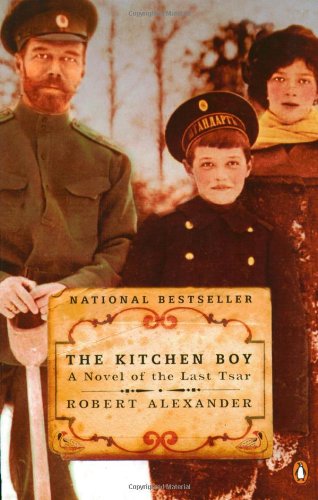
Review: The Kitchen Boy -- A Novel of the Last Tsar, by Robert Alexander

Book #92 is the third book of the year involving the Russian Revolution, and the second of pure fiction -- but the first that I really was getting into.  

The Kitchen Boy: A Novel of the Last Tsar, by Robert Alexander, is a historical fiction novel written in 2003, four years before the ultimate fate of the Romanov family was revealed.  An elderly Russian emigre named Mischa records the tale of his escape from Russia following the Revolution, when he was a young kitchen boy named Leonka, serving the deposed Tsar and his family during their last days at the Ipatiev House in Ekatrinburg.  As the youngest person in the little "family" made up of royals and their servants, Leonka comes and goes as he pleases, without raising suspicion amongst the Red Army guards or their leader, the cunning and heartless Yakov Yurovsky.  But when one of Leonka's missions goes awry and the guards take action, Leonka is left with an incredible sense of guilt -- and a secret that even eighty years later he can't bear to reveal.

SPOILER ALERT.

I really liked this book, until the last two chapters.  Mischa's story about his life in Ekatrinberg as the kitchen boy Leonka was riveting, and my favorite kind of historical fiction -- the kind that you know isn't true, but the kind where there's no evidence to prove it wrong.  There really was a kitchen boy to the family of Tsar Nicholas II in captivity, and his name was Leonka -- he was around the same age as the Tsar's son, Alexei, and he was the only one of the servants who was not taken to the basement and shot to death.  I thought that the story was absolutely riveting, as well as how neatly Alexander ties up the fates of the two missing bodies, those of Alexei and the Princess Marie Nicholaevna, the Tsar's third daughter.

And then came the final chapter, about Mischa's granddaughter Katia going to Russia after hearing his story, and discovering that Mischa's whole tale was a lie -- he was not the kitchen boy, Leonka, but a soldier in the Red Army who was in the basement that night, carrying out the execution.  Instead of watching the horror from outside the Ipatiev House, he was the soldier assigned the task of executing the Princess Marie.  Wracked with guilt following the brutal murders, he saw two bodies bounce out of the lorry traveling to the burial spot -- those of Alexei and Marie -- and realized that Marie was still alive.  Given one chance to redeem himself, Mischa saved Marie, took her to America, and made her his wife.

I hate to say it, because so many people loved it, but this ruined the book for me.  It's a wonderful story, but that's just the point -- it's a story, and was so far-fetched it didn't even seem plausible.  That a Red Army soldier at the time of the Revolution would risk his life to save a dying Romanov grand duchess is romantic and interesting, yes, but impossible to conceive, and impossible to imagine him getting away with it.  My disappointment primarily stems from the fact that I thought this was going to be a plausible historical fiction book, and went along with believing Mischa's story (as Leonka) the whole time.  I'm not a fan of the deus ex machina tool in writing, where the reader can't figure out the story by him/herself, and that's probably where my feelings of negativity come from.  Still it's well written, and I'll be picking up some more of Alexander's books.

Rating: ***

Thursday, December 8, 2011

Review: Alexandra, The Last Tsarina by Carolly Erickson

Confession here.  I don't  know if it's the winter, the going back to school in the spring, or what, but I'm definitely on a Russian history kick right now.  Don't seem to know how to stop, don't want to.  Even after the grim awfulness that was The House of Special Purpose, I still want more, more, more.  Book 91 of the year is Alexandra: The Last Tsarina by Carolly Erickson.

Much in the style of Antonia Fraser, author Erickson chronicles the life of the unfortunate Alix of Hesse and by Rhine, later the Tsarina-Empress Alexandra Feodorovna Romanov of Russia.  Alix is a minor German princess and the daughter of the formidable Queen Victoria of Great Britain, who defies her family's wishes and becomes engaged to Nicholas II, the gentle, quiet heir to the throne of Russia.  Nicholas believes he has many, many years to educate himself in the duties of being the Tsar-Emperor of Imperial Russia, when his father dies suddenly and he and Alix are thrown haphazardly into their roles of leading an immense empire.  Nicholas is inept and vacillating, Alix constantly ill and, after birthing four daughters, obsessed with the production of an heir.  When her son Alexei is finally born, Alix feels intense relief, until she discovers that Alexei is a hemophiliac, and it was her genes that passed it on to him.  Her obsession with Alexei's health drives her to search for help in the divine intercession of the starets Gregory Efimovich, known as Rasputin, and as the country races toward revolution, Alix grimly tries to hold on to her throne, her husband, her son, and her land.

It's unfortunate that I read this book after reading Nicholas and Alexandra by Robert Massie, in my opinion the greatest biography of the Romanov family ever written.  Erickson tries to paint a vivid portrait of Alix's life, but compared to Massie's, her writing comes up short.  She also fails to elicit sympathy for Alix, choosing to highlight her less-than-favorable characteristics, a good reason why she was so hated by the Russian people, and making much of her poor relationship with Nicholas' mother, the Dowager Empress Marie.  Reading about Alix's mocking caricatures of the members of the Russian court, it is difficult to feel sorry for her when she was maligned and reviled.  Instead of making Alix seem like the sad, somewhat fatalistic, yet very much in love woman that Massie portrays, Erickson draws her as emotional, depressive, an Eeyore of a queen that was highly insufferable.

Two stars because it was well-researched, clearly Erickson did her homework, but it wasn't enough to captivate my interest.

Rating: **

Friday, November 4, 2011

Review: Marie Antoinette: The Journey by Antonia Fraser

Connecticut is still recovering from our freak snowstorm and widespread power failure.  I entertained myself by downloading a book on Kindle right before the storm.  I seem to have a penchant for reading about doomed female monarchs, and having read a great deal about the Tudors and England, I have moved on to the French Revolution.  Book #81 for the year was Marie Antoinette: The Journey by Antonia Fraser.

Born an Austrian archduchess and married at 14 to the future King of France, Maria Antonia Josepha Johanna, better known as Marie Antoinette, is an elusive character to understand.  Like Anne Boleyn, another doomed queen, she takes on many forms.  On one hand, she's the she-devil who corrupted a nation, spent millions of dollars on frivolity, kept countless lovers while cuckolding her husband the King, and deserved the inglorious end she received.  On the other, she's the tragic martyr of Versailles, a doting wife and loving mother who was falsely accused of a storm of accusations, betrayed by the nation she loved and whose interests she worked tirelessly for.  It is difficult to remember that the woman who mounted the scaffold at thirty-eight years old began her life as an indulged little daughter of one of Europe's most celebrated monarchs, a young girl desperate to please all around her.  Antonia Fraser takes this much-disputed figure and shows the journey from archduchess to queen to mother...to legend.

Like Alison Weir, Antonia Fraser has the gift of taking historical nonfiction and writing it like a novel.  This book, long as it was (500 pages) was an incredibly fast read.  Having seen the Sofia Coppola film that it was loosely based upon, I expected pages upon pages of indulgence, frivolity, and saccharine sweetness.  The film does Fraser's book no credit.  Antoinette's spendthrift days are over long before the book is halfway complete -- truly, Fraser spends the majority of her writing discussing and dissecting the long and terrible years of imprisonment and terror that Antoinette and her family spent after the liberation of the Bastille and the fall of the monarchy.  A great deal of time is spent in trying to explain exactly why the French people so hated Marie Antoinette, that she became the scapegoat and the symbol of all that was wrong with the monarchy.

Growing up, most of us are introduced to Marie Antoinette as the frivolous queen who wasted the country's money like crazy and was too stupid to realize she was spending her way into her own grave.  And Sofia Coppola and Kirsten Dunst would surely point us in that direction.  But Fraser's book offers a closer look into the life of the real Antoinette, her lifestyle, her motives, her viewpoints, and why, as Fraser believes, her tragic end was a foregone conclusion from the moment of her birth.

Rating: **** and 1/2

Tuesday, October 18, 2011

Review: Columbine by David Cullen

Almost anyone who was in high school in the late 1990s - early 2000s remembers April 20, 1999, or more simply "Columbine" -- the day that the word ceased to be the name of a high school, and became the name of the most deadly school shooting to date.  On that day, two teenagers entered their high school, armed with automatic guns and homemade pipe bombs, and slaughtered classmates and teachers indiscriminately, before turning the guns on themselves and committing suicide.  Shock waves resonated across the United States, leaving everyone wondering "Could it have been prevented?  Why would two teenage boys commit such an atrocity?  What caused them to do so?  Can we keep 'Columbine' from happening again?"

Columbine is the result of a decade's worth of gathering information by the author, David Cullen, in an attempt to quash the plethora of rumors surrounding this terrible tragedy and set the record straight.  In the months surrounding the attack, all sorts of stories -- especially about the motives of the killers, Eric Harris and Dylan Klebold -- rampaged through the media.  Everything from bullying to Marilyn Manson to the highly-violent computer game Doom was blamed.  But Cullen paints quite a different, equally-mystifying picture of the two antagonists, and why they did what they did.  He takes evidence from both of their respective journals and homemade videos known as the "Basement Tapes", plus forensic evidence taken by the FBI, to show the boys in their true lights: Harris, the dangerous, violent psychopath, driven by his lust for killing and his insatiable desire to mastermind the ultimate massacre, and Dylan, the manic-depressant, whose obsession with finding his true place in the world and equally-futile search for love spiraled him downward into suicidal thoughts.

Besides doing an extensive study into the lives and motives of the two killers, Cullen also interviewed the survivors and the families of the victims, illustrating their struggle to put their lives back together and move on after the tragedy.  It is equally touching and heartbreaking to see the different ways in which the victims' families attempted to move on: from the father who turned his grief into an anger-based crusade to rid the world of guns and abortion, to the parents of questionable martyr Cassie Bernall, who wrote a book about their daughter's life and death as a means of keeping her legacy alive, to the principal who channeled his PTSD into helping a generation of students take back Columbine High School.  All are stories of struggles and triumphs, and all are depicted beautifully, tragically in this book.

In the end, Columbine is as victorious as it is tragic -- the story of a generation of people in a small town learning to rise from the ashes of the most vicious school shooting of the 20th century.

Rating: ****

Friday, September 16, 2011

Learning to sew!

It's Friday!  That wonderful day when work is furthest away, and the weekend stretches in front of you like it's never going to end (but of course it will).  I have big plans for this weekend, and they involve...learning to sew.

I've sewn a few things before...an apron when I was 9, a dress for my little sister Christina when I was 10, a baby quilt for a doll when I was 11.  But I've never actually learned how to sew.  This is about 80% my fault (for being impatient and not wanting to learn), and 20% the fault of my mother, an excellent sewer and quilter herself, who is also impatient and who generally finishes a sewing lesson with me by saying "Here, it's faster if I just do it for you."

But this time, I'm determined to learn (I really want to be able to sew my own dresses, instead of relying on the stores to produce adequate ones in my size for me), and I'm going to my parents' house today to make use of my mother's sewing machine and her wealth of knowledge.

(She has promised, this time, not to simply take over and sew it for me.  But we shall see how well she sticks to her promise :))

And what am I sewing?  McCall's Pattern #5094, shown at right.  The one I'm planning on making is going to be only slightly modified: I'm not planning on adding the contrasting ribbon., although who knows; I may change my mind.  With any luck, I'll have this dress made by September 29th, before David and I leave for his cousin's wedding in Massachusetts.  I told my mom I have no problem with coming over quite frequently in the next week or so, to work on it.  I just want it to be done in time. 

I picked out a really beautiful dusty pink fabric at the store, which I almost passed over, until I realized that it was patterned with Tudor roses.  Lovers of English history or historical fiction (or Philippa Gregory) will know immediately what I am talking about, but for those of you playing the home game, a Tudor rose was an emblem created by Henry Tudor  (Henry VII) after he won the Wars of the Roses between the English ruling houses of Lancaster (the red rose) and York (the white rose).  Taking both emblems as his, Henry VII created the "Tudor rose" -- a symbol of both families as rulers of England -- by putting the white rose inside the red. (See left)
 
Of course, because my fabric is a dusty pink color, the roses are done in pink and white, but I noticed just the same, and decided that, my love for English history being what it is, this was the fabric I had to choose.  

Real pictures of the progress forthcoming.  Hopefully I won't mess up too much and I will have a real dress to post pictures of within the next two weeks!

Happy Friday, and I hope you have a great weekend!  Enjoy the fall weather.  I know I will.

Friday, July 8, 2011

Review: The Children of Henry VIII by Alison Weir

My third Alison Weir book of the year!  With the 2011 Summer Book Challenge in full-swing, and waiting on some more books to come in, I jumped to one I have read before, to fulfill the "historical nonfiction" category.  And so here is the review for The Children of Henry VIII.

When King Henry VIII died in 1544, he left behind three talented, intelligent children to rule England, three children from three very different mothers and ways of life.  Mary, born to Henry's first wife, Katharine of Aragon: nervous, anxious, and piously Catholic.  Elizabeth, born to the infamous Anne Boleyn: beautiful, flirtatious, and cautious.  And Edward, the long-awaited legitimate son and heir: insensitive, brilliant, and a committed Protestant.  In the wings was Henry's intelligent and piously Protestant niece, the Lady Jane Grey, never desiring the crown yet having it thrust upon her to her own detriment. These four "children" (Mary veritably middle-aged, Elizabeth a teenager, and Edward and Jane only nine years old) were left to continue in their father's famous footsteps, but quickly discovered that differences of religion, combined with old rivalries never buried, would divide their paths and bring about tragedy.  
 
This book is the "sequel" to The Six Wives of Henry VIII (my review is the link), and continues through the next 14 years of the English monarchy.  Weir describes the juvenile reign of Edward VI, who ascended the throne at only 9 years of age and ruled for six years, turning England into a completely Protestant state and ruthlessly executing those who opposed him, even his relatives, and disinheriting his biological sisters in favor of his cousin, Jane Grey, who was a Protestant like he was.  Jane followed Edward, and won herself the title "the Nine-Days' Queen" in honor of her brief reign before Mary took control of England and took what she felt was her rightful place.  The next five years were devoted to Mary I's rule of England, the Counter-Reformation which turned England into a Catholic nation again, and won the soubriquet "Blood Mary" due to her fanatical burning of Protestants.

Weir's history is just as thorough as before, though unlike Six Wives, this reads more as a history book than as a novel.   I find the first half of the book, about Edward VI, less interesting than the other parts, although I am fascinated with the short and sad reign of Jane Grey and the sad and turbulent years of Mary I's rule.  The book ends with Elizabeth (her 45-year reign earned it's own sequel), which does inspire me to (finally) finish Weir's The Life of Elizabeth I...but I think it's time for a break, and to get to something more lighthearted and fictitious.

Rating: *** and 1/2

Thursday, June 23, 2011

Review: The Six Wives of Henry VIII by Alison Weir

Warning: Spoilers.

Alison Weir is my favorite British historian, bar none.  I have many of her biographies (most of them) and I have read two of her three historical fictions.  But of all her books, this one, The Six Wives of Henry VIII, is by far my favorite.

Due in part to writers like Philippa Gregory and the Showtime series The Tudors, there has been a definite resurgence of interest in Renaissance England andTudor dynasty.  But especially in King Henry VIII, the man who virtually created the English Reformation and who was notorious in his married life, the only King to have six wives.  But Weir does not merely focus on the life of Henry VIII -- something colorful and occupying in its own right -- but chooses to tell the story of the six women who were bound to him in holy matrimony throughout his turbulent reign.  Because of a dearth of knowledge about the latter four queens (and also their shortened reigns and little influence on English history), Weir chooses to write the first two thirds of her book about Henry's first two queens, leaving one chapter for the third lady, and cramming the last three into the third part.  

Part One, entitled "The Princess from Spain", is all about Katherine of Aragon, the first queen, a princess from Spain who came to England to marry Henry's elder brother Arthur, who died just weeks after their wedding.  After swearing that the marriage was never consummated, Katharine was then betrothed to Henry, who took her as his wife for fourteen years before annulling the marriage on the grounds that she could not provide him with a son.  This part of the book is probably the happiest, and where we see Henry at his best, before age and intransigence made him a vicious tyrant.  Weir dissects English history up to this point, describing the English court and political stage, as well as the marriage between Henry and Katherine, why it began so successfully, and what lead to its ultimate failure.

Part Two is titled "The King's Great Matter" and is all about Anne Boleyn, the lady-in-waiting who aspired to the throne of England and who promised Henry a son if he married her.  Weir explains the religious schisms happening in Europe at the time and why it was ultimately so easy for Henry to break with the Roman Catholic Church when they did not give him his annulment, and how Anne's constant assurances that Henry had absolute power lead them all to disaster.  By the end of Part Two, Henry is no longer an affable and friendly monarch, he is a tyrant who stops at nothing to have his will and destroy those who oppose him.  And of course, by its end, Anne is dead, as is Henry's third wife, Jane Seymour, whose short but memorable career as queen of England ended in death after the birth of Henry's son, the future Edward VI.

Part Three, "How Many Wives Will He Have?" focuses on Henry's last three marriages and the motivations behind each, as well as his attempts to fulfill his two very important needs: more sons for the assurance of the succession after his death, and his attempts to reclaim the youth he lost.  His marriage to his fourth wife, the German Anne of Cleves, was a dismal failure from the start (Henry is reported to have been displeased with her appearance) and was annulled after six months.  Henry's fifth marriage was to a mere English teenager, the 15-year-old Katherine Howard, whom he was reported to be deeply and passionately in love with (rather like Anne).  After Katherine's death, Henry married the widow Katherine Parr, who is his queen during his short but successful invasion of France and up until his last days.

Weir's biography explains Tudor England and Renaissance Europe during a time of incredible turmoil and change, through the lives of these six women who had the fortune (good or bad) to marry England's most notorious and irascible King.  Yet by the end, Weir almost has me feeling a modicum of sympathy even for King Henry, for surely the life she unfolded in her novel was not what he had anticipated.  The sequel, The Children of Henry VIII, is nearly as well-written and colorful, and picks up where Wives left off.  This book and others of Weir's are, IMO, a must for any Tudor fanatics, and much better than most historical fiction about the period.

Rating: *****

Wednesday, March 30, 2011

Review: The Last Full Measure by Jeff Shaara

I don't generally read books out of obligation any more (I stopped doing that in graduate school), but after finishing Gods and Generals, I felt somewhat of an obligation to complete the so called "Civil War Trilogy" and give The Last Full Measure a shot.

*sigh*  Where to begin.

In The Last Full Measure, Jeff Shaara once again faces his old nemesis of biting off more than he can chew.  He picks up where The Killer Angels left off, in July 1863, describing the Confederate retreat from Gettysburg and the inability of the Union army to capitalize on their victory.  Shaara attempts to sift through the confusion by focusing on three leaders this time -- Robert E. Lee, Ulysses S. Grant, and Joshua L. Chamberlain (who is really relegated to little more than a footnote in this final book).  But there is still just too much information.  The battle scenes are confusing -- without the incredibly dramatic chapter ends (Shaara explains where the battles are taking place by way of one general saying the name of the city/location i.e. "Appomatox" or "Cold Harbor" on several occasions), it's difficult to even discern where the battles are taking place.

The wounding of the superior officers gets somewhat repetitive as well.  Although Shaara's research is correct, and many commanding officers suffered major, yet not quite fatal wounds towards the end of the Civil War, his description of "the punch" in the arm or the gut for every single wounded man is repetitive AT BEST.  I concede that Shaara has never experienced a bullet or Minie ball to the stomach or one of his extremities...but a variation in the description might have served him well.

Jeff Shaara, unfortunately, is not working to the same caliber as his father Michael.  The original book, The Killer Angels, was based off of extensive research by Michael Shaara into the personal memoirs and reports of the soldiers at the battle of Gettysburg, which were then turned into a novel.  Jeff Shaara takes an alternate approach, and just writes the history.  He is more interested in telling a compelling story than he is concerned about the accuracy of emotion.  And it is painfully obvious when he was conjuring up his own interpretation of a character's reactions -- it is at these moments that his writing is most heavy, wooden, or awkward.

I said in my review of Gods and Generals that it is unfair to compare the writing of the father to that of the son.  But by attaching his body of work to his father's, Jeff Shaara opens himself up to the criticism that unfortunately I must give -- he is not his father, and the "prequel and sequel" to The Killer Angels are better read on their own, and not in connection to the Pulitzer-prizewinning novel.

Rating: **

Thursday, March 24, 2011

Review: Gods and Generals by Jeff Shaara

Loving The Killer Angels as purely as I do, it is probably odd that I have never (until now) seriously ventured into the rest of the so-called "Civil War Trilogy".  Truthfully, I had misgivings when I found out that Jeff Shaara had taken it upon himself to add a prequel and a sequel to his father's work.  I'm not a fan of other authors building on original stories.  But my father gave me the Civil War Trilogy, and it's been sitting on my bookshelf for several years now, so I thought, why the hell not?

Gods and Generals, the first book in the Trilogy, differs from The Killer Angels in the scope of its timeline.  While Angels takes place over four days (June 30th - July 3rd, 1863), Gods begins with the unsettlement of John Brown's raid on Harper's Ferry in 1859, before the Civil War even began.  Like his father before him, Jeff Shaara focuses on the military leaders and their points-of-view of events leading up to the war, and the battles, when they begin.  He chooses to focus on Robert E. Lee, Thomas "Stonewall" Jackson, Winfield Scott Hancock, and the fledgling-soldier Joshua Lawrence Chamberlain, with a few chapters about other minor officers.

The domestic scenes, the interpersonal reactions, are where Jeff Shaara's writing shines.  I never found Michael Shaara's descriptions of battle sequences confusing, but I muddled my way through the battles of Bull Run, Second Manasses, and Antietam in a way I never did the Battle of Gettysburg.  The main issue, unfortunately, lies in the fact that Jeff Shaara has too much material to work with.  A better choice might have been to focus on one or two battles -- perhaps Fredericksburg and Chancellorsville, which he writes more clearly -- instead of trying to cram so many years into one novel.  True, four years does not seem like much, until you realize that 1859 to 1863 were four extremely turbulent years.  Jeff's handicap is that he simply has too much to write about.

That being said, the humane side that Jeff gives to some of the soldiers --  noteably, Stonewall Jackson and Joshua Chamberlain -- is well-written and appreciated by this reader.  I wasn't a fan of his portrayal of Robert E. Lee, mainly because I felt it was too far from what Michael Shaara had depicted.  

It comes down to this one fact -- one cannot compare the writing of the father to that of the son.  It is just too different, the scope of writing too large.  I will be reading Jeff Shaara's sequel, The Last Full Measure, but really only to finish off the trilogy.

Rating: ** and 1/2

Monday, March 21, 2011

Review: The Killer Angels by Michael Shaara

In the summer of 1994, when I was ten years old, closing in on 11, I went to a now-defunct used-bookstore in Old Saybrook, CT, with my mom and little sister.  My sister ran for the kids' books, my mom, to the romance novel section.  I shyly approached the cashier and asked her if she would help me find a certain book.  She didn't think they had it.  But she thumbed the shelves, and there, at the very bottom, close to the floor, collecting dust, was a paperback copy of The Killer Angels by Michael Shaara.  Probably selling for less than $5.

I had just seen the film "Gettysburg" in my fifth grade class the previous year, and something about that movie captured my attention.  Other kids in my class hated it; I loved it.  I wanted to get my hands on as much literature about the battle as I could.  And during the credits of the film, the words "Based on the Pulitzer-prizewinning novel "The Killer Angels" by Michael Shaara" flashed across the screen, and I knew I had to read the book.  The book that became my "gateway drug" to becoming a history freak.

I read it.  Then I read it again.  And again.  I wore out that copy.  My mother found me another in a used bookstore.  I wore out that copy.  Now, seventeen years after I picked up that old paperback book in a used-bookstore, I have worn my way through four copies of The Killer Angels.

Why am I telling you all this?  By way of explaining exactly why it is so difficult for me to write an unbiased review of it.  How do I critically evaluate the book that made me the history geek I am today?  I will give it my best shot, though.  Bear with me.

The Killer Angels is historical fiction -- I use this term loosely -- about the battle of Gettysburg, July 1 - 3, 1863, as seen from the points of view of the men who were there, the leaders of the battle.  Michael Shaara, the author, during his meticulous research, dug into the memoirs of such military greats as Robert E. Lee, James Longstreet, Joshua Lawrence Chamberlain, and John Buford (to name a few), to determine exactly what they were thinking at the time.  What were the emotions as these men directed their troops into battle?  What was Lee's motivation for Pickett's Charge?  How did they, as individuals, view the opposing army, or the nigh-impossible tasks they faced?  Shaara took their words, their writings, and wove them into his novel, to give the reader an insider's look at the battle.  Years after reading the book, when I was 14, my grandparents took my sister and I to Pennsylvania to tour the battlefield at Gettysburg.  Seeing the places I had imagined in my mind so many times was just astounding, and viewing the monuments to the many men who died there was a humbling and moving experience.

Shaara won the Pulitzer Prize for writing The Killer Angels in 1975.  After his death in 1988, his son, Jeff Shaara, wrote a prequel (Gods and Generals) and a sequel (The Last Full Measure) to his father's work.  I am currently embarking on Gods and Generals, which, thus far, I am disappointed in.  But to compare the son's work to the father's is unfair, I guess.  And I have to be honest: there is nothing that I can imagine taking the place of The Killer Angels in my mind.

If  you are going to read one historical novel about the Civil War, make it this one.

Rating: An admittedly biased *****

Thursday, February 24, 2011

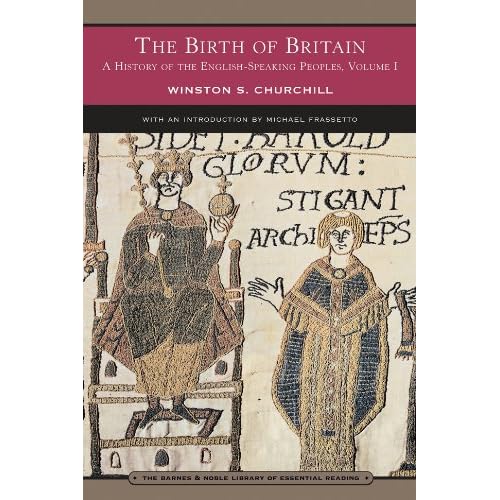
Review: HOTESP, Vol. 1, The Birth of Britain by Winston Churchill

I don't flatter myself that ANYONE is as interested in this review (or as happy to have it finally done) as I am, but I'm going to put it out there anyway, mainly because I feel it is only fair to those who have a crazy obsession with English history like I do.  This is one book (series of books?) that really should not be skipped, if you fall into that category of clinical psychosis.

Winston Churchill (the Winston Churchill you're thinking of, yes) began writing his four-volume A History of the English-Speaking Peoples in the  year 1937, just before England was thrown into World War II.  Delayed by the war and by other projects, Churchill did not get this epic published until 1956 -- nineteen years after it was begun.

Volume I, The Birth of Britain, covers the history of the English isle from 55 B.C. (the year Julius Caesar and the Roman army invaded England) to 1485, with the end of the Wars of the Roses at the Battle of Bosworth Field.  The hardcover copy I borrowed from my father weighed in at a hefty 500 pages.  This is not light reading.

And yet, at times, it seems it!  Churchill's famous prose is amazing.  I will admit (to my great embarrassment) that there were times when I had more fun reading quietly aloud to myself, in order to savor the prose, similar to the method in which some people insist on reading Shakespeare.  Also, considering how long the book is, Churchill is anything but long-winded.  Each great moment in history has its chapter, and doesn't drag out unduly.  Churchill makes his point, then moves on.  Would that all historical writers did the same!

It's a wonderful read, and should really be considered by anyone who is interested in some serious English history.  I plan on reading all three of the remaining volumes, but I'm going to give myself a little time to read something lighter and fluffier before I delve into Volume II.

Rating: *****

Wednesday, February 23, 2011

Yarn Along Wednesday!

My God, has it really been a week since I posted?  My apologies, guys.  I'll explain more after the obligatory yarn post!

It's Yarn Along time!  Every Wednesday, I (try, at least) to join in on the Yarn Along happening over at Ginny's blog, small things.  The objective is to take a picture of what you are currently reading and knitting, together, and then post it to your blog.  Then link your post to the Yarn Along, and everyone can see what everyone else is reading and knitting.


This is a picture of why the blog has been silent for a straight week.  There hasn't been much going on.  But I did finish one of the Noro socks that I was working on the last time we met.

The book is still the same too -- Churchill's History of the English-Speaking People, Vol. 1, The Birth of Britain.  BUT BUT BUT.  I AM ALMOST DONE (with Vol. 1, that is).  I am currently on page 392 of 500, and I am determined -- DETERMINED, I SAY -- to finish this book tonight.  I have barely any books completed for February, and this is part of the reason why.

I also confess that I jumped the gun and started a new book, on my Kindle, that I have had trouble putting down, so I have had to go on temporary hiatus from the Kindle in order to finish Churchill (which I am still loving, BTW).  More on that, when I finish Churchill.  With any luck, I will have a review for you tomorrow.  If you are still reading me, that is!

The other reason my blog has been temporarily silent is that I have been busy on my OTHER blog, which is my "married" blog about David and I planning our move (five weeks from Friday!) and our plans to renovate said apartment into a real home.  We signed and mailed the lease this morning (!) so plans are underway!  If you would like to follow up with me in my "real life" blog, Between the Bay State and the Big Apple, feel free!

More tomorrow, I promise!

Wednesday, February 16, 2011

Yarn Along Wednesday!

It's Yarn Along time!  Every Wednesday, I (try, at least) to join in on the Yarn Along happening over at Ginny's blog, small things.  The objective is to take a picture of what you are currently reading and knitting, together, and then post it to your blog.  Then link your post to the Yarn Along, and everyone can see what everyone else is reading and knitting.


I'm working on a plain, standard sock, of Noro Silk Garden Sock yarn, which is by far my favorite sock yarn. This is my second pair of socks made with Noro, and I love how they knit up really thick and bulky -- the way I feel a knitted winter sock should feel!  It knits up thick and thin, in some places more like a sport weight than a sock weight, but I love it.  I'm knitting on US 2's.  This is the first of two socks, and it's taking me awhile to finish them because it is a standard sock pattern and can get a little boring at times.

The book is my "white whale", A History of the English-Speaking Peoples, Volume I, "The Birth of Britain" by Winston Churchill.  I'm over halfway through, reading about the reign of King Edward I (the guy who was the king of England in the movie "Braveheart", which sort of (well, more like completely) bastardized his reign.  It's very good so far.  I'm hoping to be done with Volume I by this weekend.

Happy knitting and reading!

Tuesday, February 15, 2011

"The Whiiiiiiiite Whale!"

I've heard people speak of books reverently as their "White Whale" (to quote Melville's Moby-Dick) or "Mount Everest."  When I thought about it, I really couldn't come up with a book that was my own personal goal.  I try not to think of books as challenges.  I mean, it seems pretty commonsense, here -- you don't like a book, you put it down and stop reading it.  Outside of school, reading shouldn't be forced, it should be enjoyable, right?

Until last night.  Having finished my latest Alison Weir, I rifled through my bookshelf, in search of something new, and found the dusty hardback book my father loaned me over a year ago.

And I have found my Everest.


A History of the English-Speaking Peoples, by Winston Churchill (yes, the Winston Churchill)
I can't put it down, guys.  It's a history book, yes -- a work of nonfiction, probably "dull as tombs" (to quote Louisa May Alcott) to most people.  But it is a work of beauty.  Churchill's prose is phenomenal, as rich as his formal speeches were (and do not even try to tell me that he didn't write those -- unless you want to tell me he hired a ghostwriter to do this, too, and then maybe we'll talk.

The work is long -- four volumes, with three "books" each.  I'm currently working on Volume I "The Birth of Britain", and I'm in Book Two, "The Making of the Nation", Chapter Three, "Coeur de Lion" (about Richard the Lionheart).  Book One, about the Roman invasion of Britain and the Celts and Boadicea, was an odyssey, and one I'm glad to be done with.  I figure this series is going to take me the better part of 2011 to finish -- but I'm glad to be getting through it, and I'll be richer for the experience!

What's your "White Whale" or "Mount Everest"?

Sunday, February 13, 2011

Review: Mistress of the Monarchy: The Life of Katharine Swynford...by Alison Weir

Everyone and their mother is reading (and writing) about the Renaissance these days, thanks to the popularity of books like The Other Boleyn Girl and TV shows like The Tudors (yum).  I myself have read many, many books about the period of English history beginning with the Wars of the Roses and ending with Queen Elizabeth I.  And having done so, I'm looking to branch out a bit.  My first historical foray into the history of medieval England is Alison Weir's Mistress of the Monarchy: The Life of Katherine Swynford, Duchess of Lancaster.

Katharine Swynford, as author Alison Weir puts it several times, is quite the anomaly.  Married very young to a knight of humble origins, she was employed by the King's son, John of Gaunt, Duke of Lancaster, as a governess to his daughters.  Upon the death of his beloved wife, Blanche of Lancaster, John embarked on a torrid and scandalous affair with Governess Katherine, an affair that lasted over thirty years and produced four children!  But most shocking of all, the governess who became a mistress later, upon the death of John of Gaunt's second wife, was taken by John in marriage!  This was practically unheard of in a time when men "of a certain standing" never married their mistresses, but bedded them and then provided for any bastards born to them.

But John of Gaunt's bastards did not live in peaceful obscurity.  Two of them went on to marry and produce children who would become the ancestors of such royal figures as Richard III, Henry Tudor (later Henry VII), Henry VIII, and Queen Elizabeth I herself.  Were it not for John of Gaunt's passionate love for Mistress Katherine, the royal house of England today would not exist.

Weir tries to do justice to Katharine, but unfortunately, there are not nearly enough records to paint a clear portrait of her life.  Instead, Weir fleshes out her story with a history of medieval England -- the rule of the incompetent and tyrannical Richard II, the usurption of Henry of Derby (later Henry IV), and the slow but sure change to the Renaissance period.  It is a fantastic story, but Weir might have done better to write a biography of John of Gaunt, or even just a history of that exciting and turbulent period in history, rather than to simply focus on England's most prolific mistress.

Rating: ***