Monday, February 28, 2011

Review: The Man Who Would Be King by Rudyard Kipling

I spent so much time in February reading historical non-fiction, I didn't even notice we were getting to the end of the (already short) month.  Fortunately, I finished up Churchill and Alison Weir, so I was able to pick up a few fun, short pieces, and I've picked up the slack in February.  I'm not going to meet my goal of 10 books for the month, but I managed six, and two of those were extremely long, so I don't feel bad.  Unless I finish my current read tonight (unlikely, considering I'm going to be at work until 5:30 PM), my count at the end of February will be 18 books of 100.  Not shabby. 

Today I'll review a book that I've planned on reading many times, but just picked up recently free for Kindle: The Man Who Would Be King by Rudyard Kipling.

We visited my in-laws in Massachusetts this weekend, and I started (and finished) this book en route back to CT.  It's a short book, and a quick read.  The story is told in the first person, by an unnamed narrator (presumably Kipling), who is an Englishman living and working in India.  One evening, he is visited by a former acquaintance, English soldier Peachey Taliaferro Carnahan, and his friend, Daniel Dravot, who confide to the narrator that "India has become too small" for them, and that they plan on traveling to the most remote corners of the land, to the uncharted territory of Kafiristan, and once there, declare themselves kings of the native people.  One year later, a bedraggled, broken Carnahan returns to the astounded narrator, and rambling, tells the tale of what happened to "Peachey" and "Danny" and their enterprises in Kafiristan.

This book was made into a film in 1975, starring Michael Caine as Peachy Carnahan, Sean Connery as Daniel Dravot, and Christopher Plummer as Rudyard Kipling, the narrator.  As with Brokeback Mountain, a story of surprisingly brevity was lengthened into a two-hour-plus film -- but it's a great film, and one I definitely wouldn't mind reviewing for Film Friday, if I can get my hands on it.  Although it deviates from the book, the changes aren't noticeable, and are merely "fleshing-out" of the story, rather than abrupt changes.

I first read Kipling as a child when my sister received a copy of Just So Stories from my grandfather -- which I very much recommend, if you haven't read them.  Kipling is occasionally criticized for his use of imperialism and what is sometimes perceived as xenophobia or racism.  But to do this is the same as calling Samuel Clemens a racist for writing The Adventures of Huckleberry Finn, or Margaret Mitchell a white supremecist for Gone with the Wind.  Kipling is describing quite vividly the English empire in India and the line of public opinion during that era.

What I find remarkable about his writing in The Man Who Would Be King is that Kipling is able to take two men -- white men, chauvinists, convinced of their own superiority as Englishmen -- and yet make them tragic heroes, the instruments of their own demise.  One cannot help but feel pity for Danny and Peachey, as they walk into a trap of their own making, constructed by their own sense of righteousness and self-satisfaction.  Kipling may have lived in the thick of imperialist India, but it is quite obvious what his opinion of it was, and that he knew exactly what the consequences might be, in the end.

Rating: ****


Sunday, February 27, 2011

Review: Isabeau...by N. Gemini Sasson

My first book of my 100 for the year was The Traitor's Wife by Susan Higgenbottom, the story of Lady Eleanor Despenser, the wife of Hugh Despenser, the overly-ambitious favorite of King Edward II of England.  Higgenbottom was sympathetic to the plights of Eleanor and Hugh, whose ambition, though regrettable, was the only catalyst that lead to their fall from grace.  This piece of historical fiction is the same story...from the opposing point of view.

Isabelle (the titular "Isabeau" is a moniker given to her by her French family) is a child when she is given in marriage to King Edward II.  She soon learns, however, that Edward treats her with nothing more than vague contempt, using her merely as a breeder for their many children and instead lavishing attention on his favorite, Hugh Despsenser, whom Isabelle suspects is his lover.  When his abuse of his throne and of Isabelle go too far, she retreats to her homeland of France and joins forces with Sir Roger Mortimer, a former traitor to the English crown whom Isabelle once allowed to escape the Tower and execution.  Together, they plan to lead an army into England to overthrow Edward, crush Hugh Despenser, and reclaim justice for Isabelle once and for all.

After reading about the "demon" Isabelle in Traitor's Wife, it was interesting to read a book where she is not only the protagonist, but also a heroine.  Portrayed as a wicked and traitorous queen by Higgenbottom, Isabelle is merely an abused mother and much-wronged wife in Sasson's work, a woman driven only by the desire to be revenged upon her husband's lover and to see her son crowned King. 

I was disappointed on a couple of fronts: I did not like the characters portrayed in such black and white means.  Isabelle and Mortimer were "good"; Edward II and Hugh Despenser were "bad", etc.  There were no redeeming qualities of the evil characters and nothing terribly sinful about Isabelle.  Also, the end of the book comes abruptly -- while it is long, there's buildup to a climax that happens so suddenly, you almost miss it, and Isabelle's declining years and ultimate fate are relegated to a mere "Author's Note" that doesn't really answer anything.

Nevertheless, it is interesting historical fiction, a light romance, and besides the characterization (which can neither be proven nor disproven), it is relatively accurate.

Rating: ***

Thursday, February 24, 2011

Review: HOTESP, Vol. 1, The Birth of Britain by Winston Churchill

I don't flatter myself that ANYONE is as interested in this review (or as happy to have it finally done) as I am, but I'm going to put it out there anyway, mainly because I feel it is only fair to those who have a crazy obsession with English history like I do.  This is one book (series of books?) that really should not be skipped, if you fall into that category of clinical psychosis.

Winston Churchill (the Winston Churchill you're thinking of, yes) began writing his four-volume A History of the English-Speaking Peoples in the  year 1937, just before England was thrown into World War II.  Delayed by the war and by other projects, Churchill did not get this epic published until 1956 -- nineteen years after it was begun.

Volume I, The Birth of Britain, covers the history of the English isle from 55 B.C. (the year Julius Caesar and the Roman army invaded England) to 1485, with the end of the Wars of the Roses at the Battle of Bosworth Field.  The hardcover copy I borrowed from my father weighed in at a hefty 500 pages.  This is not light reading.

And yet, at times, it seems it!  Churchill's famous prose is amazing.  I will admit (to my great embarrassment) that there were times when I had more fun reading quietly aloud to myself, in order to savor the prose, similar to the method in which some people insist on reading Shakespeare.  Also, considering how long the book is, Churchill is anything but long-winded.  Each great moment in history has its chapter, and doesn't drag out unduly.  Churchill makes his point, then moves on.  Would that all historical writers did the same!

It's a wonderful read, and should really be considered by anyone who is interested in some serious English history.  I plan on reading all three of the remaining volumes, but I'm going to give myself a little time to read something lighter and fluffier before I delve into Volume II.

Rating: *****

Wednesday, February 23, 2011

Yarn Along Wednesday!

My God, has it really been a week since I posted?  My apologies, guys.  I'll explain more after the obligatory yarn post!

It's Yarn Along time!  Every Wednesday, I (try, at least) to join in on the Yarn Along happening over at Ginny's blog, small things.  The objective is to take a picture of what you are currently reading and knitting, together, and then post it to your blog.  Then link your post to the Yarn Along, and everyone can see what everyone else is reading and knitting.


This is a picture of why the blog has been silent for a straight week.  There hasn't been much going on.  But I did finish one of the Noro socks that I was working on the last time we met.

The book is still the same too -- Churchill's History of the English-Speaking People, Vol. 1, The Birth of Britain.  BUT BUT BUT.  I AM ALMOST DONE (with Vol. 1, that is).  I am currently on page 392 of 500, and I am determined -- DETERMINED, I SAY -- to finish this book tonight.  I have barely any books completed for February, and this is part of the reason why.

I also confess that I jumped the gun and started a new book, on my Kindle, that I have had trouble putting down, so I have had to go on temporary hiatus from the Kindle in order to finish Churchill (which I am still loving, BTW).  More on that, when I finish Churchill.  With any luck, I will have a review for you tomorrow.  If you are still reading me, that is!

The other reason my blog has been temporarily silent is that I have been busy on my OTHER blog, which is my "married" blog about David and I planning our move (five weeks from Friday!) and our plans to renovate said apartment into a real home.  We signed and mailed the lease this morning (!) so plans are underway!  If you would like to follow up with me in my "real life" blog, Between the Bay State and the Big Apple, feel free!

More tomorrow, I promise!

Wednesday, February 16, 2011

Yarn Along Wednesday!

It's Yarn Along time!  Every Wednesday, I (try, at least) to join in on the Yarn Along happening over at Ginny's blog, small things.  The objective is to take a picture of what you are currently reading and knitting, together, and then post it to your blog.  Then link your post to the Yarn Along, and everyone can see what everyone else is reading and knitting.


I'm working on a plain, standard sock, of Noro Silk Garden Sock yarn, which is by far my favorite sock yarn. This is my second pair of socks made with Noro, and I love how they knit up really thick and bulky -- the way I feel a knitted winter sock should feel!  It knits up thick and thin, in some places more like a sport weight than a sock weight, but I love it.  I'm knitting on US 2's.  This is the first of two socks, and it's taking me awhile to finish them because it is a standard sock pattern and can get a little boring at times.

The book is my "white whale", A History of the English-Speaking Peoples, Volume I, "The Birth of Britain" by Winston Churchill.  I'm over halfway through, reading about the reign of King Edward I (the guy who was the king of England in the movie "Braveheart", which sort of (well, more like completely) bastardized his reign.  It's very good so far.  I'm hoping to be done with Volume I by this weekend.

Happy knitting and reading!

Tuesday, February 15, 2011

"The Whiiiiiiiite Whale!"

I've heard people speak of books reverently as their "White Whale" (to quote Melville's Moby-Dick) or "Mount Everest."  When I thought about it, I really couldn't come up with a book that was my own personal goal.  I try not to think of books as challenges.  I mean, it seems pretty commonsense, here -- you don't like a book, you put it down and stop reading it.  Outside of school, reading shouldn't be forced, it should be enjoyable, right?

Until last night.  Having finished my latest Alison Weir, I rifled through my bookshelf, in search of something new, and found the dusty hardback book my father loaned me over a year ago.

And I have found my Everest.


A History of the English-Speaking Peoples, by Winston Churchill (yes, the Winston Churchill)
I can't put it down, guys.  It's a history book, yes -- a work of nonfiction, probably "dull as tombs" (to quote Louisa May Alcott) to most people.  But it is a work of beauty.  Churchill's prose is phenomenal, as rich as his formal speeches were (and do not even try to tell me that he didn't write those -- unless you want to tell me he hired a ghostwriter to do this, too, and then maybe we'll talk.

The work is long -- four volumes, with three "books" each.  I'm currently working on Volume I "The Birth of Britain", and I'm in Book Two, "The Making of the Nation", Chapter Three, "Coeur de Lion" (about Richard the Lionheart).  Book One, about the Roman invasion of Britain and the Celts and Boadicea, was an odyssey, and one I'm glad to be done with.  I figure this series is going to take me the better part of 2011 to finish -- but I'm glad to be getting through it, and I'll be richer for the experience!

What's your "White Whale" or "Mount Everest"?

Sunday, February 13, 2011

Review: Mistress of the Monarchy: The Life of Katharine Swynford...by Alison Weir

Everyone and their mother is reading (and writing) about the Renaissance these days, thanks to the popularity of books like The Other Boleyn Girl and TV shows like The Tudors (yum).  I myself have read many, many books about the period of English history beginning with the Wars of the Roses and ending with Queen Elizabeth I.  And having done so, I'm looking to branch out a bit.  My first historical foray into the history of medieval England is Alison Weir's Mistress of the Monarchy: The Life of Katherine Swynford, Duchess of Lancaster.

Katharine Swynford, as author Alison Weir puts it several times, is quite the anomaly.  Married very young to a knight of humble origins, she was employed by the King's son, John of Gaunt, Duke of Lancaster, as a governess to his daughters.  Upon the death of his beloved wife, Blanche of Lancaster, John embarked on a torrid and scandalous affair with Governess Katherine, an affair that lasted over thirty years and produced four children!  But most shocking of all, the governess who became a mistress later, upon the death of John of Gaunt's second wife, was taken by John in marriage!  This was practically unheard of in a time when men "of a certain standing" never married their mistresses, but bedded them and then provided for any bastards born to them.

But John of Gaunt's bastards did not live in peaceful obscurity.  Two of them went on to marry and produce children who would become the ancestors of such royal figures as Richard III, Henry Tudor (later Henry VII), Henry VIII, and Queen Elizabeth I herself.  Were it not for John of Gaunt's passionate love for Mistress Katherine, the royal house of England today would not exist.

Weir tries to do justice to Katharine, but unfortunately, there are not nearly enough records to paint a clear portrait of her life.  Instead, Weir fleshes out her story with a history of medieval England -- the rule of the incompetent and tyrannical Richard II, the usurption of Henry of Derby (later Henry IV), and the slow but sure change to the Renaissance period.  It is a fantastic story, but Weir might have done better to write a biography of John of Gaunt, or even just a history of that exciting and turbulent period in history, rather than to simply focus on England's most prolific mistress.

Rating: ***

Friday, February 11, 2011

Film Friday: Tim Burton's Alice in Wonderland

Mia Wasinowski as Alice, all grown up
When it was announced that Tim Burton was going to direct a film-version of the classic Alice's Adventures in Wonderland, I wasn't really that interested in seeing it.  My husband and younger sister are die-hard Burton fans.  Me, I can take him or leave him.  There are several of his movies I love (Sleepy Hollow, Sweeney Todd, Beetlejuice) and others that I tolerate when everyone around me wants to watch them (The Corpse Bride, The Nightmare Before Christmas, Edward Scissorhands).  I think in the annals of time, Burton is going to be remembered mostly for his choice of cinematography and use of color in his films, and also for his so-repetitive-it-kills me use of Johnny Depp and Helena Bonham Carter as actors, the latter being the main reason why I didn't want to see the film.   We get it, Tim Burton.  You want to be Johnny Depp, and you're in love with Helena Bonham Carter.  But we're seeing the same people in every film.  Branch out a bit!

A lot of people took issue with Alice in Wonderland, Burton's almost-trippy adaptation.  I realized ten minutes into the film that the title was inaccurate.  Burton wasn't putting his own spin on Alice; his characters and setting were lifted from the pages of Through the Looking Glass.  And the story line was 100%  his own -- unlike Sleepy Hollow, where he chose to take a famous story and add a little filler here and there to flesh it out, Burton took the characters and setting of a children's classic, and wrote his own sequel, daring to ask the question "And what happened next?"

Alice in Wonderland takes place thirteen years after the original stories left off.  Alice, now a disillusioned 19-year-old, has spent the better part of the last decade convincing herself that everything she experienced as a child was nothing more than a dream.  She chafes at the modern society she is being indoctrinated into, and realizes that, should she choose to accept the proposal of her suitor, she will have to give up the very things that make her Alice -- her imagination, her curiosity, and her fantasies.  In a blind panic, Alice runs away -- and falls right down the rabbit hole again.

Wonderland (or Underland, as she discovers it really is called) has been thrown into upheaval.  Where once, the Red Queen Irasabeth (Bonham-Carter) and the White Queen Mirana (Anne Hathaway) ruled in harmony, the jealous and ill-tempered Red Queen has now banished her younger sister and taken over all of Underland.  The other creatures of Underland -- the White Rabbit, the Mad Hatter, the March Hare, and the Dormouse -- back the White Queen, and wait in hopes of the Alice, their prophesized savior, to return to defeat the Red Queen and restore peace.  Alice, now merely a shadow of her former self, is faced with the difficult task of admitting to herself that her "childhood dreams" were not merely fantasy, and must find a way to win the White Queen her throne back.

I didn't expect to like this movie, but I really did, for a number of reasons.

- I was happy that Tim Burton didn't try to do a spin on the original Alice and just make it weird.  I loved the original story, the "what-ifs", the idea that the beautiful fantasy world went on and grew wild in Alice's absence.  Surely the backwards living ideas of Lewis Carroll's Wonderland and Looking Glass Land didn't bode well for adequate government.  It would really only be a matter of time before the fairy tale creatures rose in anarchy against each other.

- NEW leading characters.  True, Johnny Depp and Helena Bonham Carter were in it, and in large roles, but they weren't THE stars of the film.  Probably my favorite character was Anne Hathaway as the White Queen.  She's beautiful and fragile and delicate, but as the film goes on, you see the streak of inner sadism that is very much alive within her.  The confrontation between Queens Red and White is extremely dramatic, leaving you wondering, in the end, who the real enemy was all along.

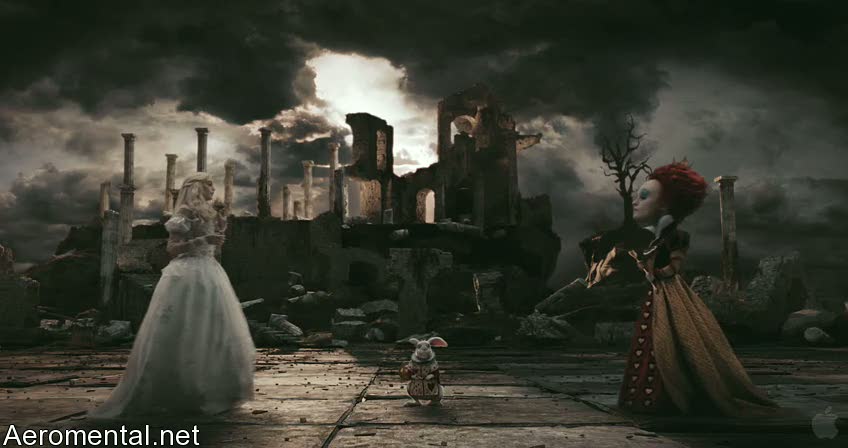
The White Queen (Anne Hathaway) and the Red Queen (Helena Bonham Carter) meet on the field of battle at last.

- The cinematography, of course, is beautiful, but that's something one comes to expect from Tim Burton.

For someone who really does bristle when film tries to reproduce literature and ends up completely bastardizing it, I like this movie a lot, and I suppose that's surprising.  But I don't feel that it rapes Carroll's original vision.  Carroll began Alice's story, Tim Burton creates his own spin on what would have happened after Alice grew up.  And considering that Carroll's Alice spends a great deal of time attempting to grow up, I think he would have enjoyed Burton's theory that she would grow up, and yet be unable to separate from the magic of her childhood completely.  Alice can never fully relinquish her childhood, any more than the rest of us can.

Thursday, February 10, 2011

Review: Through the Looking Glass... by Lewis Carroll

Loving Alice's Adventures In Wonderland as I did, I was hoping to love Through the Looking Glass, and What Alice Found There just as much.

Unfortunately, I couldn't.  Maybe it was because I was less familiar with the story line (everyone is familiar with the original Alice, not many of us are as familiar with its sequel).  Wrapping my brain around "backwards living" was a trip in itself, but like Alice, I just found myself very confused.

Still, it's entertaining, bringing Alice falling through her own mirror into Looking Glass Land, where everything is backwards and the effects occur before their causes -- for example, the White Queen's finger bleeds before she pricks it with her brooch.  The concept is interesting -- in Wonderland, the royal court is comprised of suits of cards; in Looking Glass Land, there are two royal courts, one White and one Red, and the whole world is a giant game of chess which Alice (taking the place of a White pawn) must navigate if she is to become a Queen piece at the end of it, and thus secure her way home again.

This book took me a longer time to read than its predecessor (mainly due to work, knitting, and checking out apartments for the eventual move in April), but it was still a quick read, which is exactly what I have needed in this chilly, gray weather.  I'd recommend it, if for no other reason than to continue following Alice's journeys.  Be advised though, the Kindle edition of Through the Looking Glass does not feature any of Lewis Carroll's poetry.  The lines are taken out, removing such classics as "Jabberwocky" and "The Walrus and the Carpenter", which are so vital to the storyline that they leave the reader at quite the loose end.

Rating: ***

Wednesday, February 9, 2011

Yarn Along!

It's Wednesday, and we're halfway to the weekend!  That's enough reason for excitement.  We're in the midst of another cold snap in CT (brrr) but fortunately, the sun is shining and it looks like it's going to be a beautiful day, even if it doesn't melt any more of the snow.  Even better, it looks as if the snowstorm predicted for tomorrow is going to go right past us, without hitting us.  I'm so happy.  We might get through one whole week without a snow day!

Today, I'm participating in the Yarn Along over at Ginny's blog.  Participants take a picture of what they're knitting and reading, and upload it to their blog.  Then Ginny posts the links on her blog, so we reading knitters can all see what other people are reading and knitting.  Get that?  Good.


I'm knitting (what else?) a baby hat for one of the many babies that are coming into the world this year in my extended family.  It's not one of the hats in that entry; this one's going to be a little more subdued.  I'm knitting it out of a skein of Debbie Bliss Baby Cashmerino (55% merino wool, 33% microfibre, 12% cashmere), in what I think is color 002 (as the Yarn Harlot would say, bewitching name) -- I lost the ball band a while ago.  I love this yarn for baby garments; it's super-soft and bouncy.  Plus it's easy on the fingers.

As for reading?  I know you can't get a good idea from just looking at the attractive apple green cover of my Kindle, Annabelle Lee.

After finishing Alice's Adventures in Wonderland and enjoying it very much, I downloaded its sequel, Through The Looking Glass and started it last night.  I'm more than halfway done with it.  I like it, although not as much as I liked Alice.  There are more characters (many who don't last more than a page or two) and the settings change quite often, which isn't surprising, as she's now in Looking Glass World (where everything is backwards), so it can be a bit more confusing than the first.  But I'm really enjoying it.

Also, I finally saw the Tim Burton version of Through The Looking Glass last night -- more about that when I finish the book!